
Introduction
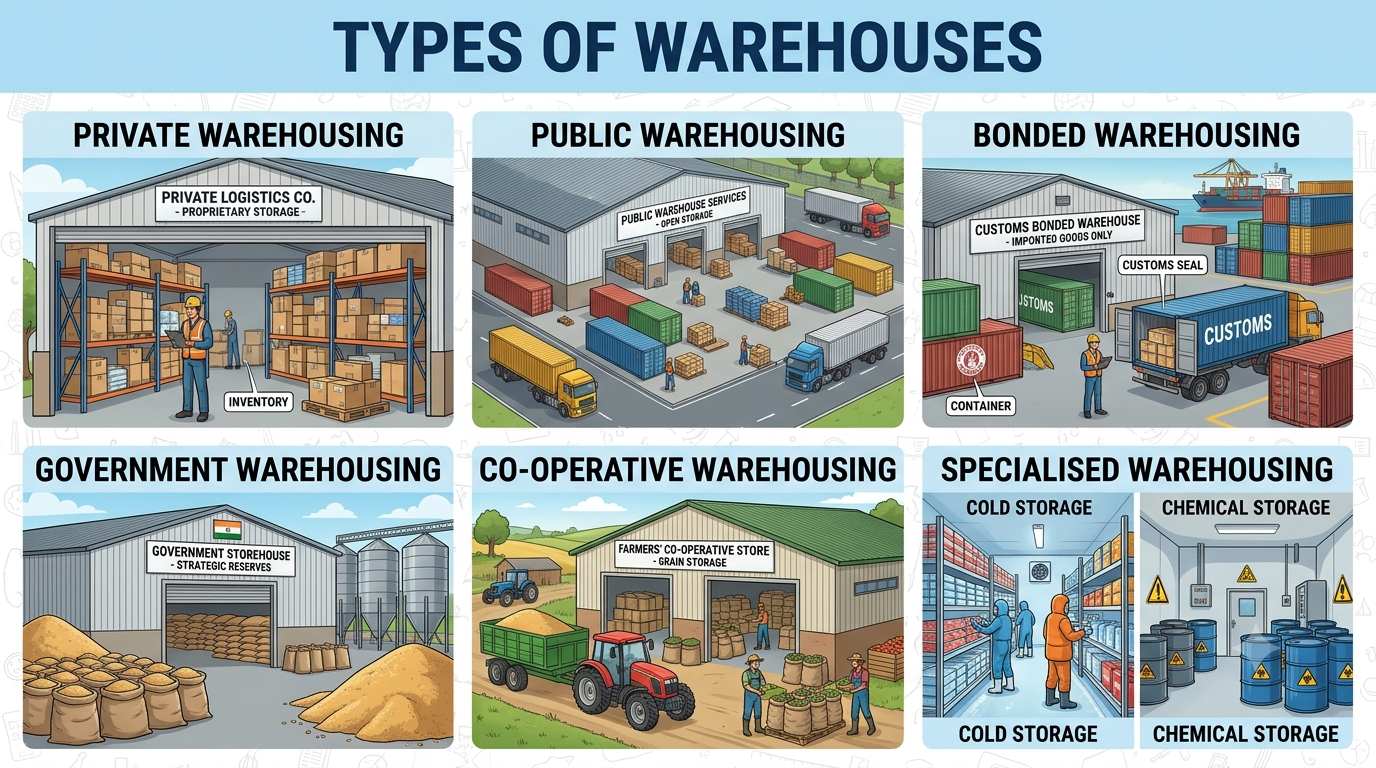
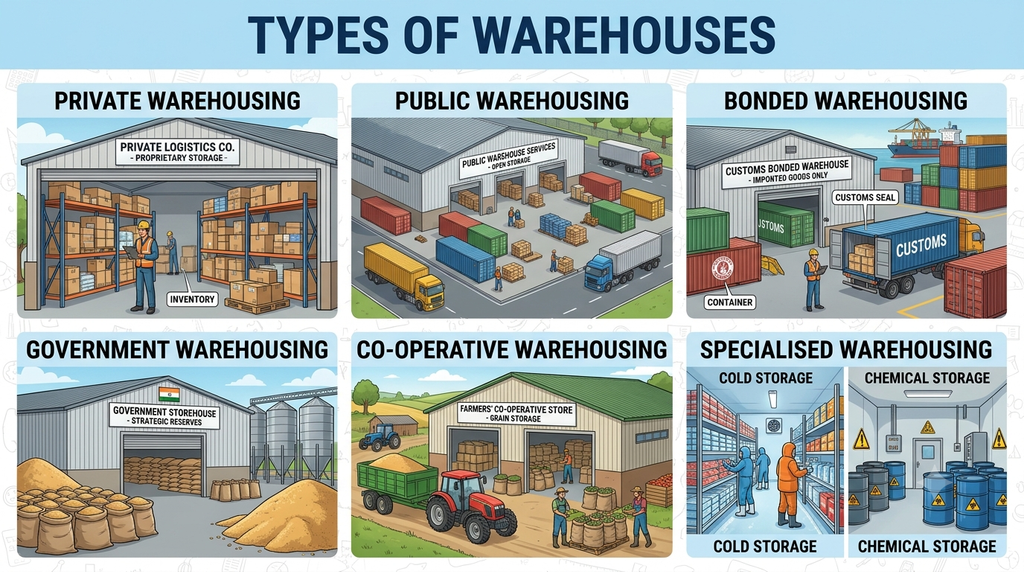
Different businesses require different types of storage facilities. Some businesses need warehouses for general goods, while others require special facilities for agricultural products, medicines, chemicals, or imported goods.
Based on ownership, control, and the nature of goods stored, warehouses can be classified into different types.
Meaning of a Warehouse
A warehouse is a place where goods are stored safely until they are required for sale, distribution, or further use.
Warehouses help businesses maintain a regular supply of products and protect goods from damage and loss.
Types of Warehouses
1. Private Warehouses
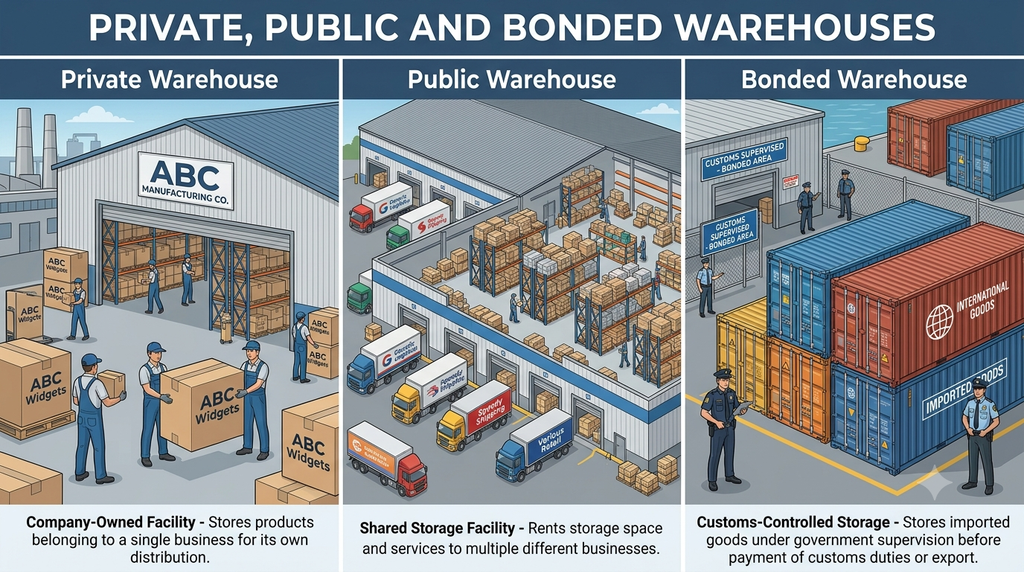
Private warehouses are owned or rented by individual businesses for storing their own goods.
Characteristics:
- They are controlled by the business that owns or rents them.
- They are mainly used for storing the company’s own products.
- Businesses can manage storage according to their requirements.
- They usually require considerable investment or rental expenses.
Example: A supermarket chain may operate its own warehouse to store products before distributing them to its stores.
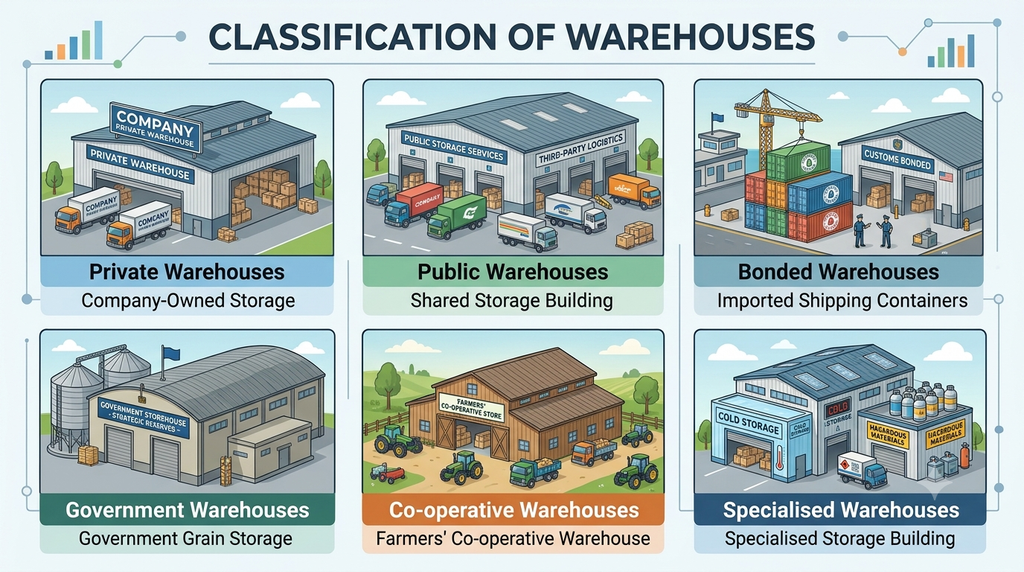
2. Public Warehouses
Public warehouses are storage facilities that provide warehousing services to different businesses in return for charges.
Characteristics:
- They are available to different businesses.
- Businesses pay storage and service charges.
- They are useful for small and medium-sized businesses.
- They may provide facilities such as loading, unloading, and handling.
Example: A small manufacturer may store finished products in a public warehouse instead of constructing its own storage facility.
3. Bonded Warehouses
Bonded warehouses are special warehouses where imported goods can be stored under customs control before the applicable customs duties are paid.
The payment of customs duty is generally deferred until the goods are cleared for home consumption, subject to customs rules.
Characteristics:
- They are subject to customs supervision and regulations.
- Imported goods can be stored before customs clearance.
- Customs duties are generally deferred while goods remain under the bonded arrangement.
- They are useful for importers and international traders.
Example: An importer may store electronic products in a bonded warehouse until the required customs procedures are completed.
4. Government Warehouses
Government warehouses are owned, managed, or controlled by government authorities or public agencies.
They are generally used for storing agricultural products, food grains, and other essential goods.
Characteristics:
- They are established or managed by government bodies.
- They support the storage of essential commodities.
- They may help maintain food security and public distribution.
- They provide storage facilities to farmers, traders,s or government agencies, depending on their rules.
Example: Government agencies may store wheat and rice in warehouses to maintain food supplies.
5. Co-operative Warehouses
Co-operative warehouses are established and managed by co-operative societies for the benefit of their members.
They are especially useful for farmers and small producers.
Characteristics:
- They are managed by co-operative societies.
- Members share the benefits of the storage facility.
- They help reduce individual storage expenses.
- They support farmers and small producers in storing and marketing their goods.
Example: A farmers’ co-operative society may establish a warehouse where members can store harvested crops.
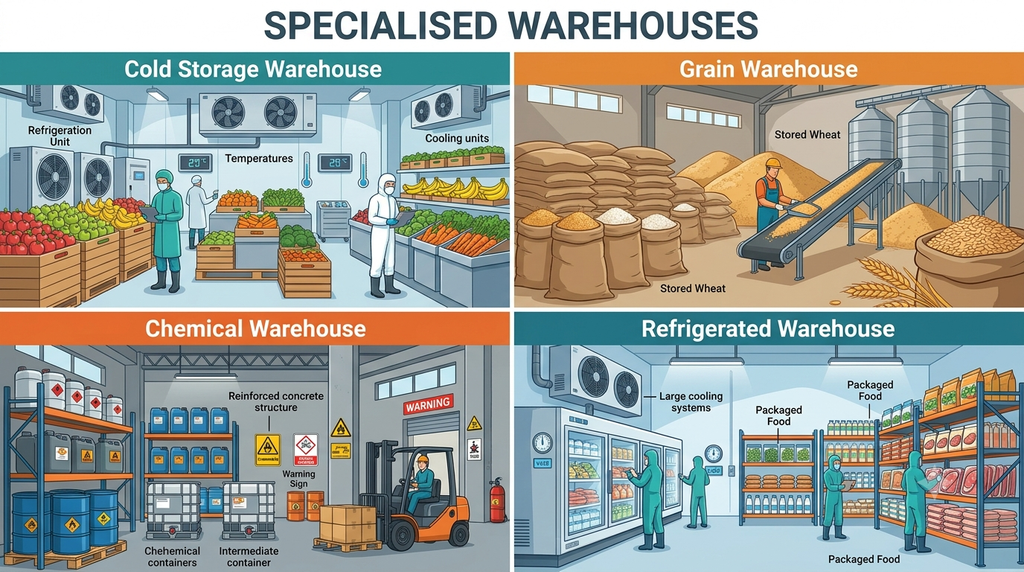
6. Specialised Warehouses
Specialised warehouses are designed to store particular types of goods that require special storage conditions.
Characteristics:
- They are designed for specific products.
- They provide suitable temperature, humidity, ty or safety conditions.
- They help maintain the quality of sensitive goods.
- They require specialised equipment and trained staff.
Examples:
- Cold Storage Warehouses: Used for fruits, vegetables, dairy products, and other perishable goods.
- Refrigerated Warehouses: Used for products that need controlled low temperatures.
- Chemical Warehouses: Designed for storing chemicals under suitable safety conditions.
- Grain Warehouses: Used for storing wheat, rice, and other food grains.
Difference Between Major Types of Warehouses
| Basis | Private Warehouse | Public Warehouse | Bonded Warehouse |
|---|---|---|---|
| Ownership | Owned or rented by a business | Operated as a storage service | Operated under customs rules |
| Users | Mainly one business | Different businesses | Importers storing bonded goods |
| Charges | Ownership or rental expenses | Storage and service charges | Charges according to applicable terms |
| Main Purpose | Store own goods | Provide storage to others | Store imported goods under customs control |
Conclusion
Different types of warehouses serve different business requirements. Private and public warehouses support general storage needs, bonded warehouses help importers, government and co-operative warehouses support public and member interests, while specialised warehouses protect goods that require special conditions.
Choosing the correct type of warehouse helps businesses store products safely and manage their supply efficiently.