

(i) RBI (Reserve Bank of India)
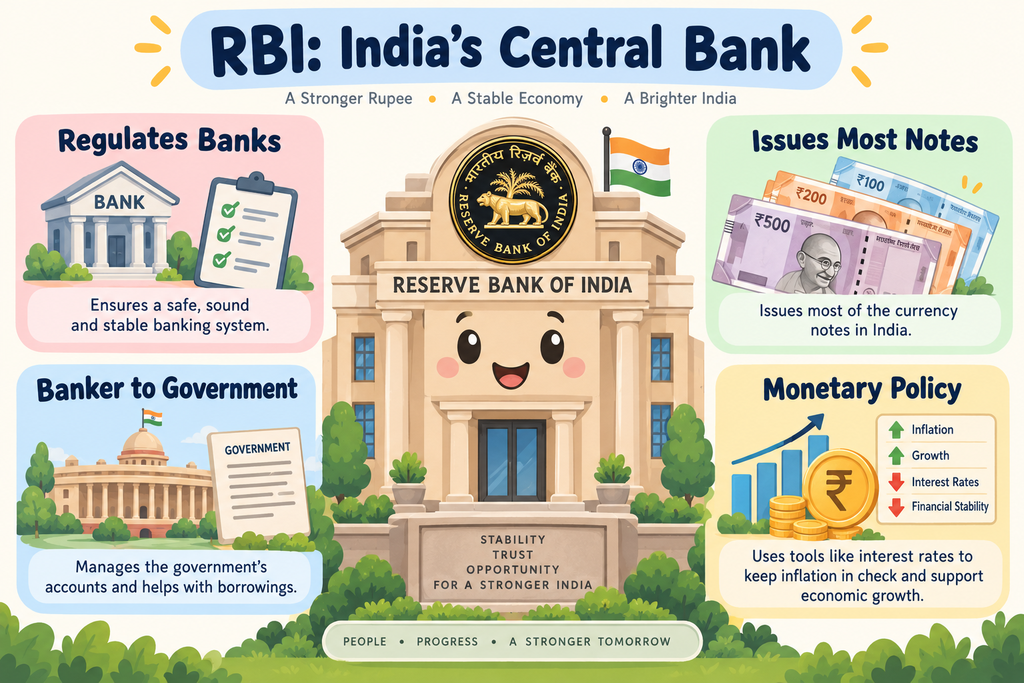
The Reserve Bank of India (RBI) is the central bank of India. It was established in 1935.
Its main functions are:
- Regulating and supervising banks.
- Issuing most currency notes in India, except the ₹1 note.
- Acting as a banker to the government.
- Formulating monetary policy to manage inflation and support economic stability.

(ii) Cooperative Bank
A cooperative bank is a bank formed by people who join together to meet their financial needs through mutual help.
Its main functions are:
- Providing loans and banking services to farmers, artisans and small businesses.
- Supporting rural and semi-urban communities.
- Helping people access credit through a cooperative system.

(iii) Commercial Bank
A commercial bank is a financial institution that provides banking services to the public and businesses.
Its main functions are:
- Accepting deposits from customers.
- Giving loans to individuals and businesses.
- Providing services such as payments and overdrafts.
- Earning income mainly from interest and service charges.
Example: State Bank of India (SBI) is an example of a commercial bank.
