In economics, there is one major rule that applies to every single person on Earth, from billionaires to normal families: You can never satisfy all of your wants at the same time.
This sounds like bad news, but it is just a fundamental fact of life. This fact is the entire reason the science of economics exists.
The problem comes down to a constant battle between two opposing forces:
- Our endless desires.
- The strictly limited resources available to satisfy them.
1. The Endless List of Wants
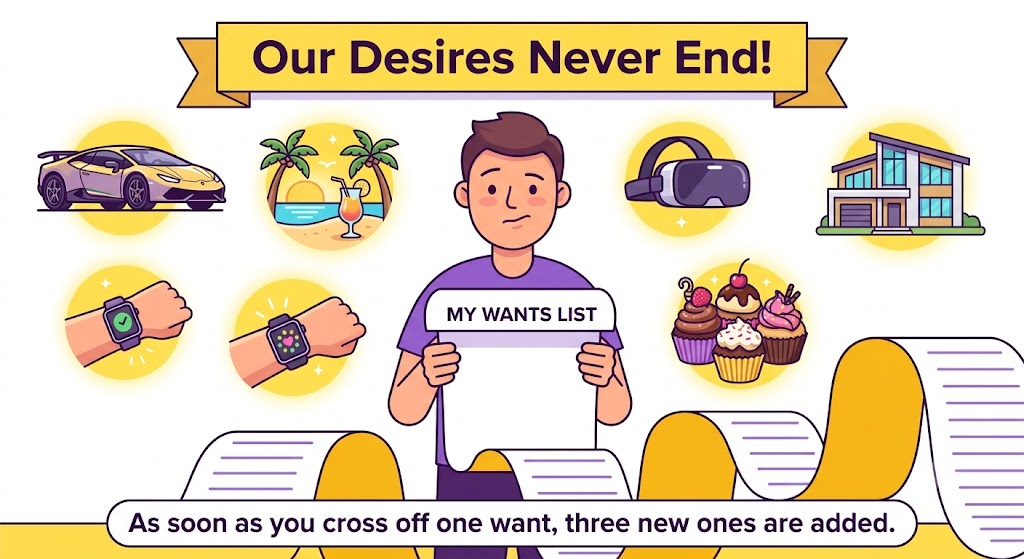
Think about the things you want. Maybe you want a new phone. As soon as you buy that phone, you might start wanting a protective case for it. Then you want wireless headphones. Then you want the newer version of the phone that comes out next year.
Human wants are like weeds: as soon as you pull one, two more pop up in its place. Our minds are always coming up with new desires, often fueled by:
- New inventions: Nobody wanted a smart watch before they were invented.
- Social media: Seeing what friends or celebrities have makes us want those same things.
- Pure curiosity: We just want to try new experiences.
2. The Limits of Resources
If our wants are unlimited, the resources we need to satisfy those wants are very much the opposite: they are limited, or “scarce.”
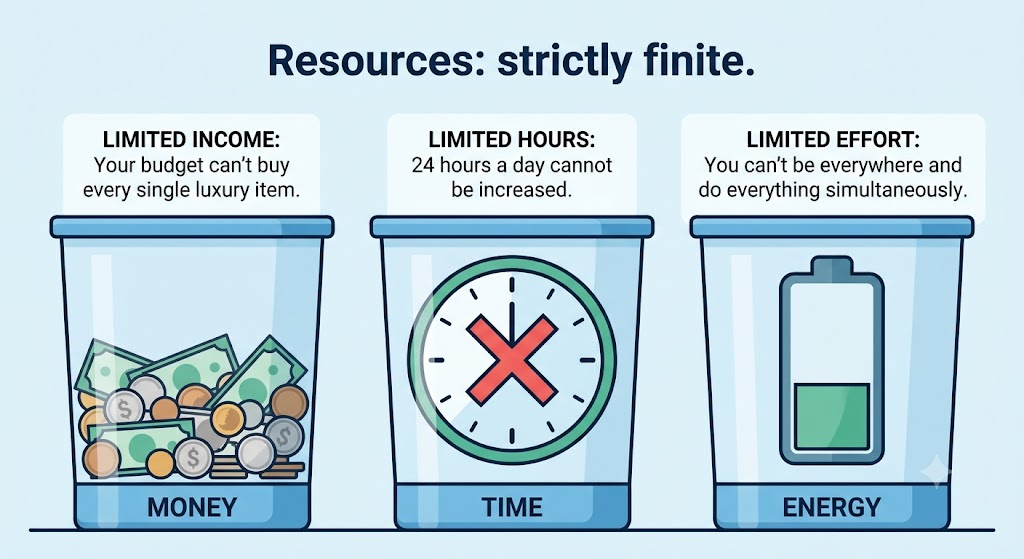
The most obvious scarce resource is money (or income). No matter how much money you make, you still have a budget. If you use your limited budget to buy a new car, you simply cannot use that same money to buy a new boat or pay for a vacation. Your limited money forces you to prioritize.
Other key limited resources include:
- Time: Everyone has exactly 24 hours a day. If you choose to study for four hours, you cannot use those same four hours to play video games.
- Energy: You can only do so much work or activities before you need to rest.
The Final Showdown: Wants vs. Resources
Imagine our unlimited wants are a raging fire that is always growing. Our limited resources are the small buckets of water we have to put out the fire. No matter how fast we pour, the fire (our desires) always has more fuel.
This is the inescapable reality of economics: Scarcity.
Because you have limited resources (like money and time), and endless desires, you are forced to choose. This is why every single decision you make—how to spend your Saturday, which car to buy, or what food to eat—is an economic choice driven by the reality that you can’t have everything.
Summary
- An individual want can be satisfied temporarily (you eat a burger and you aren’t hungry).
- All wants simultaneously can never be satisfied because new wants constantly arise.
- Your resources (time, money, energy) are limited, forcing you to prioritize what matters most.