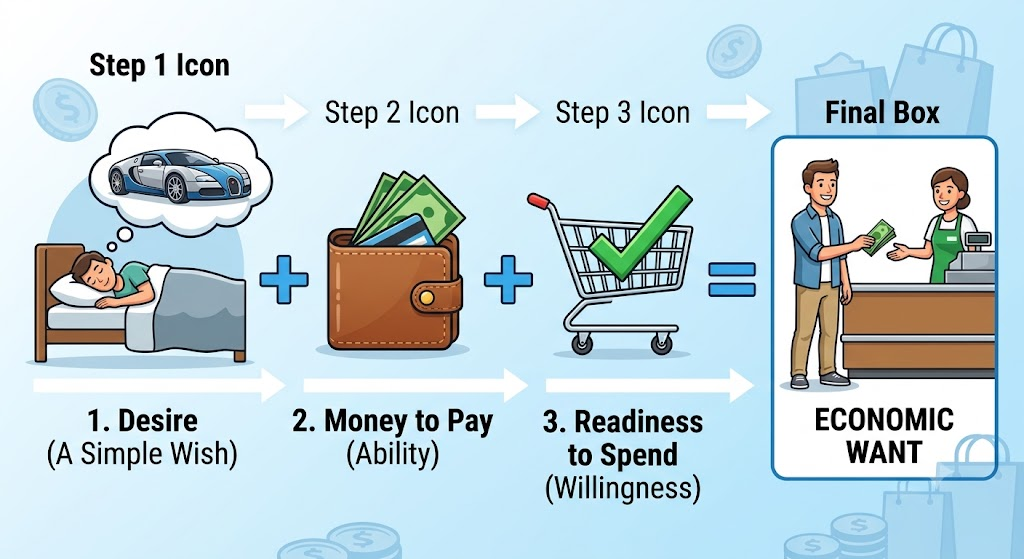
In daily life, we often use the words desire and want to mean the same thing. But in economics, there is an important difference between them.
A simple wish is not enough to matter in the market. A wish only becomes an economic want when two conditions are met:
Ability to Pay: You have the money (purchasing power).
Willingness to Spend: You are actually ready to spend that money.
The Formula: From Desire to Want
To turn a basic wish into an economic want, you need money and the decision to spend it:
$$\text{Desire} + \text{Money to Pay} + \text{Willingness to Spend} = \text{Want}$$
Desire: A simple wish or craving for a product or service.
Want: A desire backed by cash and a clear plan to buy it.
Real-Life Example 1: The Toy Store
Just a Desire: A young child walks past a store window and sees a shiny remote-controlled car. The child wants the toy very much. However, because the child has no money, this wish remains just a desire. It does not affect the economy.
Conversion into a Want: A working adult visits the same store. They see the exact same remote-controlled car, have enough cash in their wallet, and choose to buy it. Because money and the willingness to spend are present, the desire officially becomes an economic want.
Real-Life Example 2: The Luxury Vacation
Just a Desire: A college student dreams of taking a luxury trip overseas. Since the student has zero savings or income to pay for airfare and hotels, the trip stays a simple wish or desire.
Conversion into a Want: A working professional saves a portion of their monthly salary for a full year specifically for a holiday. Once they have the savings in their bank account and use it to book the flight tickets, their dream transforms into an economic want.
Summary
A desire is just a wish without any money behind it.
A want is a desire that has cash behind it and a decision to buy.
Businesses and economists focus on wants because only people with purchasing power actually buy products in the real world.
Bizniz uses cookies to improve your experience, analyze website traffic, and make our Commerce learning resources better. Choose which cookies you allow.
Functional
Always active
The technical storage or access is strictly necessary for the legitimate purpose of enabling the use of a specific service explicitly requested by the subscriber or user, or for the sole purpose of carrying out the transmission of a communication over an electronic communications network.
Preferences
The technical storage or access is necessary for the legitimate purpose of storing preferences that are not requested by the subscriber or user.
Statistics
The technical storage or access that is used exclusively for statistical purposes.The technical storage or access that is used exclusively for anonymous statistical purposes. Without a subpoena, voluntary compliance on the part of your Internet Service Provider, or additional records from a third party, information stored or retrieved for this purpose alone cannot usually be used to identify you.
Marketing
The technical storage or access is required to create user profiles to send advertising, or to track the user on a website or across several websites for similar marketing purposes.