
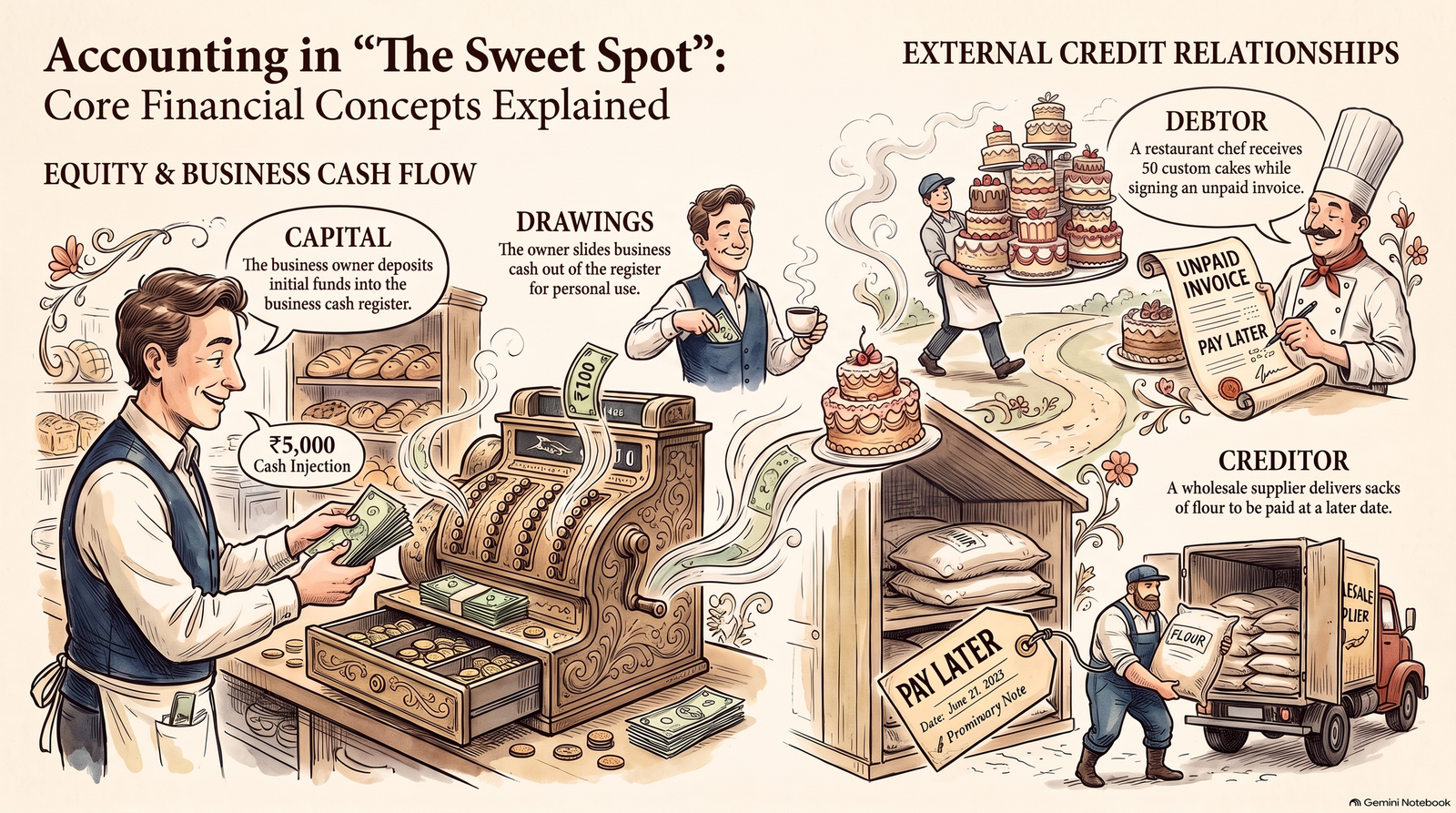
Imagine stepping into the ultimate business arena. Before you can build an empire, score millions, or read financial reports like a seasoned pro, you need to master the core vocabulary. These aren’t just dry textbook definitions—they are the literal building blocks of every transaction happening on planet Earth right now.
Get ready for an instant dopamine rush as we break down the Fantastic Four of Accounting Terms using a legendary neighborhood bakery!
1. Capital: The Fuel That Ignites the Machine ⛽
- Simple Answer: Capital is the money, property, or assets that an owner invests to start or run a business. It represents the owner’s stake in the company.
- The Behind-the-Scenes Secret: Remember, because of the Business Entity Concept, the business treats this invested money as a liability—a debt it officially owes back to you! It forms the foundation of the master equation: $\text{Assets} = \text{Liabilities} + \text{Capital}$.
- Real-World Scenario: Imagine you decide to open a bakery and put $\text{₹}5,000$ of your personal savings into the business bank account to buy shiny new ovens and raw ingredients. That $\text{₹}5,000$ is your initial capital. In the eyes of your business’s ledger, you just gave it its first financial heartbeat!

2. Drawings: The Secret Pocket Dip 🕵️♂️
- Simple Answer: Drawings refer to any cash or goods that a business owner takes out of the business for their own personal use.
- The Behind-the-Scenes Secret: This is not a business expense. Mixing your personal grocery shopping with your store’s inventory is an accountant’s worst nightmare. Drawings act as a reverse-capital—it directly eats away at your ownership stake in the company.
- Real-World Scenario: If you take $\text{₹}100$ straight out of your bakery’s cash register to buy birthday gifts for your family, that amount is recorded as drawings because it was spent on personal needs rather than fueling business operations.

3. Debtors: The Trusted Customers on Credit 🤝
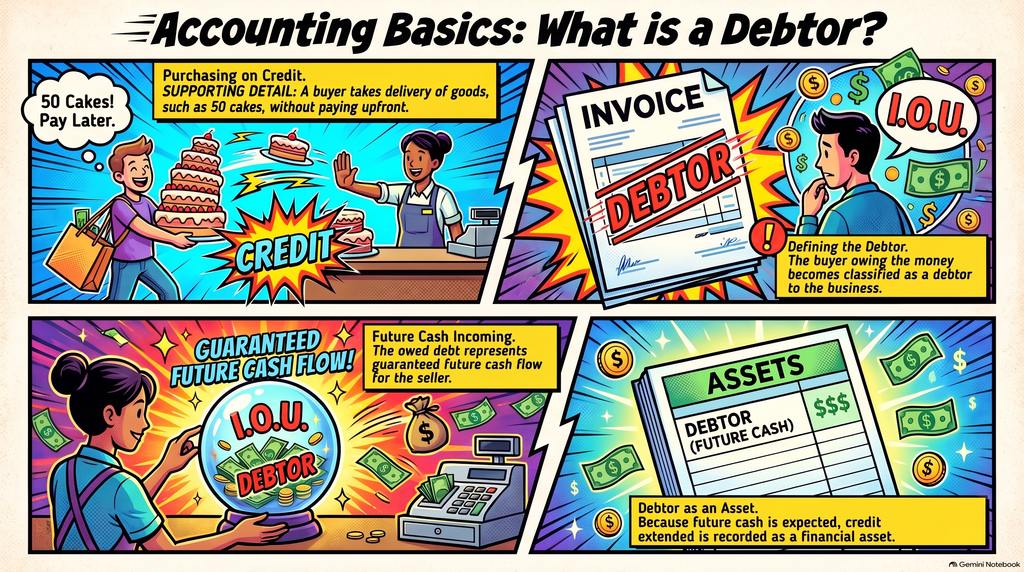
- Simple Answer: Debtors are customers who buy goods or services from a business on credit, meaning they take the product now and promise to pay the money back at a later date.
- The Behind-the-Scenes Secret: In accounting, debtors are treated as an asset because they represent future cash walking back into your business.
- Real-World Scenario: A local restaurant orders 50 custom-baked cakes from your bakery for a weekend festival and tells you, “Hey, we’ll clear the bill by the end of the month.” During that waiting period, that restaurant is officially your debtor. They owe you, and you’re trusting them to keep their word.
4. Creditors: The Supply Line Lifeline 📦
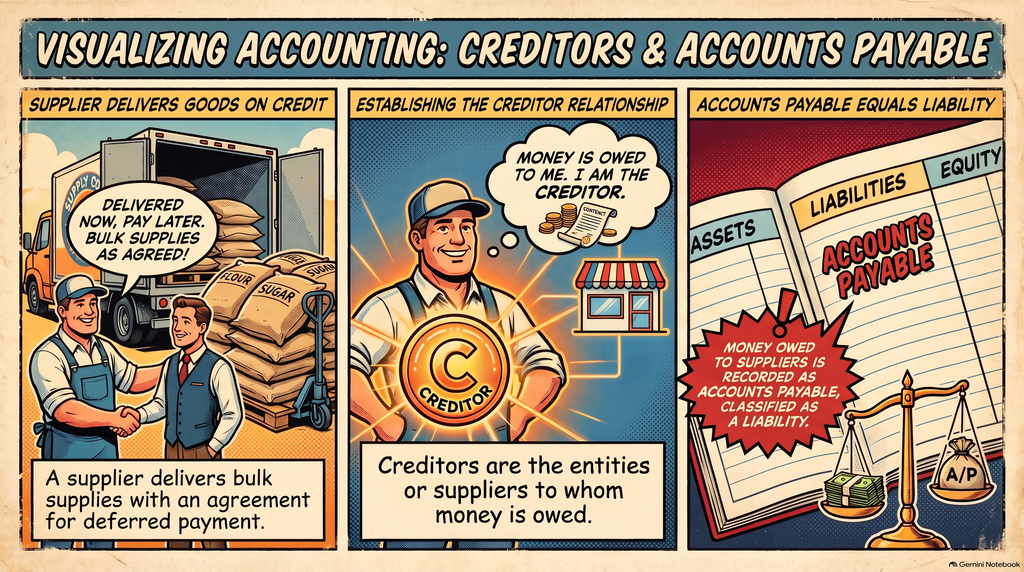
- Simple Answer: Creditors are people or businesses that your company owes money to, usually because you bought goods, raw materials, or services from them on credit.
- The Behind-the-Scenes Secret: Creditors are the flip side of debtors. While debtors owe you, you owe creditors. They are classified as a liability because they represent an obligation you must pay off.
- Real-World Scenario: Your bakery runs low on flour and sugar. You call your wholesale supplier, get massive bags delivered immediately, and promise to pay them next week. That wholesale supplier is now your creditor. They trusted you with their goods before seeing the cash!
Quick-Recall Concept Summary Table 📊
| Term | In Plain English | Who/What Is It? | Real-Life Bakery Example |
| Capital | The owner’s stake / startup fuel. | Internal Liability (Owed to owner) | Putting $\text{₹}5,000$ of savings into the shop bank account. |
| Drawings | Personal withdrawal from the business. | Reduction of Capital | Taking $\text{₹}100$ from the register for a family birthday gift. |
| Debtors | Customers who owe you money. | Asset (Future cash coming in) | A restaurant taking 50 cakes now and paying at month-end. |
| Creditors | Suppliers you owe money to. | Liability (Future cash going out) | Buying flour and sugar on credit from a wholesaler. |
Mind-Blowing Fast Facts to Lock It In Your Brain 🧠⚡
- The Great Reversible Mirror: Notice how Debtors and Creditors are mirror images? If you look at a transaction from your view, a buyer is your debtor. But if you look at it from their view, you are their creditor! Commerce is just a massive web of mutual trust.
- The Capital Protection Shield: Tracking your drawings meticulously ensures you never accidentally drain your business dry. Companies that fail to separate personal spending from capital withdrawals usually collapse within a year.
- The Ultimate Dopamine Hit: When you balance your books and see your debtors paying up, your creditors being cleared, and your capital growing through pure profit, you realize you aren’t just memorizing definitions—you are fluent in the universal language of business success!