Knowing definitions is only half the job. The real test comes when a business’s figures land on your desk and you must turn them into accounts.
Let’s solve three accounting challenges step by step.
Challenge 1: Prepare a Trading Account
Question: Prepare the Trading Account for the year ended 31 March 2012 from the supplied figures.
Step 1: Calculate net purchases and net sales
Net purchases = Purchases − Purchase returns
= ₹11,500 − ₹500
= ₹11,000
Net sales = Sales − Sales returns
= ₹48,000 − ₹600
= ₹47,400
Step 2: Total the listed debit items
| Particulars | Amount |
|---|---|
| Opening stock | ₹6,000 |
| Net purchases | ₹11,000 |
| Carriage on purchases | ₹1,000 |
| Freight and octroi | ₹500 |
| Wages | ₹2,500 |
| Factory lighting | ₹600 |
| Coal, gas and water | ₹800 |
| Total | ₹22,400 |
Step 3: Calculate gross profit using the supplied figures
Net sales − Listed debit items
= ₹47,400 − ₹22,400
= ₹25,000
Important source check: This ₹25,000 result assumes no closing-stock figure needs to be included. The supplied material does not state a closing-stock amount. If closing stock was given in the original question, it must be included on the credit side of the Trading Account, and the gross profit will be higher by that amount. The result above should therefore be treated as provisional until the complete question is checked.
Office rent and carriage on sales, if included among the original balances, belong in the Profit and Loss Account rather than the Trading Account under the classification used here.
Challenge 2: Prepare a Profit and Loss Account
Question: Prepare the Profit and Loss Account for the year ended 31 March 2012.
Step 1: Add the incomes
| Income | Amount |
|---|---|
| Gross profit | ₹32,100 |
| Interest on investment | ₹700 |
| Sundry receipts | ₹700 |
| Discount received | ₹1,090 |
| Total income | ₹34,590 |
Step 2: Add the expenses
| Expense | Amount |
|---|---|
| General expenses | ₹800 |
| Charity | ₹100 |
| Electricity charges | ₹175 |
| Law charges | ₹180 |
| Advertisement | ₹440 |
| Commission | ₹870 |
| Rent | ₹1,800 |
| Carriage on sales | ₹900 |
| Office expenses | ₹650 |
| Insurance premium | ₹1,200 |
| Telephone expenses | ₹600 |
| Sales tax | ₹800 |
| Establishment expenses | ₹700 |
| Miscellaneous expenses | ₹750 |
| Indirect expenses | ₹340 |
| Traveller salary | ₹300 |
| Printing and stationery | ₹65 |
| Repairs | ₹270 |
| Total expenses | ₹10,940 |
Step 3: Find net profit
Net profit = Total income − Total expenses
= ₹34,590 − ₹10,940
= ₹23,650
The arithmetic checks out using the supplied figures. This result assumes that the stated gross profit of ₹32,100 is correct.
Challenge 3: Prepare the Trading Account, Profit and Loss Account, and Balance Sheet
Question: From the supplied particulars of Gopal Nath and Sons, prepare the Trading Account and Profit and Loss Account for the year ended 31 December 2012 and the Balance Sheet as at that date.
Part A: Calculate gross profit
First, calculate the net figures:
Net purchases = ₹12,000 − ₹300 purchase returns
= ₹11,700
Net sales = ₹20,000 − ₹200 sales returns
= ₹19,800
The Trading Account calculation is:
| Debit items | Amount |
|---|---|
| Opening stock | ₹4,000 |
| Net purchases | ₹11,700 |
| Carriage | ₹1,170 |
| Wages | ₹1,000 |
| Total debit items | ₹17,870 |
| Credit items | Amount |
|---|---|
| Net sales | ₹19,800 |
| Closing stock | ₹6,000 |
| Total credit items | ₹25,800 |
Gross profit = Total credit items − Total debit items
= ₹25,800 − ₹17,870
= ₹7,930
Part B: Calculate net profit
| Particulars | Amount |
|---|---|
| Gross profit | ₹7,930 |
| Add: Commission received | ₹120 |
| Total income | ₹8,050 |
| Less: Office expenses | ₹250 |
| Less: Salaries | ₹1,600 |
| Less: Discount | ₹300 |
| Less: Repairs | ₹1,200 |
| Less: Advertisements | ₹500 |
| Total expenses | ₹3,850 |
| Net profit | ₹4,200 |
Net profit = ₹7,930 + ₹120 − ₹3,850
= ₹4,200
This calculation treats the ₹300 discount as an expense, as indicated by the supplied material.
Part C: Calculate closing capital
Closing capital = Opening capital + Net profit − Drawings
= ₹30,000 + ₹4,200 − ₹1,500
= ₹32,700
Part D: Prepare the Balance Sheet
Balance Sheet of Gopal Nath and Sons as at 31 December 2012
| Liabilities and capital | Amount |
|---|---|
| Capital, adjusted | ₹32,700 |
| Sundry creditors | ₹2,700 |
| Bills payable | ₹1,200 |
| Total | ₹36,600 |
| Assets | Amount |
|---|---|
| Plant and machinery | ₹12,000 |
| Building | ₹10,000 |
| Sundry debtors | ₹6,000 |
| Closing stock | ₹6,000 |
| Cash in hand | ₹600 |
| Cash at bank | ₹2,000 |
| Total | ₹36,600 |
Both sides total ₹36,600, so the Balance Sheet balances using the supplied particulars.
Source limitation: The complete original Trial Balance was not included in the supplied notes. These workings have been checked against the listed figures, but the completeness of the original question cannot be independently confirmed from those notes alone.
The final lesson
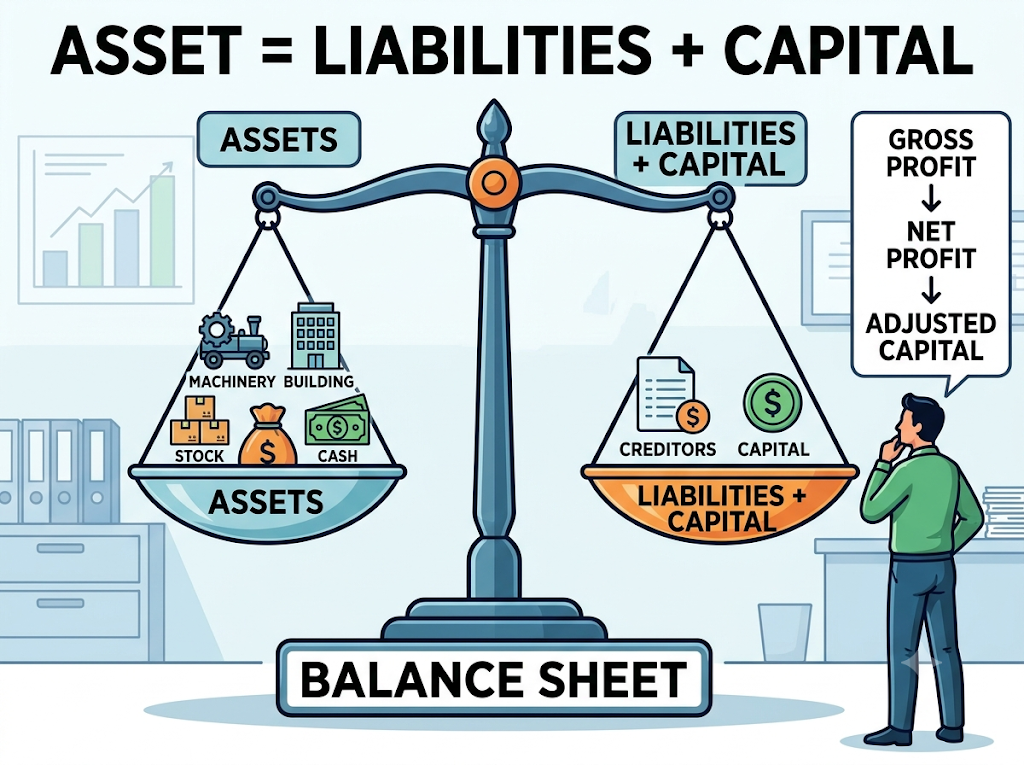
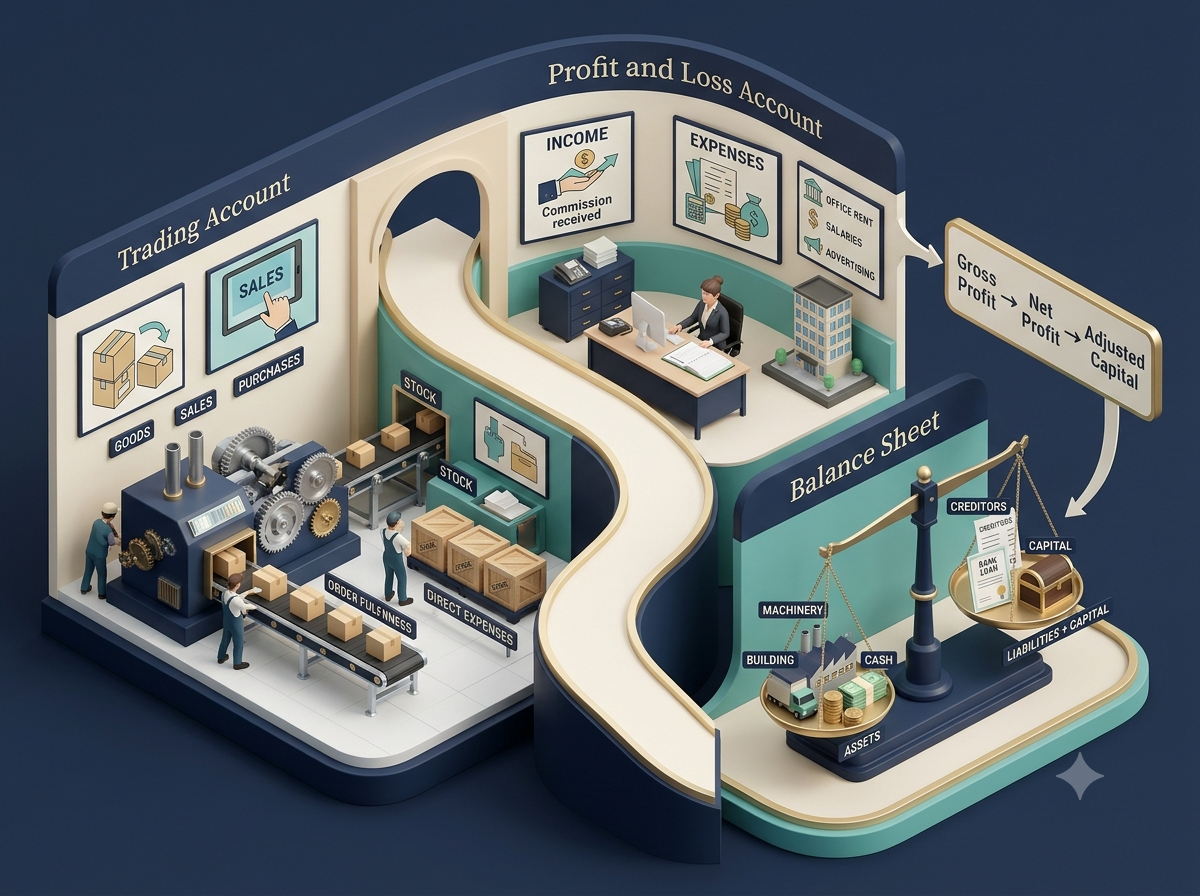
Each account has a different job. The Trading Account finds gross profit or gross loss. The Profit and Loss Account finds net profit or net loss. The Balance Sheet shows the financial position on a particular date.
Exam-ready takeaway: Calculate net purchases and net sales first, classify each item correctly, work out gross profit, then net profit, adjust capital for profit and drawings, and finally check whether total assets equal total liabilities and capital.