Imagine you’re running a bustling household. You owe your mom a favor for cooking dinner (a debt to someone on the inside), and you owe the local electricity board a massive payment for keeping the lights on (a debt to an outside stranger).
In the business universe, every single debt falls into one of these two exact categories. Welcome to the ultimate showdown between Internal and External Liabilities—the concept that separates what your business owes to you versus what it owes to the rest of the world!
Get ready for another instant dopamine rush as we break this down using our trusty neighborhood bakery!
1. Internal Liabilities: The Debt You Owe Yourself 🏠
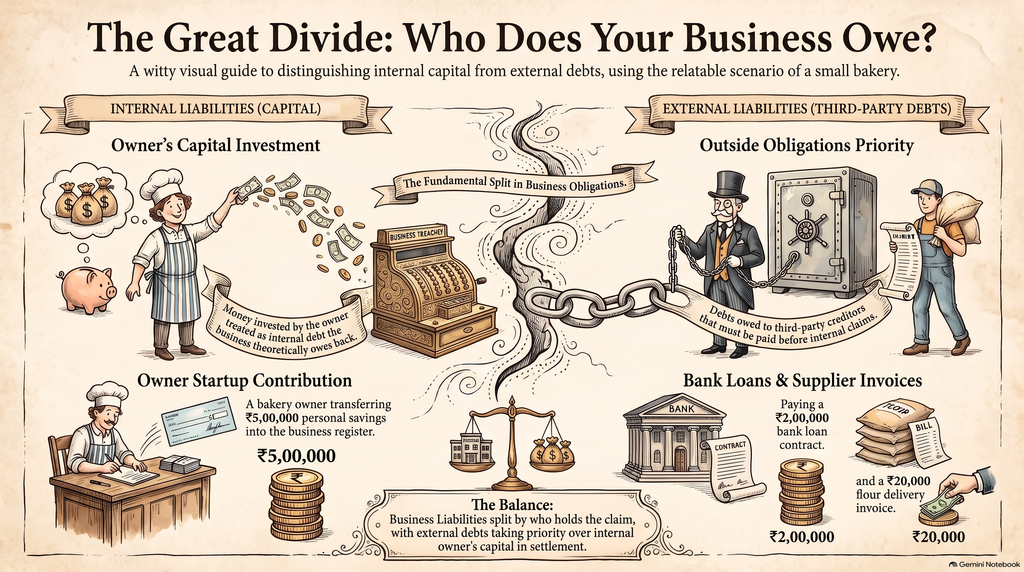
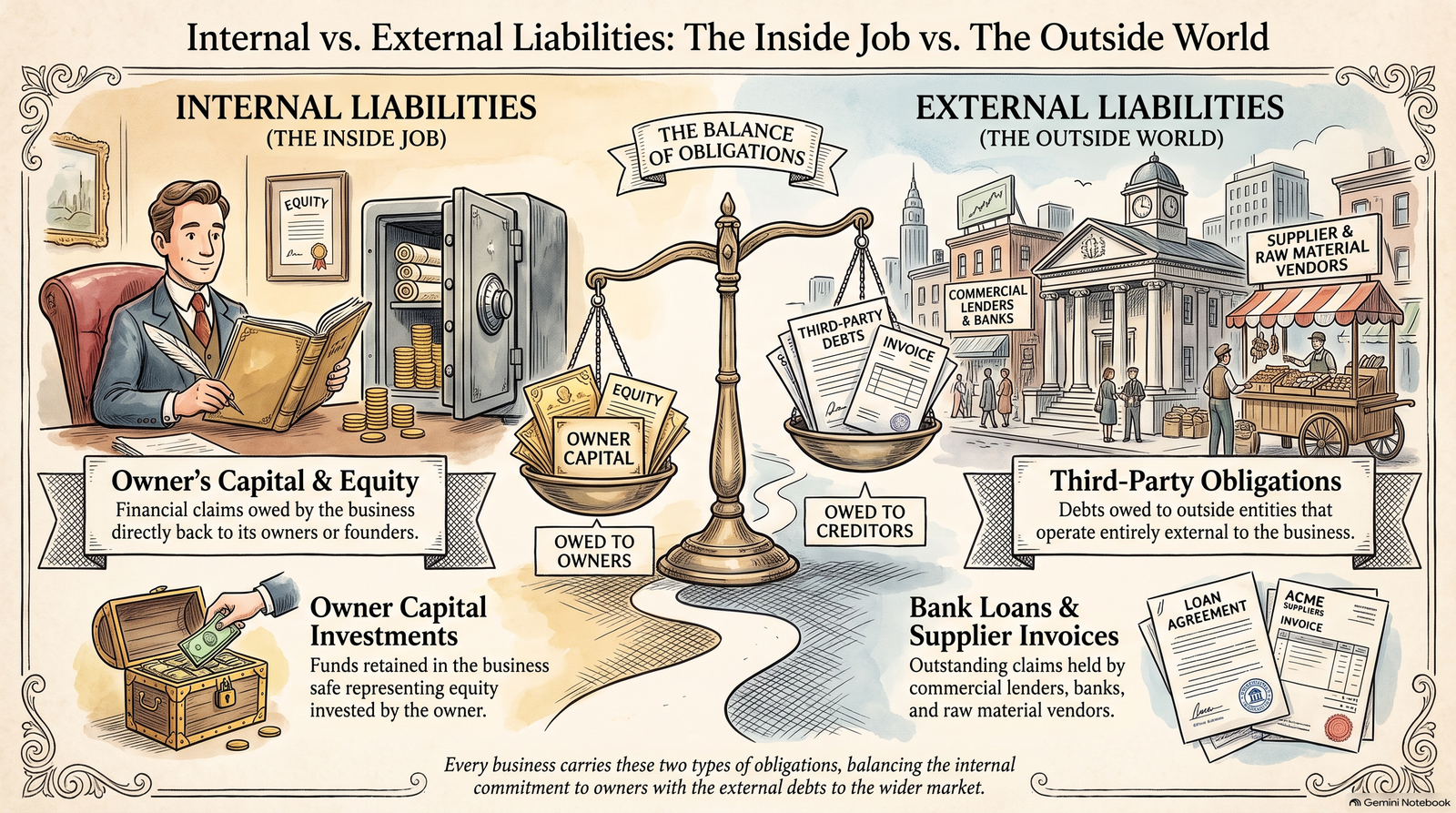
- Simple Answer: Internal liabilities are the financial obligations that a business owes to its own owner, primarily represented by the capital the owner invested to start or run the shop.
- The Behind-the-Scenes Secret: Remember our favorite rule, the Business Entity Concept? Because the business and you are treated as two completely separate entities, the business views your startup money not as a gift, but as a formal loan from you! It’s an internal debt that the business promises to pay back to you through profits or when the business closes.
- Real-World Scenario: The ₹5,00,000 you personally transferred from your savings account into your bakery’s new bank account to buy ovens is an internal liability. The bakery officially records: “We owe this money back to the boss!”
2. External Liabilities: The Outside World Coming Calling 🚪
- Simple Answer: External liabilities are debts and financial obligations that a business owes to outside third parties—people or institutions who are completely separate from the ownership.
- The Behind-the-Scenes Secret: These are the obligations that keep business owners on their toes. If you don’t pay your external liabilities, outsiders can legally demand your assets or shut your doors. They represent the resources you borrowed or consumed from the external market.
- Real-World Scenario: The ₹2,00,000 commercial loan you took from the bank to expand your seating area, plus the ₹20,000 you owe the local flour supplier for last week’s delivery, are classic external liabilities. You owe that money to real people outside your company walls!
Quick-Recall Concept Summary Table 📊
| Liability Type | Who is it Owed To? | What Does It Represent? | Real-Life Bakery Example |
|---|---|---|---|
| Internal Liability | The Business Owner(s) | Capital / Owner’s stake in the business. | The ₹5,00,000 personal savings you put into the shop. |
| External Liability | Outside Third Parties | Bank loans, creditors, and unpaid bills. | The ₹2,00,000 bank loan or unpaid supplier invoices. |
Mind-Blowing Fast Facts to Lock It In Your Brain 🧠⚡
- The Ultimate Accounting Equation: Every asset your business owns is funded by these two liabilities combined with profit! The golden balance sheet equation is: Assets=Internal Liability (Capital)+External Liabilities.
- The Safety Cushion: Internal liabilities act like a shock absorber. If a business runs into hard times, external liabilities must be paid first because outsiders have legal priority over the business’s assets.
- The Ultimate Dopamine Hit: When your business grows strong enough to pay off every single external liability (bank loans, suppliers) while your internal capital keeps multiplying, you realize you’ve built a self-sustaining financial machine. That feeling of absolute fiscal independence? Unbeatable!