
Imagine playing a classic board game with your family. The rulebook explains how to move your pieces and win, but it doesn’t cover every single weird situation that pops up on a lazy Sunday afternoon. So, your family relies on unwritten house rules—traditions passed down over years that everyone respects to keep the game fair and fun. 🎲
In the professional world of finance, strict laws and math formulas form the official rulebook, but businesses also run on a set of deeply respected unwritten traditions. Welcome to Accounting Conventions!
What is an Accounting Convention? 🤝
Here is the core definition in plain human language: An accounting convention is a common practice, custom, or tradition that has evolved over time to help accountants record and present financial information when there is no rigid, black-and-letter law.
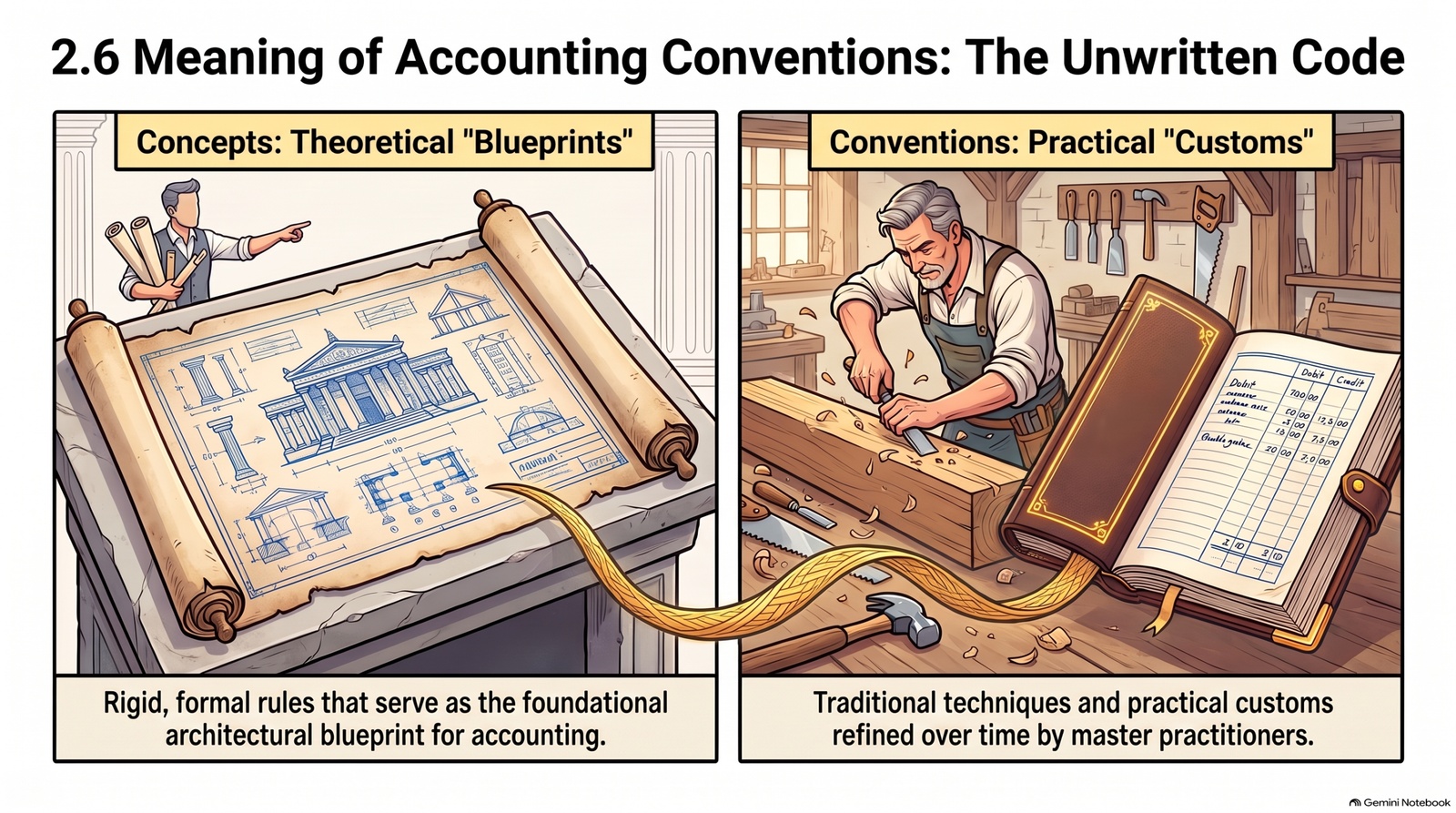
While Accounting Concepts are foundational theoretical assumptions (like treating the business separately from its owner), Accounting Conventions are practical habits and working guidelines adopted universally by the accounting profession to ensure financial reports remain honest, comparable, and crystal clear.
They are like the unspoken etiquette of money management. Just as politeness isn’t written in a criminal code, accounting conventions aren’t rigid statutes—yet every reliable business follows them religiously to maintain trust with investors, banks, and the public.
Concepts vs. Conventions: What’s the Difference? ⚖️
People often mix these two up, so let’s clear it up with a quick mental filter:
- Accounting Concepts: The foundational theory. They are fundamental assumptions (like Going Concern or Business Entity) that form the bedrock of accounting systems.
- Accounting Conventions: The practical tradition. They are methods and customs (like Consistency, Full Disclosure, Materiality, and Conservatism) used to handle complex or uncertain reporting situations in daily practice.
Think of Concepts as the blueprint of a house, and Conventions as the traditional craftsmanship workers use to finish the interior cleanly and safely.
Real-Life Scenario: The Family Recipe Tradition 🍲
Imagine your grandmother has a famous secret recipe for pasta.
- The official ingredient list tells you what goes in (the Concept).
- The unwritten kitchen habits—like tasting the sauce three times before serving, letting it simmer on low heat, and never rushing it—are the Conventions passed down through generations to ensure the dish always tastes amazing.
In accounting, conventions like Consistency (using the same method every year so you can compare results) and Conservatism (being cautious and not overstating profits when things look uncertain) act just like those kitchen traditions. They ensure that anyone reading a company’s financial report gets an honest, reliable plate of data every single time!
Concept Snapshot Table
| Feature | Accounting Concepts 🧠 | Accounting Conventions 🤝 |
| Nature | Fundamental theoretical assumptions. | Practical customs and traditions developed over time. |
| Origin | Built into the core logic of bookkeeping. | Evolved through professional practice and widespread usage. |
| Purpose | To establish the basic boundaries of recording transactions. | To guide tricky reporting choices and ensure transparency. |
| Flexibility | Rigid and foundational. | Adaptable guidelines for practical situations. |
To make sure this tradition is permanently locked into your brain: If a business decides to completely change its method of valuing inventory every single year just to make its profits look better, which major accounting convention is it breaking, and why does this trick investors?