
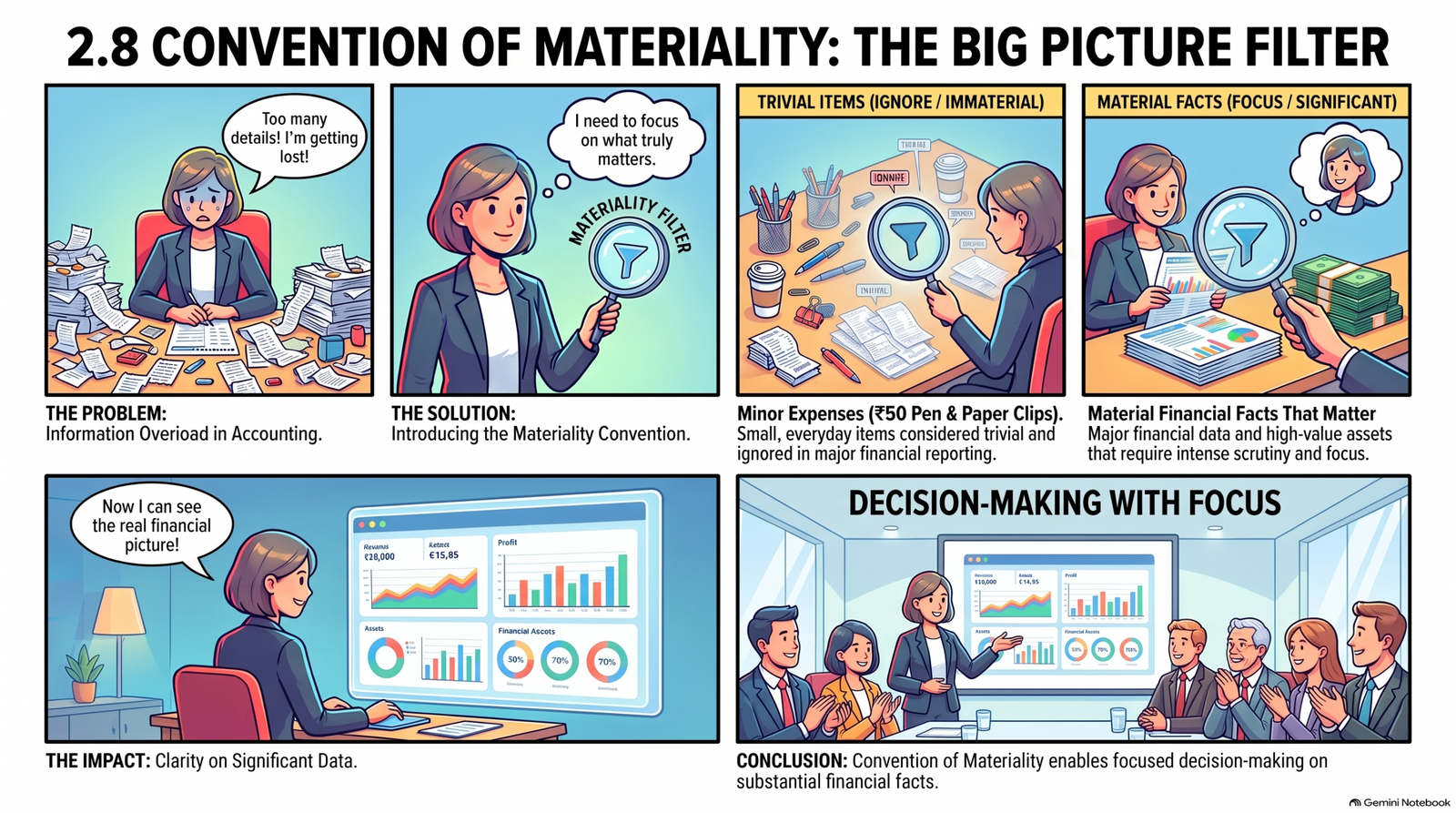
Imagine you are looking at a massive, multi-page financial report for a giant tech corporation that makes billions of dollars a year. Would you want to see a detailed, itemized record of every single pen, paper clip, and stick of chewing gum the office manager bought for ₹50?
Of course not! If accountants tried to list every microscopic transaction, financial reports would be thousands of pages thick, and nobody would ever figure out if the company is actually making money.
Welcome to the Convention of Materiality—the brilliant rule that gives accountants permission to ignore tiny, trivial details and focus strictly on what actually moves the needle!
What is the Convention of Materiality? 🎯
Here is the core definition in plain human language: The Convention of Materiality states that financial statements should only report significant, “material” information that is important enough to influence the decisions of a user.
An item is considered material if knowing about it would change how an investor, bank owner, or manager views the company’s financial health. If an item is totally trivial or insignificant (immaterial), the accountant doesn’t need to waste time giving it a separate spotlight. They can club it together under a general head or ignore it entirely.
The Plot Twist: Size Matters! 📏✨
Here’s the coolest part about this convention: Materiality is completely relative. There is no fixed rupee amount that makes something “material.” It entirely depends on the size, nature, and context of the business:
- For a small roadside tea stall: Spending ₹500 on a broken stool is a massive deal. It directly impacts their daily cash flow and profit margins. It’s material.
- For a massive multinational tech company: Spending ₹500 on a broken stool is so tiny it’s basically invisible. If they rounded their net profit to the nearest thousand rupees, that ₹500 wouldn’t even show up. For them, it’s immaterial.
The accountant uses personal experience and professional judgment to decide what matters and what is just background noise.
Real-Life Scenario: The Box of Paper Clips 📎🏢
Picture two different business owners:
- Rohan runs a tiny neighborhood grocery shop with a modest daily revenue. He buys a box of pens for ₹100. Because his total business scale is small, tracking minor items carefully helps him keep a tight grip on every rupee.
- Priya runs a sprawling manufacturing factory with crores of rupees in turnover. Her accountant spends three hours trying to separately account for a packet of stapler pins worth ₹45.
Under the Convention of Materiality, Priya’s accountant is wasting precious time! Instead of tracking every single stapler pin individually, minor office expenses are simply grouped together under “Miscellaneous Office Supplies.” This keeps the financial reports clean, concise, and laser-focused on the big financial picture.
Concept Snapshot Table
| Feature | Material Facts / Items 🌟 | Immaterial / Trivial Items 🗑️ |
|---|---|---|
| Definition | Significant information that can influence user decisions. | Minor, trivial details that don’t affect big-picture choices. |
| How It’s Handled | Given clear, separate headings in financial reports. | Grouped together under general heads or omitted to save space. |
| Example | A major lawsuit or a massive loss of inventory. | Buying a single box of paper clips or losing a ₹20 coin. |
… Class 10 Accountancy Chapter 2 Lesson Guide …
This video is relevant because it provides a comprehensive chapter walkthrough covering accounting concepts and conventions designed specifically for students mastering these foundational rules.
To make sure this rule is permanently locked into your brain: If a massive multinational corporation spends ₹1,000 on office coffee, why does the Convention of Materiality allow them to lump it into general office expenses instead of giving it a massive dedicated section in their annual report?