

Introduction
Every person who purchases goods or uses services to satisfy their needs is generally known as a consumer. Consumers play an important role in the economy because businesses produce goods and provide services to satisfy their requirements.
However, consumers may sometimes face problems such as poor-quality products, overcharging, adulteration, misleading advertisements and unsatisfactory services. Therefore, understanding the meaning of a consumer and the concept of consumerism is important.
1. Meaning and Definition of a Consumer
A consumer is a person who buys goods or hires or avails services for consideration (payment).
Under the Consumer Protection Act, 2019, a consumer generally includes a person who:
- Buys goods for consideration that has been paid, promised, partly paid or partly promised.
- Uses goods with the approval of the buyer.
- Hires or avails services for consideration.
- Includes a beneficiary of goods or services when such use is made with the approval of the person who purchased or hired them.
A person purchasing goods for resale or for a commercial purpose is generally not treated as a consumer. However, goods used exclusively to earn a livelihood through self-employment are covered by an exception.
Example: A person purchasing a refrigerator for their home is a consumer. A person purchasing refrigerators in bulk for resale is generally not considered a consumer under the Act.
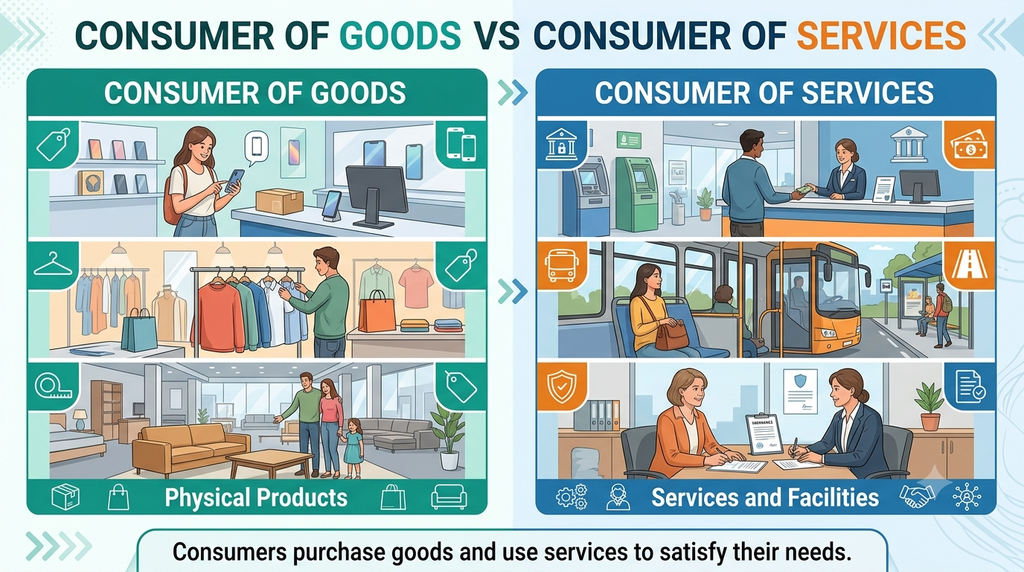
2. Difference Between a Consumer of Goods and a Consumer of Services
Consumers may purchase physical products or use services provided by different organisations.
| Consumer of Goods | Consumer of Services |
|---|---|
| Purchases physical products. | Hires or uses services. |
| Goods can generally be seen and touched. | Services are generally intangible. |
| Ownership of goods may be transferred to the buyer. | A service generally provides a facility or benefit. |
| Examples include buying clothes, furniture and electronic products. | Examples include banking, insurance, transportation and medical services. |
Example: A person purchasing a mobile phone is a consumer of goods. A person using mobile network services is a consumer of services.
3. Concept of Consumerism
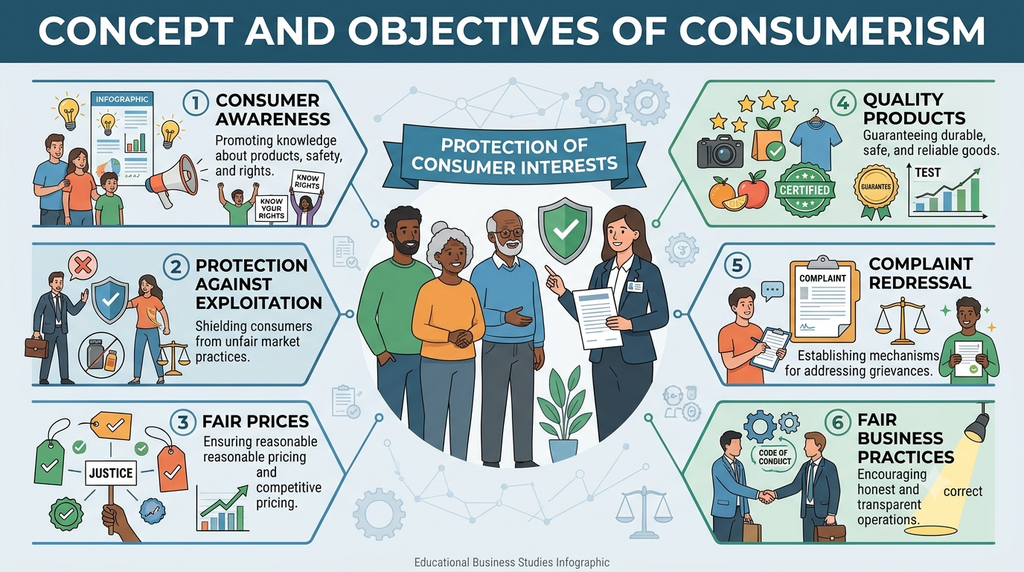
Consumerism refers to the organised efforts made by consumers and consumer organisations to protect consumer interests and demand fair treatment from businesses.
It aims to protect consumers against unfair trade practices, exploitation, defective goods, poor services and misleading advertisements.
Consumerism encourages consumers to become aware of their rights and responsibilities and to take action when their interests are harmed.
Main Objectives of Consumerism
- Consumer Awareness: To educate consumers about their rights and responsibilities.
- Protection Against Exploitation: To protect consumers from unfair business practices.
- Fair Prices: To encourage businesses to charge reasonable and correct prices.
- Quality Products: To ensure that consumers receive safe and good-quality goods and services.
- Consumer Complaints: To encourage consumers to report grievances and seek suitable remedies.
- Fair Business Practices: To promote honesty and transparency in business activities.
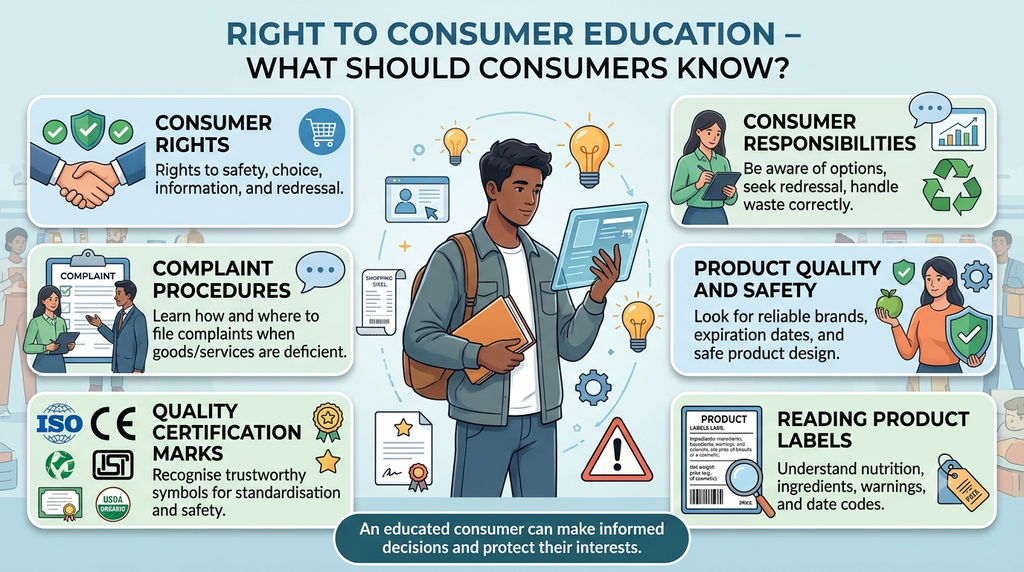
4. Right to Consumer Education – What Should Consumers Be Educated About?
The Right to Consumer Education means that consumers should have access to knowledge and information that help them make informed purchasing decisions.
Consumers should be educated about:
- Consumer Rights: They should know their rights, such as the right to safety, information, choice and redressal.
- Consumer Responsibilities: They should understand their duties while purchasing and using goods and services.
- Product Quality: They should know how to identify good-quality and standardised products.
- Price and Product Information: They should understand product labels, prices, expiry dates, quantities and other important details.
- Quality Marks: They should learn about quality certification marks such as ISI, AGMARK and Hallmark.
- Unfair Trade Practices: They should be able to identify misleading advertisements, adulteration, overcharging and defective products.
- Complaint Procedures: They should know how and where to register complaints and seek remedies.
Conclusion
Consumers are an important part of every business activity. Consumerism helps protect their interests and encourages fair business practices. Consumer education makes people aware of their rights and responsibilities and helps them make informed decisions.