
Introduction
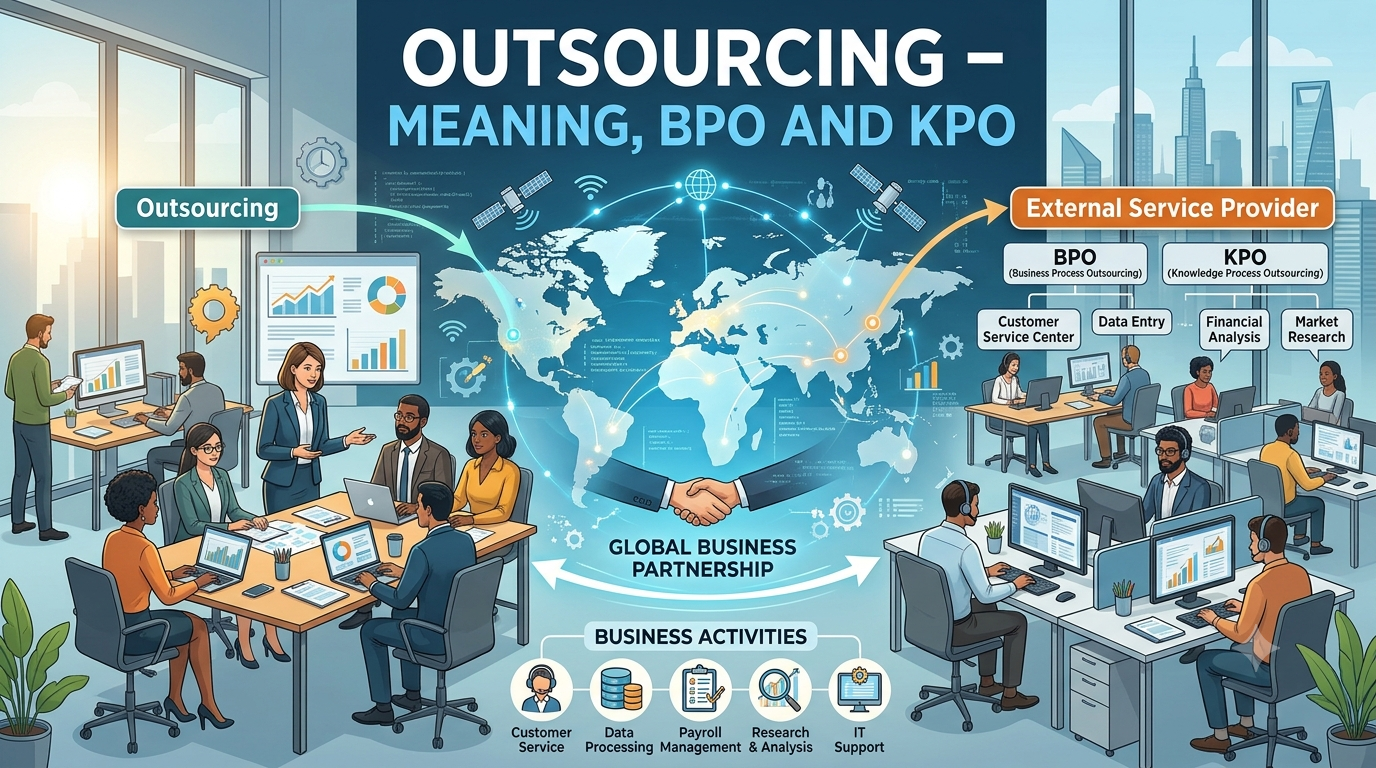
In the modern business world, organisations often need different types of services to operate efficiently. Instead of performing every activity themselves, businesses may hire outside companies or specialists to perform certain tasks.
This practice is known as outsourcing. It helps organisations focus on their main business activities, reduce costs and obtain specialised services.
Two important forms of outsourcing are Business Process Outsourcing (BPO) and Knowledge Process Outsourcing (KPO).
1. Meaning of Outsourcing
Outsourcing refers to the practice of assigning certain business activities or services to an external organisation or service provider instead of performing them within the organisation.
Businesses outsource activities when outside service providers can perform them efficiently or at a lower cost.
Examples of Outsourcing
- A company hiring an external agency to manage customer support.
- A business assigning its payroll activities to another organisation.
- A company hiring outside experts to conduct market research.
- An organisation using an external agency for accounting services.
2. Business Process Outsourcing (BPO)
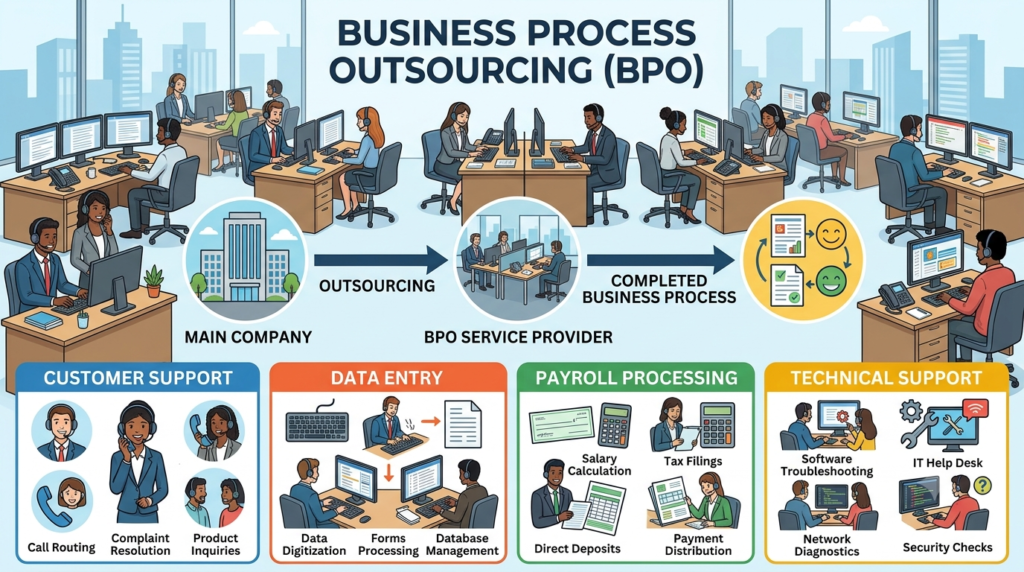
Business Process Outsourcing (BPO) refers to the practice of contracting specific business processes or routine operational activities to an external service provider.
In BPO, an organisation transfers certain non-core activities to another company so that it can concentrate on its main business operations.
Examples of BPO
- Customer care and call centre services.
- Data entry and data processing.
- Payroll management.
- Billing and accounting support.
- Technical support services.
- Human resource administration.
Advantages of Business Process Outsourcing
1. Reduction in Cost
BPO helps businesses reduce expenses related to employee salaries, infrastructure and equipment.
2. Focus on Core Activities
Businesses can concentrate on their main activities, such as production, marketing and sales, while external agencies handle routine operations.
3. Improved Efficiency
Specialised service providers may perform outsourced activities more efficiently because of their experience and resources.
4. Access to Skilled Employees
Businesses can obtain the services of trained employees without recruiting and managing a large workforce themselves.
5. Saves Time
Outsourcing routine activities allows management to spend more time on important business decisions.
6. Flexibility
Businesses can increase or decrease outsourced services according to their requirements.

3. Knowledge Process Outsourcing (KPO)
Knowledge Process Outsourcing (KPO) refers to the practice of outsourcing specialised knowledge-based activities that require advanced skills, professional expertise, technical knowledge and analytical abilities.
KPO generally involves activities that require research, analysis, interpretation and decision-making support.
Examples of KPO
- Market research and analysis.
- Financial research and analysis.
- Legal research services.
- Business and investment research.
- Data analytics.
- Scientific and technical research.
Advantages of Knowledge Process Outsourcing
1. Access to Specialised Knowledge
KPO enables businesses to access experts with specialised knowledge and professional qualifications.
2. Better Quality of Work
Knowledge-based tasks can be performed by trained professionals with the required technical expertise.
3. Improved Decision-Making
Research and analytical services provide useful information that helps management make better business decisions.
4. Saves Time and Resources
Businesses can obtain specialised services without establishing separate departments for every knowledge-based activity.
5. Increased Productivity
Organisations can focus on their core activities while experts handle complex research and analytical work.
6. Competitive Advantage
Access to specialised knowledge and research can help businesses improve their performance and compete more effectively.
4. Difference Between BPO and KPO
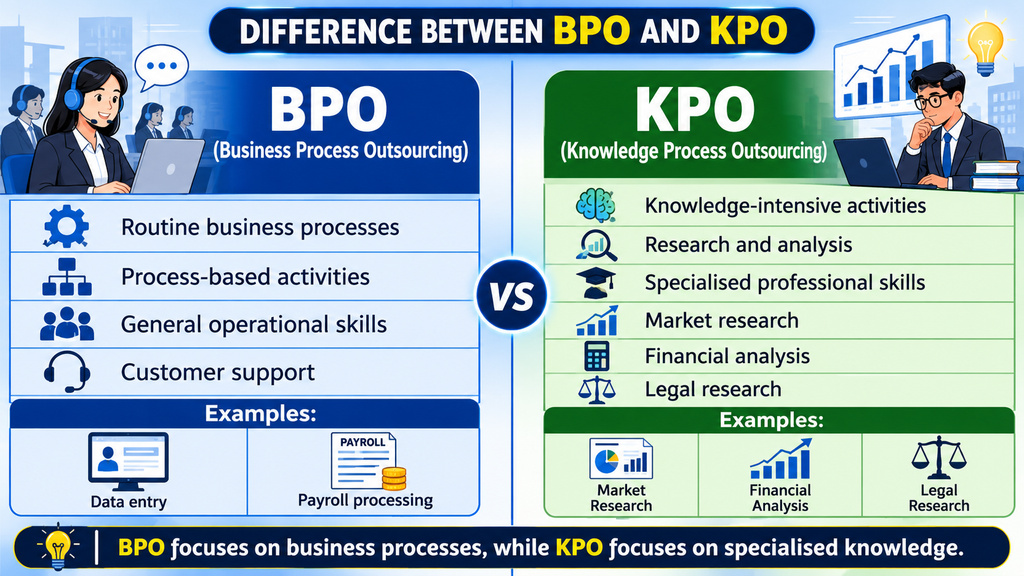
Business Process Outsourcing and Knowledge Process Outsourcing are both forms of outsourcing. However, they differ in the nature of work and the skills required.
| Basis | Business Process Outsourcing (BPO) | Knowledge Process Outsourcing (KPO) |
|---|---|---|
| Meaning | Outsourcing routine business processes to an external service provider. | Outsourcing specialised knowledge-based activities to external experts. |
| Nature of Work | Mainly involves routine and process-oriented activities. | Mainly involves research, analysis and specialised activities. |
| Skills Required | Requires general, operational and process-related skills. | Requires advanced technical knowledge and specialised expertise. |
| Complexity | Generally involves standardised and repetitive tasks. | Generally involves complex and analytical tasks. |
| Employees | Employees are often trained to follow established procedures. | Employees generally require specialised education, training or professional expertise. |
| Examples | Customer support, data entry, payroll and billing. | Financial research, legal research, market analysis and data analytics. |
| Main Objective | To improve operational efficiency and reduce costs. | To obtain specialised knowledge and improve analytical capabilities. |
5. Importance of Outsourcing in Modern Business
Outsourcing has become an important business practice because it allows organisations to use external resources and expertise.
Its importance can be understood through the following points:
- Cost Management: Helps businesses manage operating expenses.
- Specialisation: Provides access to specialised service providers.
- Time Management: Reduces the burden of handling routine activities internally.
- Business Growth: Allows management to concentrate on expansion and core operations.
- Improved Productivity: Helps organisations use their resources more effectively.
Conclusion
Outsourcing is the practice of assigning certain business activities to external service providers. Business Process Outsourcing (BPO) mainly deals with routine operational activities, whereas Knowledge Process Outsourcing (KPO) deals with specialised knowledge-based work. Both help organisations improve efficiency, access external expertise and focus on their main business objectives.