The cinematic lights dim. On the screen, we see a master hacker sitting in a dark room, tapping away at a glowing keyboard. Two international banks transfer millions of dollars across borders with a single digital keystroke—no briefcases of cash, no physical coins, just a clean, secure digital handshake.
In the business movie, not every deal happens with cash flying across a shop counter. Trust, promises, returns, and charity happen entirely on paper and agreement. When physical cash stays in the vault but a transaction still shakes your books, you need the master tool of non-cash deals: The Transfer Voucher!
Grab your popcorn—let’s step into the control room and master how to draft transfer vouchers like a cinematic genius! 🚀
The Movie Plot: The Digital Handshake of Commerce 🎥
Whenever a business transaction happens without the immediate movement of cash or bank funds, cash vouchers (debit or credit) are totally useless.
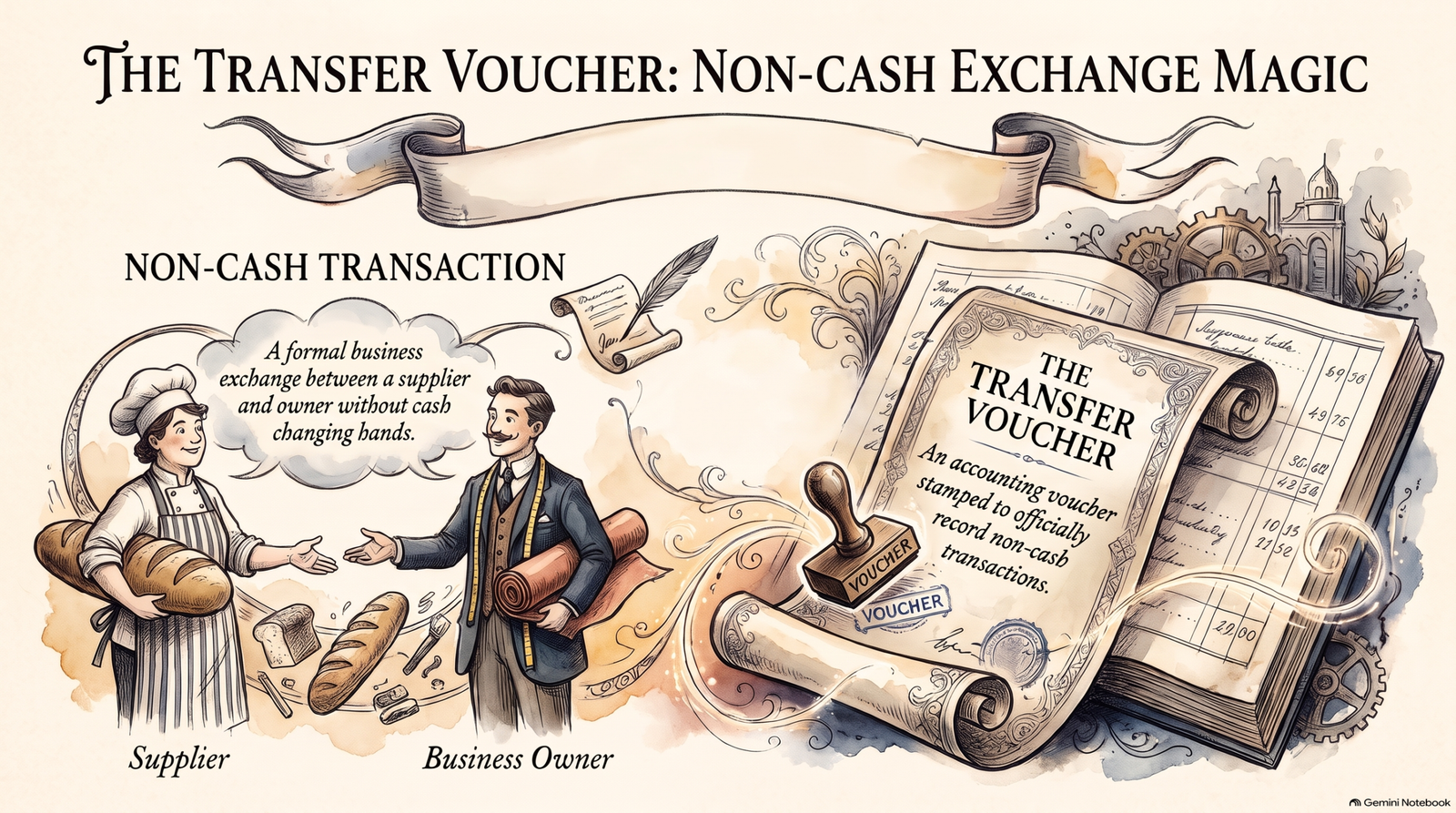
- The Core Concept: A transfer voucher (also known as a non-cash voucher) is created for transactions that involve no immediate cash flow. It records internal exchanges, credit purchases, sales returns, or gifts of inventory.
- The Rule of the Game: No cash moves? Reach for the Transfer Voucher! It acts as the official bridge connecting non-cash assets, liabilities, and expenses.
The Real-Life Blockbuster Scene: Mehta & Co., Returns, and Charity 📦📉🎁
Let’s bring this movie right onto your warehouse floor.
Imagine three non-cash transactions happening during your busy operational week:
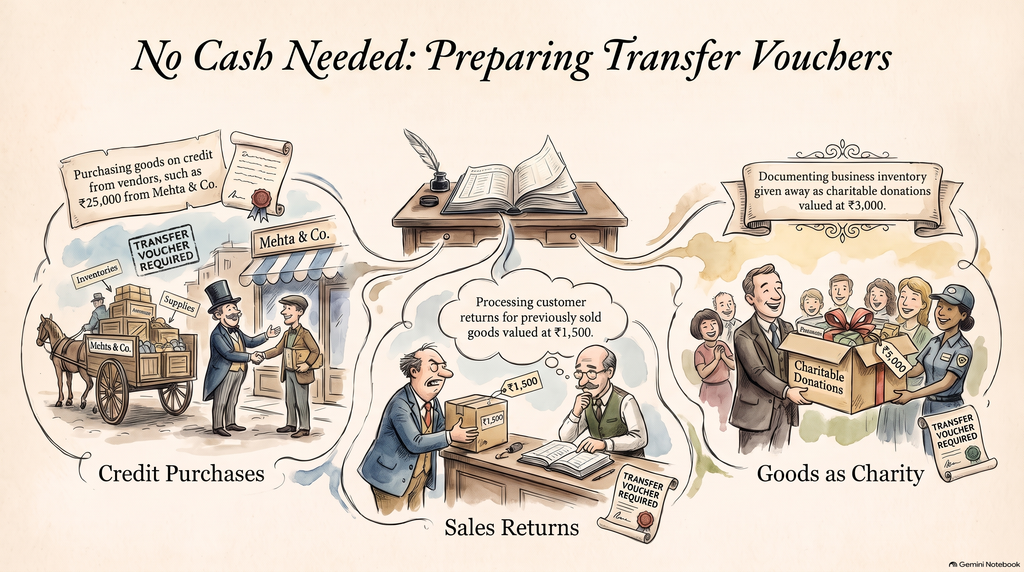
- Transaction 1: You buy inventory (goods) worth ₹25,000 from your trusted supplier, Mehta & Co., entirely on credit (no cash paid today).
- Transaction 2: A customer returns defective goods worth ₹1,500 back to your store (Sales Return).
- Transaction 3: You pack up goods worth ₹3,000 from your inventory and donate them as charity to a local community shelter.
Watch how your accountant prepares three distinct Transfer Vouchers to log these phantom exchanges:
- Voucher 1 (Mehta & Co. Credit Purchase): Date logged, “Purchases Account” debited and “Mehta & Co. Account” credited for ₹25,000. No cash touches the drawer—it’s a pure credit exchange!
- Voucher 2 (Sales Return): Date logged, “Sales Return Account” debited and the customer’s account credited for ₹1,500. Inventory comes back, receivables drop, zero cash moves.
- Voucher 3 (Charity): Date logged, “Charity Expense Account” debited and “Purchases / Inventory Account” credited for ₹3,000. Stock leaves for a noble cause without a single coin changing hands.
When goods move on trust, returns happen, or charity is given, a transfer voucher guarantees that your books stay 100% accurate without inventing fake cash entries!
🍿 The Director’s Cut (Quick-Recall Memory Lock)
| Voucher Element | What It Means in Plain English | Movie Takeaway |
| Trigger Event | A business deal where zero cash moves. | A digital handshake or signature across borders. |
| Key Details | Date, Accounts Affected (Non-Cash), Amount, Supporting Invoice. | The proof of credit deals and internal adjustments. |
| Real-World Use | Credit purchases, sales/purchase returns, charity goods. | Keeps your inventory and debts updated without touching the cash box. |