Picture this: You are sitting in a dark, packed movie theater. The lights dim, the bass drops, and on the massive screen, you see a bustling, chaotic 15th-century Venetian marketplace. Merchants are shouting, gold coins are clinking, and silk fabrics are changing hands.
Now, imagine if one merchant bought a massive shipment of spices, paid in gold, but his overworked assistant only wrote down: “Bought spices.”
Two weeks later, the gold chest is empty, nobody knows where the money went, and the business collapses into total financial anarchy. Boom! Movie over, tragedy strikes.
To save humanity from this exact nightmare, a brilliant system was born. Grab your popcorn, because you are about to witness the birth of the Double-Entry System—the most bulletproof, cinematic rule in the entire universe of wealth! 🚀
The Movie Plot: Why Money Never Moves Alone 🎥
In the financial movie playing out every second of every day, nothing happens in isolation.
If you walk into a store and buy something, you don’t just magically gain an item out of thin air. Something else must leave your pocket to pay for it. The universe of accounting demands absolute balance, like an unyielding law of physics.
- The Simple Truth: The double-entry system is a complete accounting method where every single financial transaction has a dual effect, touching at least two accounts simultaneously.
- The Rule of the Game: For every transaction that occurs, one account is debited (receiving value) and another account is credited (giving up value) with the exact same monetary amount down to the last penny.
It’s called a cosmic mirror. Whatever value enters one side of your business must be perfectly reflected and accounted for by what leaves the other side.
The Real-Life Blockbuster Scene: The Delivery Scooter 🛵💨
Let’s bring this movie right into your own modern-day startup story.
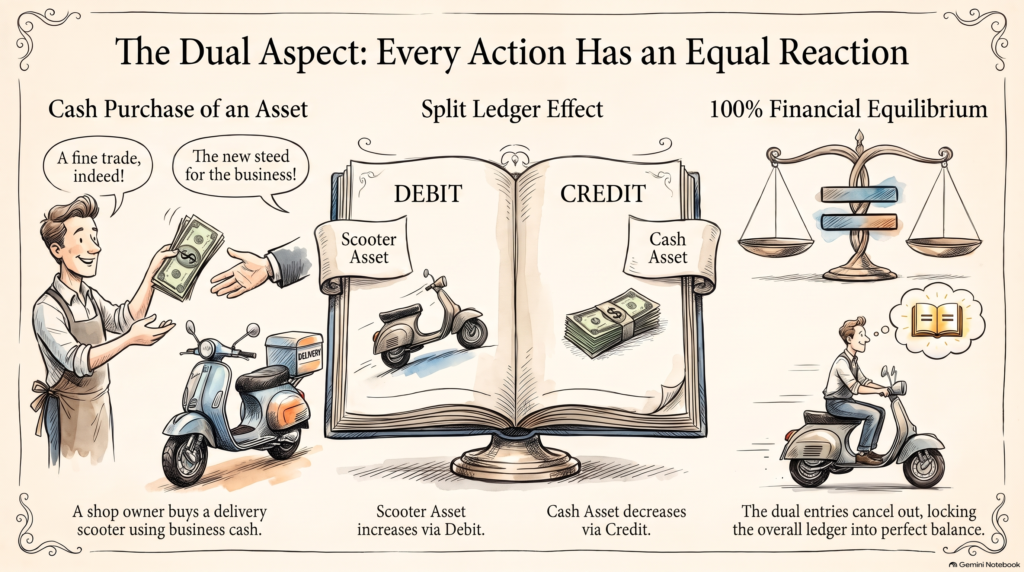
Imagine you own a buzzing local delivery shop. Business is booming, and your legs are exhausted from walking. You decide it’s time to upgrade. You walk into the showroom and buy a sleek, brand-new delivery scooter for ₹50,000 in cash.
Watch the camera zoom in on your ledger book as the transaction hits:
- Camera Angle A (The Inflow): Your scooter account (an Asset) shoots up by ₹50,000 because your business just gained a shiny new set of wheels. In accounting language, gaining an asset is recorded as a Debit.
- Camera Angle B (The Outflow): Your cash account (another Asset) drops down by the exact same ₹50,000 because you handed the money over to the showroom owner. In accounting language, losing an asset is recorded as a Credit.
Did your total wealth magically multiply or vanish into thin air? Not at all! Your money simply changed costumes—shifting from paper cash in a wooden drawer into a rolling metal asset on the street. Your books remain in absolute, pristine, unshakeable harmony.
🍿 The Director’s Cut (Quick-Recall Memory Lock)
- What is it? A dual-effect method where every financial action touches two accounts.
- The Core Equation: Total Debits $\rightarrow$ Total Credits (Always equal!).
- The Movie Takeaway: You can never have a one-sided transaction. Every gain has a matching sacrifice, keeping your business empire totally transparent and under your absolute control.