
Introduction
Consumers may sometimes receive defective goods, poor services, incorrect bills or misleading information from sellers and service providers.
When a consumer faces such problems, they should take appropriate steps to seek a remedy. The Consumer Protection Act, 2019 provides a system through which consumers can file complaints and obtain suitable relief.
1. Meaning of Consumer Grievance Redressal
Consumer grievance redressal refers to the process of receiving, examining and resolving complaints made by consumers against defective goods, deficient services and unfair trade practices.
The purpose is to provide consumers with a fair opportunity to seek remedies and protect their rights.
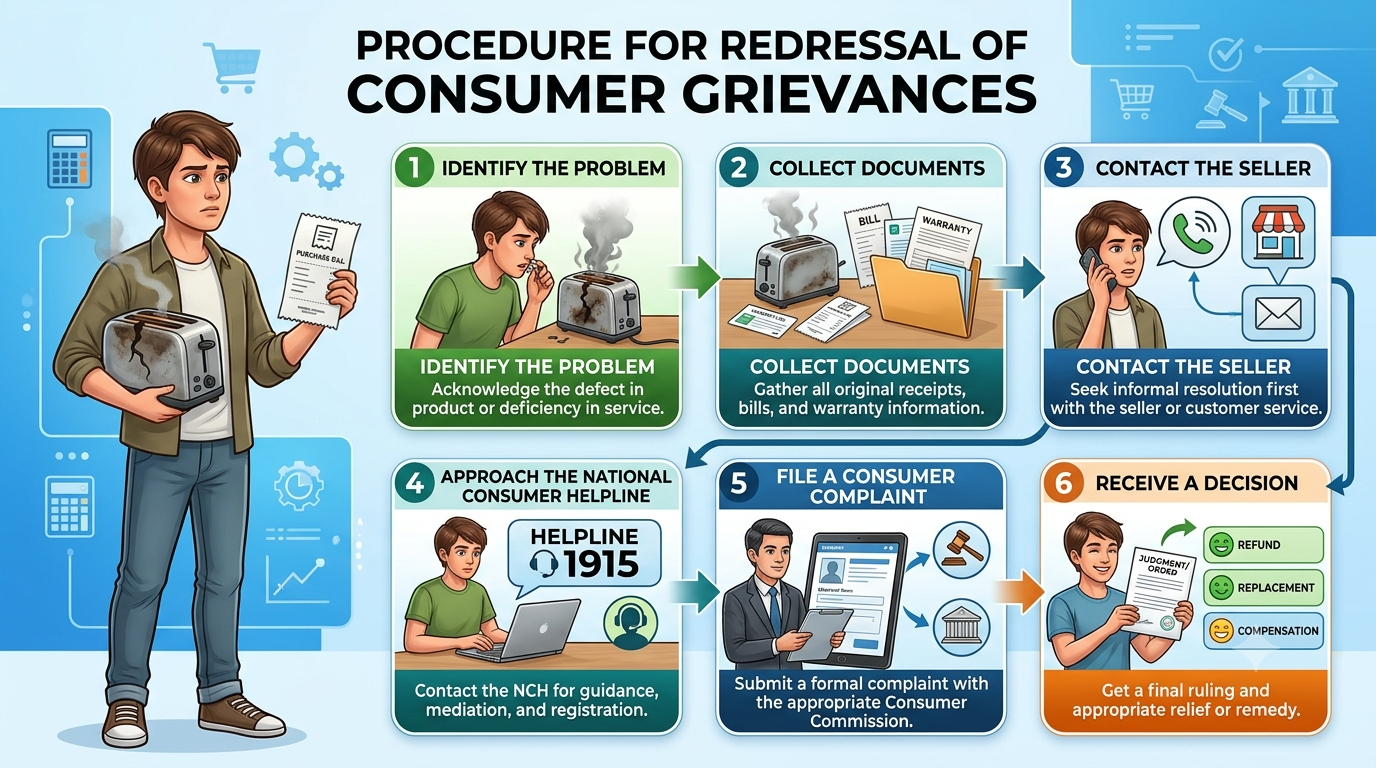
2. Procedure for Redressal of Consumer Grievances
Consumers can follow these steps when they face a problem.
Step 1: Identify the Problem
The consumer should first identify the exact problem.
It may relate to:

- Defective goods.
- Poor-quality products.
- Overcharging.
- Misleading advertisements.
- Deficiency in services.
- Unfair trade practices.
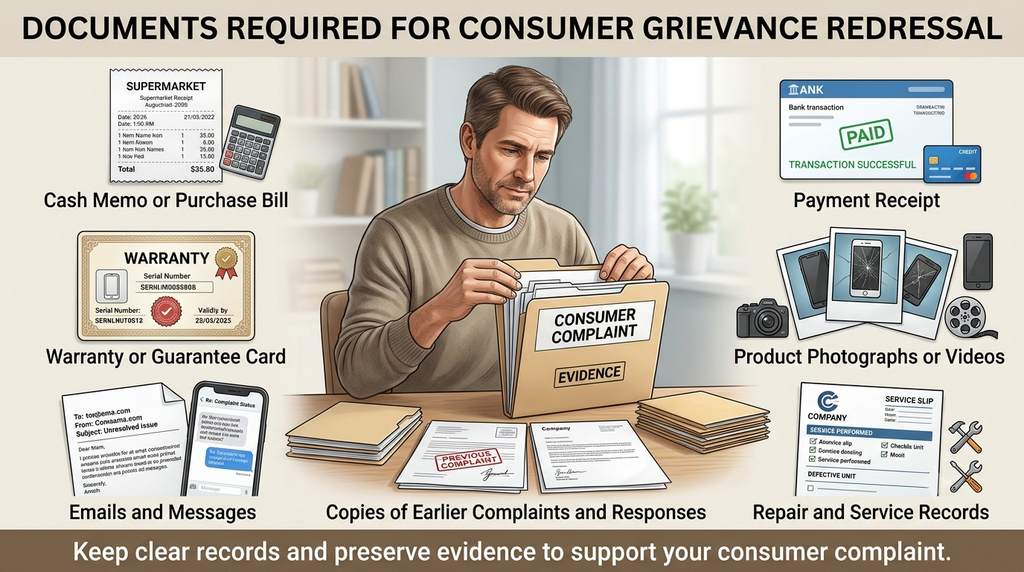
Step 2: Collect Supporting Documents
The consumer should collect and preserve all documents related to the purchase or service.
Important documents include:
- Cash memo or purchase bill.
- Payment receipt.
- Warranty or guarantee card.
- Product photographs or videos, where relevant.
- Emails, messages or letters exchanged with the seller.
- Repair and service records.
These documents help establish the facts of the complaint.
Step 3: Contact the Seller or Service Provider
The consumer may contact the seller, manufacturer or service provider and explain the problem.
They can request a suitable solution, such as repair, replacement, refund or correction of the service.
Keeping a written record of the communication is useful.
Step 4: Approach the National Consumer Helpline
If the issue is not resolved, the consumer can seek assistance through the National Consumer Helpline.
Consumers can use the following channels:
- Website: consumerhelpline.gov.in
- Toll-free number: 1915
- Available digital channels provided by the National Consumer Helpline.
The helpline helps consumers register grievances and facilitates communication with the concerned businesses. It is a grievance assistance mechanism and is different from a consumer commission.
Step 5: File a Complaint Before the Appropriate Consumer Commission
If the grievance remains unresolved, the consumer may file a formal complaint before the appropriate District, State or National Consumer Commission.
The correct commission is selected according to the applicable pecuniary and territorial jurisdiction.
A complaint may generally be filed by:
- The affected consumer.
- A recognised consumer association.
- One or more consumers representing numerous consumers with the same interest, with the commission’s permission.
- The Central Government, State Government or Central Consumer Protection Authority, as applicable.
Step 6: Prepare the Complaint
The complaint should include:
- Name and address of the complainant.
- Name and address of the opposite party.
- Details of the goods or services involved.
- Facts of the dispute.
- Date and place where the problem arose.
- Supporting documents.
- The relief requested by the consumer.
The complaint should be clear, factual and supported by available evidence.
Step 7: Submit the Complaint
Consumers can submit complaints through the prescribed online or offline process.
Online filing is available through the government’s consumer grievance filing platform, e-Jagriti.
Website: https://e-jagriti.gov.in/
The consumer should select the appropriate commission, provide the required details, upload supporting documents and pay the applicable prescribed fee.
Step 8: Admission and Notice
The consumer commission examines the complaint.
If the complaint is admitted, notice is generally issued to the opposite party so that it can submit its response.
Under the Consumer Protection Act, 2019, a complaint is generally treated as admitted if its admissibility is not decided within 21 days of filing.
Step 9: Hearing and Examination
The commission examines the complaint, the response of the opposite party and the supporting evidence.
It may also require product testing or expert examination where necessary.
The parties are given an opportunity to present their respective positions.
Step 10: Mediation, Where Appropriate

If the commission considers that the dispute may be settled through mediation, it can refer the matter to mediation with the consent of the parties.
Mediation helps both parties try to reach a mutually acceptable settlement.
Step 11: Final Order
After examining the matter, the commission passes an appropriate order.
Possible reliefs include:
- Repair of defective goods.
- Replacement of goods.
- Refund of the price paid.
- Removal of deficiencies in services.
- Compensation for loss or injury.
- Discontinuation of unfair trade practices.
- Corrective advertisement.
- Payment of appropriate costs.
Step 12: Appeal, If Necessary
If a party is dissatisfied with the order, it may file an appeal before the higher consumer commission, subject to the applicable legal conditions and time limits.
3. Important Time Limit for Filing a Consumer Complaint
Under Section 69 of the Consumer Protection Act, 2019, a consumer complaint should generally be filed within two years from the date on which the cause of action arises.
A commission may allow a complaint filed after this period if sufficient cause for the delay is shown and the delay is properly recorded.
Therefore, consumers should avoid unnecessary delays in filing complaints.
4. Important Points to Remember
- Always preserve purchase bills and payment receipts.
- Keep written records of communication with sellers and service providers.
- Clearly explain the problem and the remedy required.
- File the complaint before the commission having the correct jurisdiction.
- Attach relevant supporting documents.
- Observe the applicable limitation period.
- Keep copies of the complaint and all submitted documents.
Conclusion
Consumer grievance redressal helps consumers obtain remedies when their rights are violated. Consumers should first collect evidence and approach the concerned seller or service provider. If the problem remains unresolved, they can seek assistance from the National Consumer Helpline or file a complaint before the appropriate Consumer Commission through the prescribed procedure.