
Have you ever heard someone say, “This is what is happening,” while another person says, “This is what should happen”?
These two sentences may sound similar, but they mean different things.
For example, imagine a school where some students are not getting enough time to play.
One person says:
“Students get only 20 minutes to play.”
Another person says:
“Students should get 40 minutes to play.”
Can you see the difference?
The first person tells us what is happening. The second person tells us what they think should happen.
Economics also uses these two ways of thinking. They are called Positive Economics and Normative Economics.
Let’s understand them with easy examples.
1. What Are Positive and Normative Economics?
Economics is not only about money. It also helps us understand what is happening in the economy and decide what could be done to improve people’s lives.
There are two important ways of looking at economic situations:
- Positive Economics
- Normative Economics
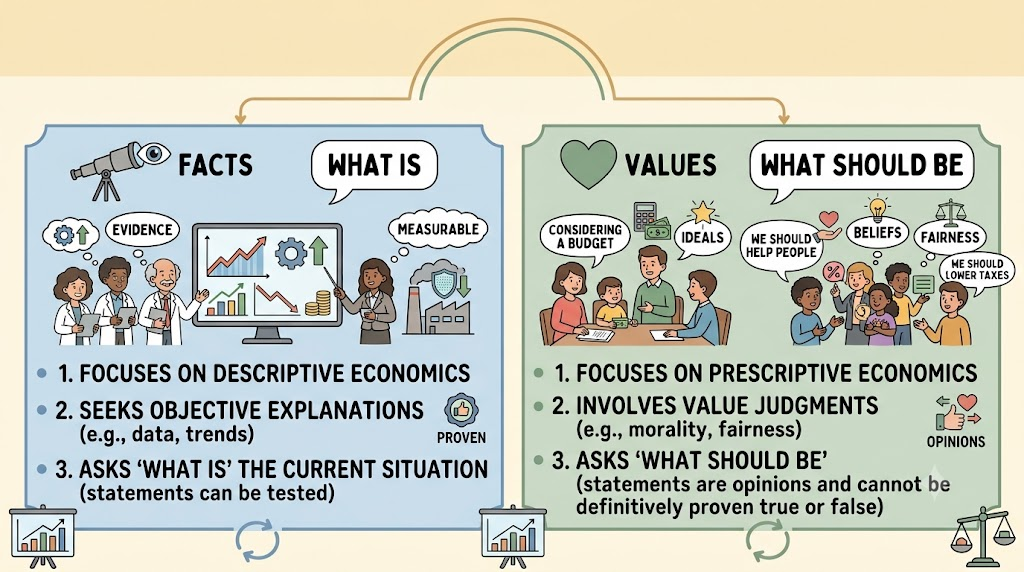
Positive economics explains what is happening or what may happen.
Normative economics explains what should happen according to someone’s opinion or judgment.
Think of it like this:
- Positive = What IS
- Normative = What SHOULD BE
LEFT PANEL — POSITIVE ECONOMICS
Show a school clock and children playing in a playground.
Include the exact text:
“WHAT IS?”
“Students get 20 minutes of playtime.”
“Describes what is happening.”
RIGHT PANEL — NORMATIVE ECONOMICS
Show the same playground with a clock showing a longer playtime.
Include the exact text:
“WHAT SHOULD BE?”
“Students should get 40 minutes of playtime.”
“Expresses an opinion about what should happen.”
At the bottom, write in large text:
“POSITIVE = WHAT IS”
“NORMATIVE = WHAT SHOULD BE”
Make the difference instantly understandable, with large fonts, correct spelling, clear arrows, and minimal text. No logos, watermarks, or unnecessary decoration.
2. Positive Economics: What Is Happening?
Positive economics explains economic facts and situations. It describes what is happening or examines what may happen when something changes.
It tries to answer questions such as:
- What is happening?
- What happened?
- What may happen if something changes?
It focuses on statements that can be checked using facts, observations, or evidence.
Example 1: India’s Population
Imagine someone says:
“India has a very large population.”
This statement describes something about the real world. We can check population data to understand whether it is true.
Therefore, it is a positive economic statement.
Example 2: The Price of Milk
Suppose the price of milk increases from ₹50 to ₹55 per litre.
Someone says:
“The price of milk has increased from ₹50 to ₹55 per litre.”
This statement describes a change that can be checked using price information.
Therefore, it is a positive statement.
Example 3: Workers and Wages
Imagine a company increases the wages of its workers.
An economist might say:
“Higher wages may encourage some workers to work harder.”
This is a positive statement because it describes a possible relationship between wages and workers’ behaviour. We can investigate whether the statement is supported by evidence.
Notice the word “may.” It does not mean that every worker will behave in the same way.
Remember This
Positive economics is about describing and examining what is happening or what may happen.
It does not automatically mean that something is good, bad, fair, or unfair.

EXAMPLE 1: POPULATION
Illustration: A group of people and a population chart.
Text: “India has a large population.”
Label: “A statement that can be checked using data.”
EXAMPLE 2: MILK PRICE
Illustration: A milk packet with two price tags: ₹50 and ₹55.
Text: “The price of milk increased from ₹50 to ₹55.”
Label: “Describes a measurable change.”
EXAMPLE 3: WAGES
Illustration: A worker receiving a salary slip.
Text: “Higher wages may encourage some workers to work harder.”
Label: “A possible relationship that can be tested.”
At the bottom, add:
“POSITIVE ECONOMICS DESCRIBES AND EXAMINES FACTS.”
Use short sentences, accurate spelling, and large readable text. Keep the design simple enough for a young child to understand in five seconds.
3. Normative Economics: What Should Happen?
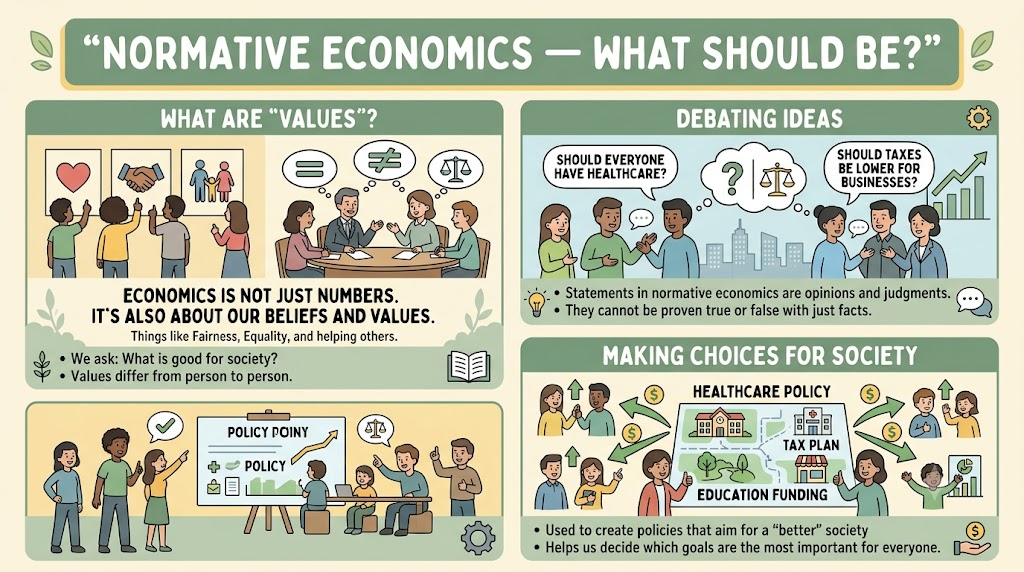
Normative economics is about opinions, values, and judgments about what should happen.
It helps people discuss what they believe would be better, fairer, or more beneficial for society.
It answers questions such as:
- What should we do?
- What would be fair?
- What should the government change?
- What would be better for people?
These statements often use words such as should, ought to, better, fair, or must.
Example 1: India’s Population
Imagine someone says:
“India should take steps to control rapid population growth.”
This statement does not simply describe what is happening. It suggests what the country should do.
Therefore, it is a normative economic statement.
Example 2: The Price of Milk
Imagine someone says:
“The government should make milk more affordable for families.”
This statement expresses an opinion about what the government should do.
Different people might suggest different solutions, such as helping low-income families or reducing certain costs.
Therefore, it is a normative statement.
Example 3: Workers and Wages
Suppose a company pays its workers very low wages.
Someone says:
“Companies should pay workers fair wages for their hard work.”
This statement expresses a judgment about what would be fair.
Therefore, it is a normative economic statement.
Remember This
Normative economics is about what people believe should happen.
People may disagree about what is best because they can have different opinions, values, and priorities.
EXAMPLE 1: POPULATION
Illustration: A family beside a community planning board.
Text: “The country should take steps to manage rapid population growth.”
Explanation: “Suggests what should be done.”
EXAMPLE 2: MILK PRICES
Illustration: A family shopping for milk.
Text: “The government should help make milk affordable for families.”
Explanation: “Expresses an opinion about a possible improvement.”
EXAMPLE 3: WORKERS’ WAGES
Illustration: A worker talking to an employer.
Text: “Companies should pay workers fair wages.”
Explanation: “Expresses a judgment about fairness.”
At the bottom, write:
“NORMATIVE ECONOMICS = OPINIONS ABOUT WHAT SHOULD HAPPEN.”
Make all text readable, use simple illustrations, and avoid clutter, logos, and watermarks.
4. Positive vs Normative Economics: What Is the Difference?
Let’s compare both types to make the difference easy to remember.
| Positive Economics | Normative Economics |
|---|---|
| Explains what is happening or may happen. | Explains what should happen. |
| Focuses on facts and testable claims. | Expresses opinions, values, and judgments. |
| Can be checked using evidence. | Involves judgments about what is desirable or fair. |
| Example: “Milk prices have increased.” | Example: “Milk prices should be reduced.” |
| Example: “Unemployment increased this year.” | Example: “The government should create more jobs.” |
| Example: “The company increased wages.” | Example: “The company should pay fair wages.” |

5. How Do Positive and Normative Economics Work Together?
Positive and normative economics are different, but both are useful when making economic decisions.
Let’s understand this with the examples from our lesson.
Example 1: Controlling Population Growth
Positive statement:
“India has a large population, and rapid population growth can create challenges for public services and resources.”
This statement describes a situation and a possible relationship that can be examined using evidence.
Normative statement:
“The government should take suitable steps to address the challenges of rapid population growth.”
This statement suggests what the government should do.
The government can study population data and other evidence before deciding which policies may help.
Example 2: Fair Wages for Workers
Positive statement:
“Researchers can examine whether wages are related to workers’ productivity.”
This is a question that can be investigated using evidence.
Normative statement:
“Employers should pay workers fair wages.”
This expresses a judgment about what employers ought to do.
Governments may use evidence about wages, living costs, and employment when deciding whether minimum-wage rules are needed.
Why Are Both Important?
Positive economics helps people understand a problem.
Normative economics helps people discuss what should be done about it.
For example:
- First, we collect information about a problem.
- Next, we study the facts and possible causes.
- Then, people discuss possible solutions and what would be fair or desirable.
- Finally, decision-makers consider the evidence, values, costs, and possible effects before choosing a policy.
In simple words, positive economics helps us understand the situation, while normative economics helps us discuss what should happen next..

6. Quick Revision: Remember the Difference
Let’s revise everything in a few seconds.
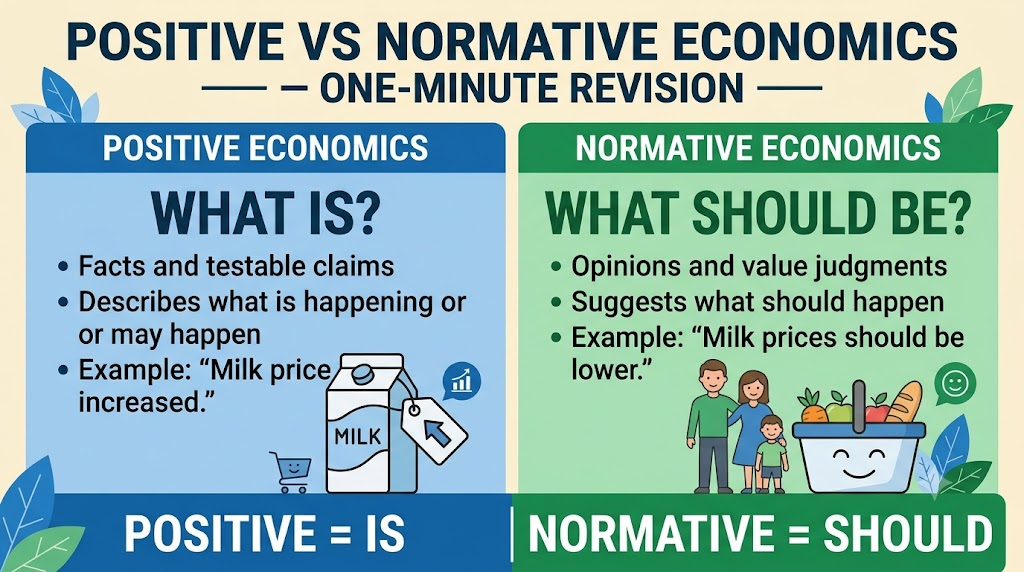
Positive Economics
- Explains what is happening or may happen.
- Focuses on facts and claims that can be tested.
- Example: “The price of milk has increased.”
- Memory word: IS
Normative Economics
- Explains what someone believes should happen.
- Involves opinions, values, and judgments.
- Example: “The price of milk should be lower.”
- Memory word: SHOULD
dable on a desktop screen. No logos or watermarks.
Conclusion
Positive and normative economics are two important ways of understanding economic problems.
Positive economics explains what is happening or what may happen and examines claims using evidence.
Normative economics expresses opinions about what should happen and considers ideas such as fairness, improvement, and social well-being.
The easiest way to remember the difference is:
Positive Economics = What IS
Normative Economics = What SHOULD BE
Both are useful because understanding a problem and deciding how to improve it are important parts of economic decision-making.
Frequently Asked Questions
1. What is positive economics in simple words?
Positive economics describes what is happening or may happen and examines statements using facts and evidence.
2. What is normative economics in simple words?
Normative economics expresses opinions or judgments about what should happen.
3. What is the main difference between positive and normative economics?
Positive economics asks, “What is happening?” Normative economics asks, “What should happen?”
4. Give one example of positive economics.
“The price of rice increased this month.”
This describes a change that can be checked using price information.
5. Give one example of normative economics.
“The government should help make rice affordable for low-income families.”
This expresses an opinion about what the government should do.
6. Why is the word ‘should’ important in normative economics?
The word “should” often signals a judgment about what is desirable, fair, or appropriate. However, the whole meaning of a statement matters, not just one word.
7. Can positive economics help the government?
Yes. It helps the government study facts, economic conditions, and the likely effects of different decisions.
8. Why are both positive and normative economics important?
Positive economics helps people understand economic situations. Normative economics helps them discuss possible improvements and what they believe should be done.
Final memory trick:
If a statement tells you what IS happening, think Positive Economics.
If a statement tells you what SHOULD happen, think Normative Economics.

Product links