The neon lights of a futuristic metropolis flicker through a heavy rainstorm. Inside the grand hall of the Financial Citadel, five distinct factions stand under towering banners. Each faction represents a fundamental force that governs how every single unit of wealth moves through the universe.
If you try to manage a business empire by treating all money the same, your ship will sink. You must learn to classify every transaction into its rightful faction!
Grab your popcorn—it’s time to meet the Five Major Tribes of modern accounting! 🚀
The Movie Plot: The Five Pillars of the Citadel 🎥
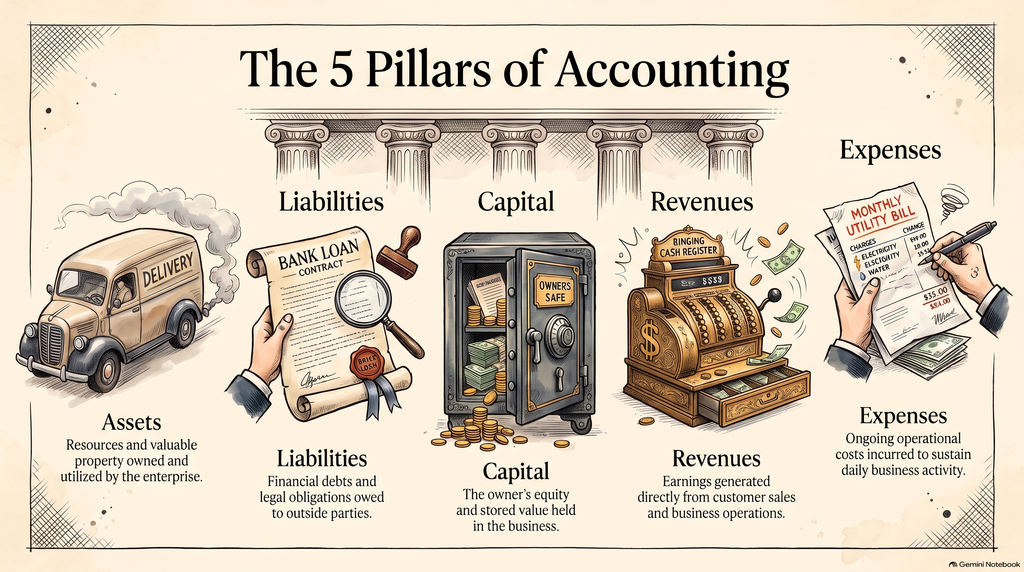
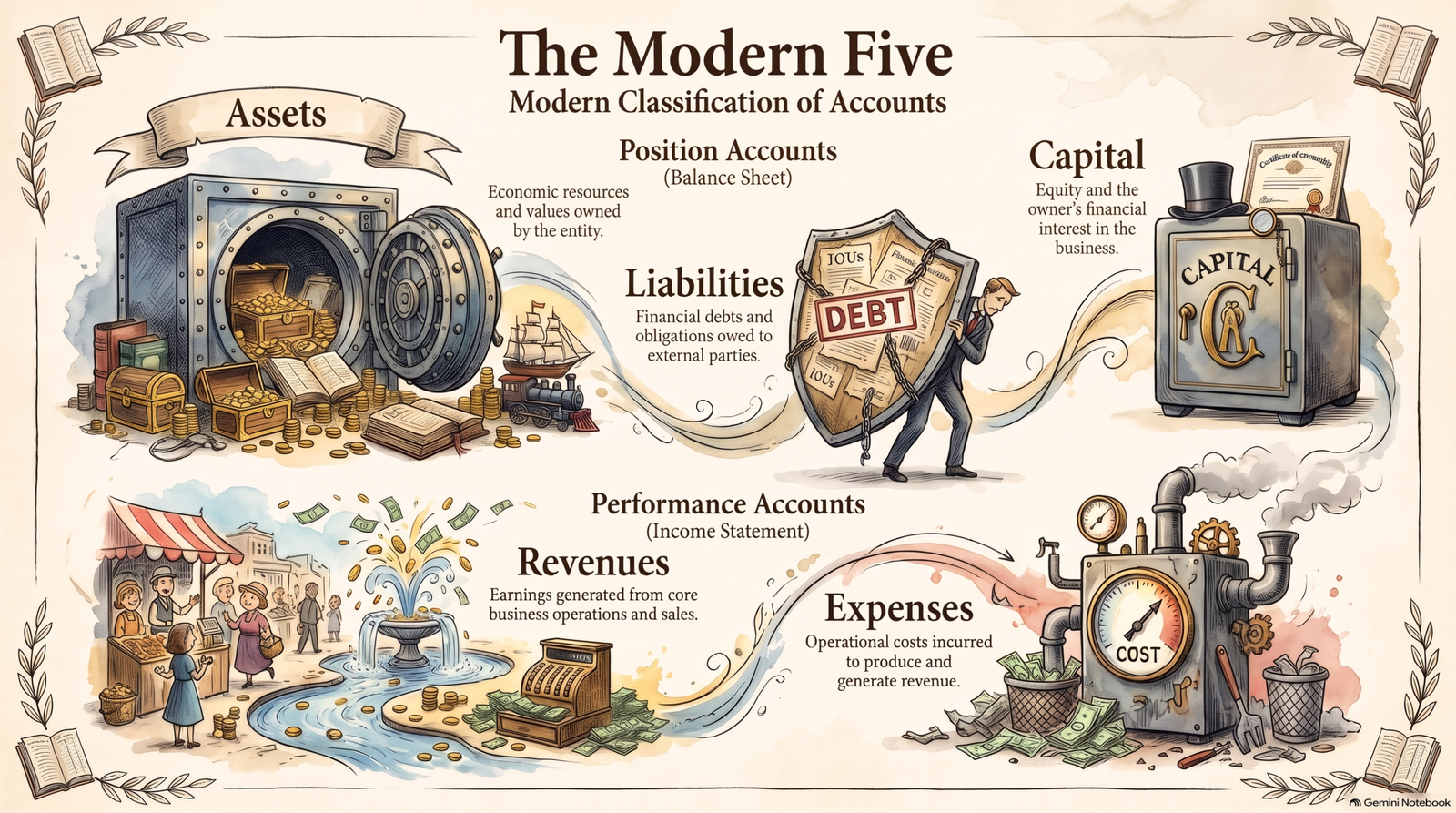
Under the modern classification system, every single account in existence belongs strictly to one of five major groups:
- Assets (The Treasure Vault): Everything of monetary value that the business owns and controls. They bring future economic benefits into your empire (e.g., Cash, Inventory, Machinery, Buildings).
- Liabilities (The Debts Owed): Legal financial obligations owed to external outsiders. They represent claims against your assets by lenders and creditors (e.g., Bank Loans, Trade Creditors, Outstanding Bills).
- Capital (The Owner’s Stake): The net financial claim of the owner against the business. It is the fuel injected by the founder to ignite the engine, plus all accumulated net profits.
- Revenues / Incomes (The Inflow Force): Earnings generated from selling goods, rendering services, or investing. Revenues expand the owner’s capital.
- Expenses (The Operational Burn): Costs incurred and resources consumed in order to run daily operations and generate revenue (e.g., Rent, Salaries, Electricity, Stationery).
The Real-Life Blockbuster Scene: Sorting the Fashion Boutique 👗🏬
Let’s bring this movie directly onto the floor of your own high-end fashion boutique.
At the end of your launch month, your desk is piled high with legal papers, keys, keys to delivery vans, and stack of bills. Watch how fast we sort this chaos into the Five Tribes:
- Delivery Van & Display Racks $\rightarrow$ Assets (Value you own that helps you make money).
- Commercial Bank Loan $\rightarrow$ Liabilities (Obligations you must repay to outsiders).
- Your Initial Investment $\rightarrow$ Capital (Your personal claim on the boutique).
- Daily Clothing Sales Revenue $\rightarrow$ Revenues (Fresh earnings flowing into the register).
- Monthly Boutique Rent & Staff Wages $\rightarrow$ Expenses (Necessary operational costs consumed to keep the lights on).
🍿 The Director’s Cut (Quick-Recall Memory Lock)
| Tribe Name | Plain English Definition | Real-World Boutique Example |
| 1. Assets | Economic resources owned by the firm. | Delivery vans, display racks, cash reserves. |
| 2. Liabilities | Financial debts owed to outside parties. | Bank loans, debts owed to fabric suppliers. |
| 3. Capital | The founder’s equity and ownership stake. | Your initial investment into the store. |
| 4. Revenues | Money earned from sales or services. | Cash collected from selling designer dresses. |
| 5. Expenses | Operational costs incurred to earn income. | Store rent, electricity bills, employee salaries |