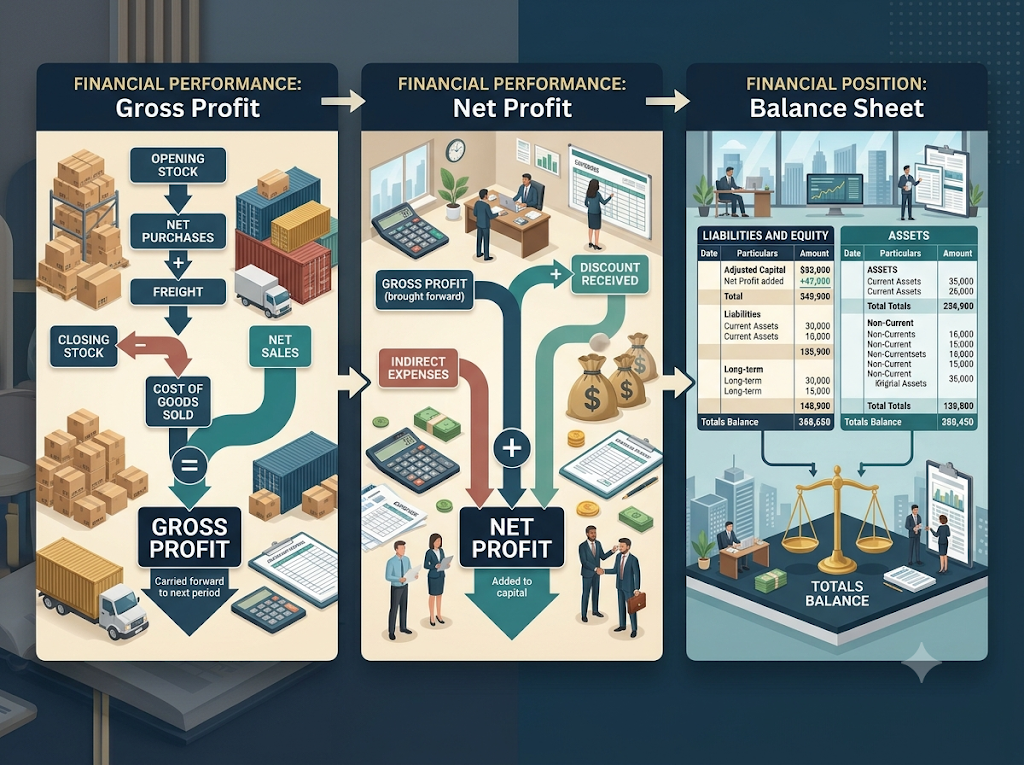
A Trial Balance is the starting point, not the finish line. To discover a business’s profit and financial position, the accountant must organise its trading items, deduct indirect expenses, and adjust the values that belong to the year-end.
M/s Pant Bros. provides a worked example of this process.
Step 1: Work Out the Adjustments
The information supplied gives three adjustments.
Closing stock: ₹1,70,000
Closing stock is shown on the credit side of the Trading Account and as a current asset in the Balance Sheet.
Outstanding salaries: ₹12,000
Adjusted salaries = ₹1,20,000 + ₹12,000 = ₹1,32,000
The additional ₹12,000 is also shown as a liability.
Depreciation on Motor Car at 10% per annum
Depreciation = ₹50,000 × 10 ÷ 100 = ₹5,000
The depreciation is an expense in the Profit and Loss Account and is deducted from the Motor Car’s value in the Balance Sheet.
Step 2: Trading Account
M/s Pant Bros. — Trading Account for the year ended 31 March 2012
| Particulars | Amount (₹) |
|---|---|
| Opening stock | 85,000 |
| Purchases | 4,20,000 |
| Less: Purchase returns | (20,000) |
| Net purchases | 4,00,000 |
| Freight | 20,000 |
| Total debit before gross profit | 5,05,000 |
| Sales | 8,10,000 |
| Less: Sales returns | (10,000) |
| Net sales | 8,00,000 |
| Closing stock | 1,70,000 |
| Total credit | 9,70,000 |
Gross Profit = ₹9,70,000 − ₹5,05,000 = ₹4,65,000
Step 3: Profit and Loss Account
M/s Pant Bros. — Profit and Loss Account for the year ended 31 March 2012
| Particulars | Amount (₹) |
|---|---|
| Gross profit | 4,65,000 |
| Discount received | 18,000 |
| Total income | 4,83,000 |
| Salaries, including outstanding salaries | 1,32,000 |
| Rent and taxes | 40,000 |
| Postage and telegrams | 25,000 |
| Interest paid | 20,000 |
| Discount allowed | 16,000 |
| Insurance | 1,00,000 |
| Depreciation on Motor Car | 5,000 |
| Total expenses | 3,38,000 |
Net Profit = ₹4,83,000 − ₹3,38,000 = ₹1,45,000
Step 4: Balance Sheet
M/s Pant Bros. — Balance Sheet as at 31 March 2012
| Liabilities | Amount (₹) |
|---|---|
| Capital | 4,00,000 |
| Add: Net profit | 1,45,000 |
| Adjusted capital | 5,45,000 |
| Creditors | 75,000 |
| Outstanding salaries | 12,000 |
| Total liabilities | 6,32,000 |
| Assets | Amount (₹) |
|---|---|
| Closing stock | 1,70,000 |
| Debtors | 1,20,000 |
| Furniture | 2,00,000 |
| Motor Car | 50,000 − 5,000 = 45,000 |
| Cash in hand | 50,000 |
| Cash at bank | 47,000 |
| Total assets | 6,32,000 |
Both sides agree at ₹6,32,000.
The Lesson
A closing stock adjustment affects the Trading Account and the Balance Sheet. Outstanding salaries affect expenses and liabilities. Depreciation affects both profit and the recorded value of the asset.
Exam memory line: Adjust the figures first, calculate gross profit, deduct indirect expenses to find net profit, and transfer that profit to capital when preparing the Balance Sheet.