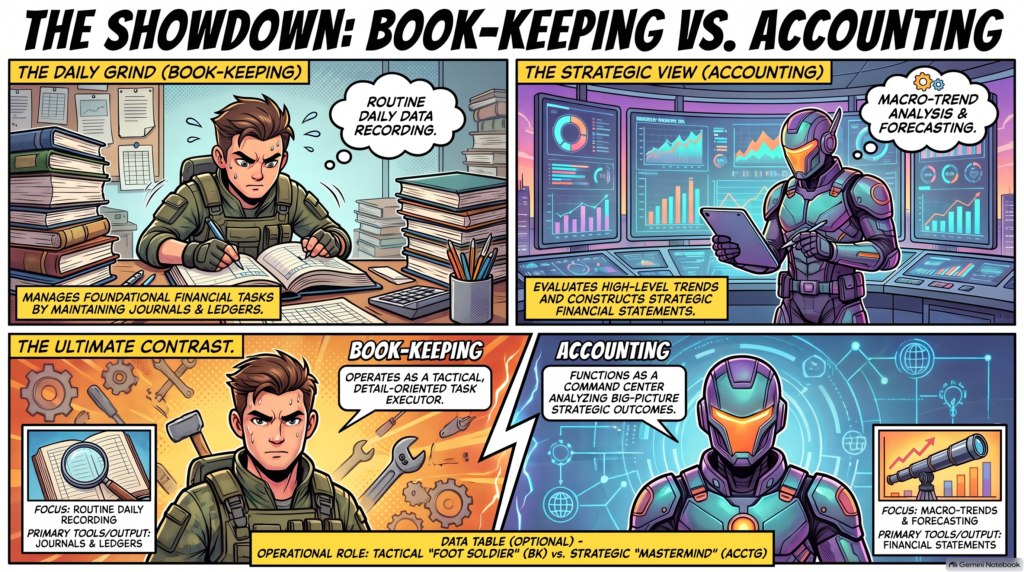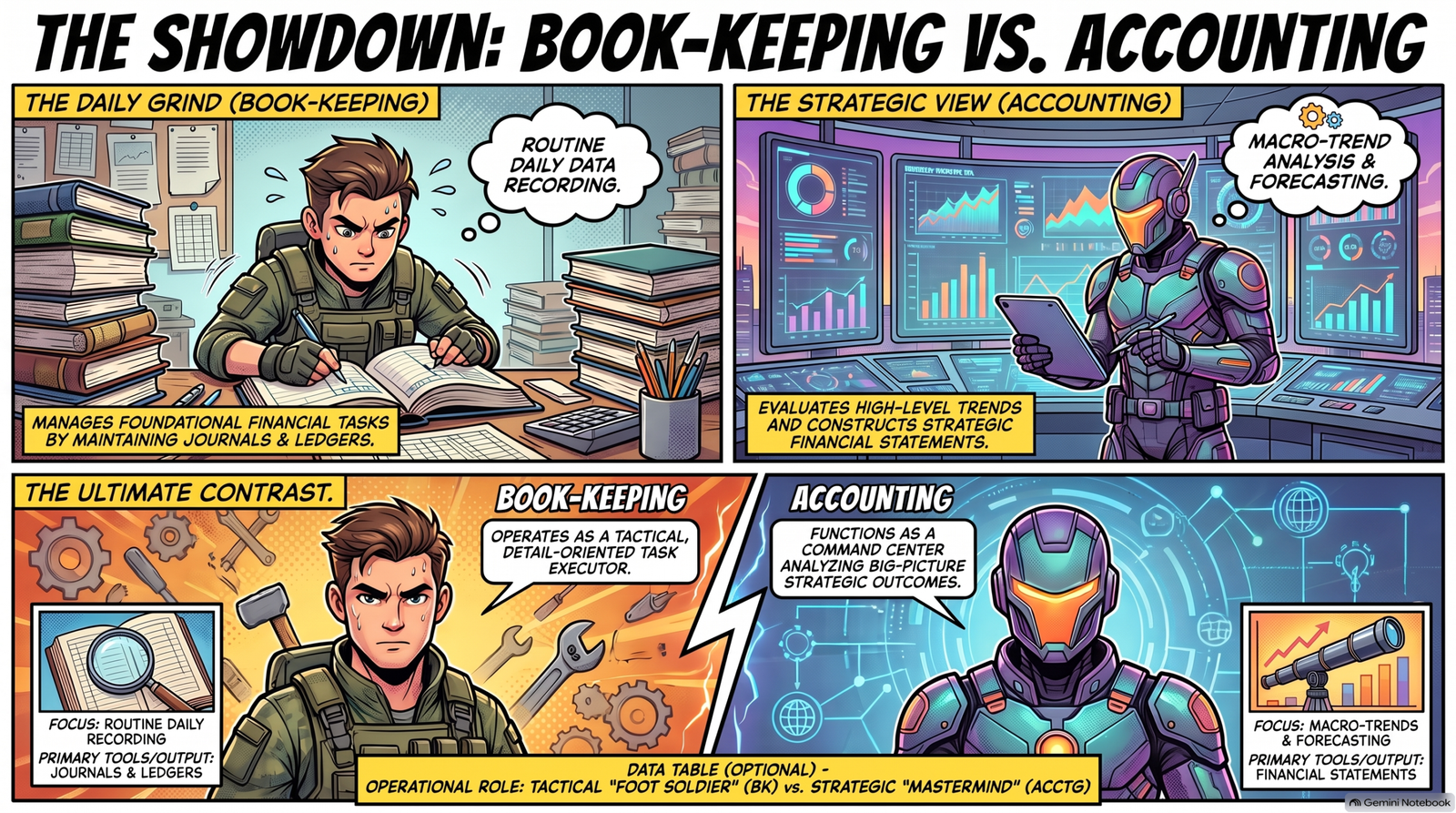
If book-keeping and accounting were characters in an action movie, book-keeping would be the elite tactical specialist clearing rooms, securing data, and setting up the grid. Accounting would be the high-level mastermind sitting in the command center, analyzing the big picture, hacking the mainframe, and executing the grand strategy.
They work together, they live in the same building, but their day-to-day lives are entirely different. Let’s break down the ultimate face-off between Book-Keeping and Accounting so you can spot the difference instantly—and never mix them up again.
Part 1: The Tale of the Tape (Head-to-Head Comparison)
Let’s look at how they stack up across the board:
| Feature | Book-Keeping 🗂️ | Accounting 📊 |
| What is it? | The initial phase focused on identifying and recording financial data. | The broader phase focused on summarizing, analyzing, and interpreting that data. |
| Stage | It’s the foundation; it happens first. | It starts where book-keeping ends. |
| Who does it? | Book-keepers (relies on routine, accuracy, and rule-following). | Accountants (requires high-level strategy, critical thinking, and advanced skills). |
| Goal | To maintain a systematic, chronological record of all transactions. | To communicate financial health and insights to decision-makers. |
| Reports | Generates the primary ledgers and journals. | Prepares the big financial statements (Profit & Loss, Balance Sheet). |
Part 2: Real-Life Scenario — The Bakery Battle
Picture this: You and your best friend open an artisanal cookie shop called The Sugar Vault.
- The Book-Keeper’s Job (Every Single Day):Every time a customer buys a box of cookies for ₹500, or you pay the electricity bill of ₹3,000, your book-keeper logs it into the books. They make sure every single rupee is accounted for, receipts match, and nothing slips through the cracks. It’s clean, organized, and routine.
- The Accountant’s Job (At the End of the Month/Year):Your accountant takes those organized logs and looks at the macro trends. They notice: “Hey, our flour costs spiked by 20% this month because of a supplier change, but our online sales doubled! If we renegotiate with our supplier and shift more budget to Instagram ads, we can double our net profit.”
See the difference? The book-keeper tells you what happened to the money today. The accountant tells you what that means for your future and how to conquer the market tomorrow.
Part 3: Why Do People Always Confuse Them?
It’s easy to blur the lines because they both deal with numbers, money, and business records. In smaller companies, the exact same person might wear both hats—doing the routine recording in the morning and building the tax strategy in the afternoon.
However, in large corporations, they are entirely different departments. You wouldn’t ask a data-entry book-keeper to negotiate a corporate tax merger with the government any more than you’d ask a high-level corporate accountant to spend eight hours filing cash receipts into a ledger!
Mind-Blowing Fast Facts to Flex Your Knowledge
- The Scope Gap: Book-keeping is essentially a subset of accounting. Think of book-keeping as a chapter inside the massive, multi-volume textbook that is accounting.
- The Decision Maker: Book-keeping data is rarely used directly to make major business pivots because it lacks context. Accounting injects that context, turning raw figures into a strategic weapon.
- The Dopamine Split: Some people love the quiet, zen-like satisfaction of balancing a book-keeping ledger where every column matches perfectly. Others love the adrenaline rush of an accountant presenting a brilliant financial forecast to a room full of investors. Which side of the fence are you on?