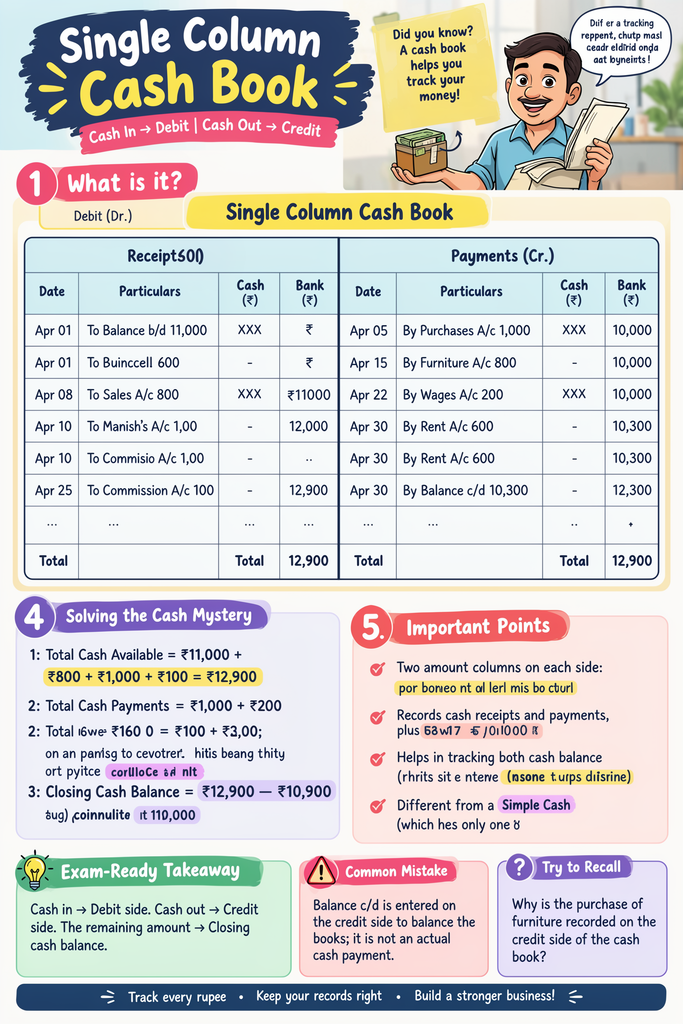
On 1 April, a shopkeeper counts ₹11,000 in the cash box. During the month, money comes in from sales, a customer named Manish, and commission. Meanwhile, purchases, furniture, wages, and rent demand their share.
By 30 April, one question remains: how much cash is left?
The shopkeeper’s best detective tool is the Single Column Cash Book.
Two Sides, One Cash Box
A Single Column Cash Book records cash received and cash paid.
- Debit side (Dr.): Cash coming into the business.
- Credit side (Cr.): Cash going out of the business.
Every rupee must be recorded on the correct side. Let’s enter April’s transactions.
Single Column Cash Book
| Date | Particulars | Amount (₹) | Date | Particulars | Amount (₹) |
|---|---|---|---|---|---|
| Dr. — Receipts | Cr. — Payments | ||||
| Apr 01 | To Balance b/d | 11,000 | Apr 05 | By Purchases A/c | 1,000 |
| Apr 08 | To Sales A/c | 800 | Apr 15 | By Furniture A/c | 800 |
| Apr 10 | To Manish’s A/c | 1,000 | Apr 22 | By Wages A/c | 200 |
| Apr 25 | To Commission A/c | 100 | Apr 30 | By Rent A/c | 600 |
| Apr 30 | By Balance c/d | 10,300 | |||
| Total | 12,900 | Total | 12,900 |
Balance c/d means “balance carried down.” It is entered on the credit side to make both sides equal; it is not an actual cash payment.
Solving the Cash Mystery
Step 1: Find the total cash available.
The shopkeeper starts with ₹11,000 and receives ₹800 from cash sales, ₹1,000 from Manish, and ₹100 as commission.
Total cash available = ₹11,000 + ₹800 + ₹1,000 + ₹100
Total cash available = ₹12,900
Step 2: Add the cash payments.
- Cash purchases: ₹1,000
- Furniture: ₹800
- Wages: ₹200
- Rent: ₹600
Total cash payments = ₹1,000 + ₹800 + ₹200 + ₹600
Total cash payments = ₹2,600
Step 3: Calculate the closing cash balance.
Closing Cash Balance = Cash Available − Cash Payments
= ₹12,900 − ₹2,600
= ₹10,300
The mystery is solved: ₹10,300 remains in the cash box on 30 April.
Why Is Furniture on the Payments Side?
The shopkeeper paid ₹800 in cash to purchase furniture. Although furniture is not goods bought for resale, cash still leaves the business. Therefore, the transaction appears on the credit side as “By Furniture A/c.”
The cash book records cash movement, not just purchases and sales of goods.
The Lesson to Remember
A Single Column Cash Book records all cash receipts on the debit side and all cash payments on the credit side. The closing cash balance is the cash available after deducting payments.
Exam memory line: Cash in → Debit side. Cash out → Credit side. The remaining amount → Closing cash balance.