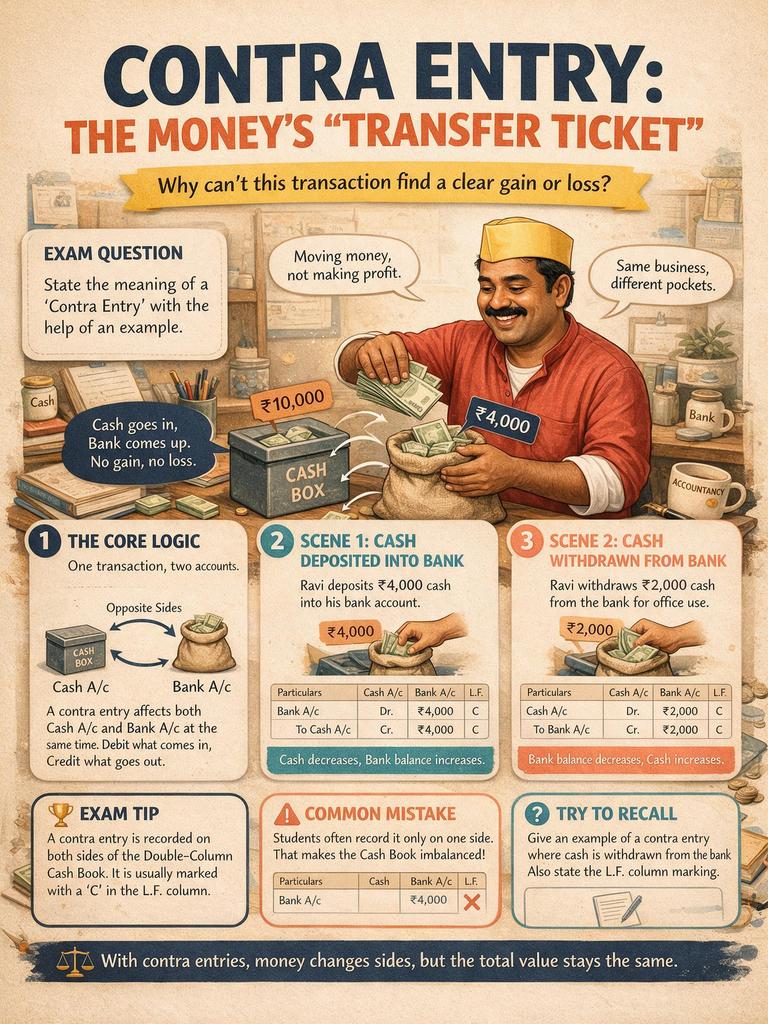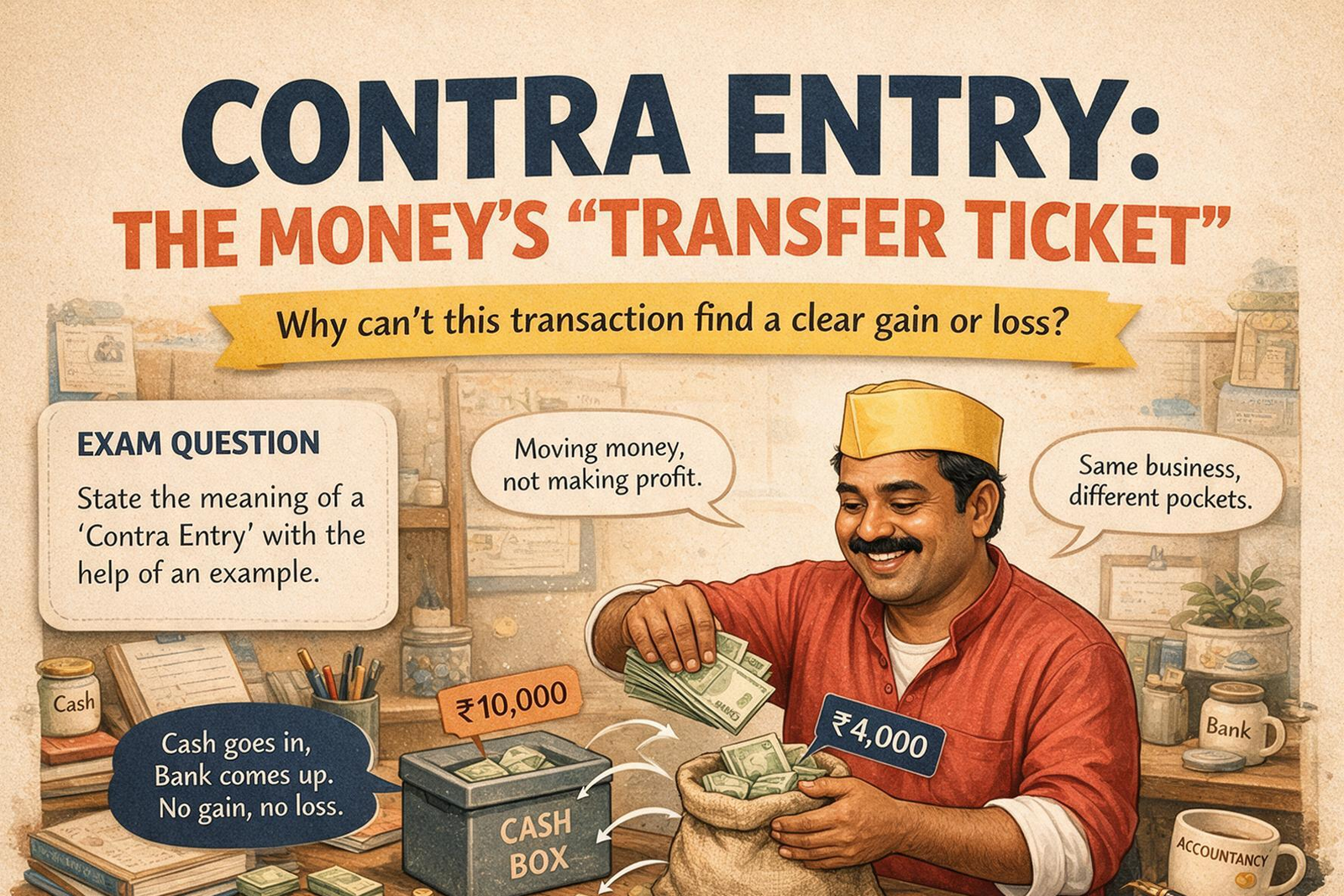
Imagine a shopkeeper named Ravi who has ₹10,000 in his cash box. He decides to deposit ₹4,000 into the shop’s bank account.
The cash box becomes lighter, but the bank balance grows. Has Ravi earned ₹4,000? No. Has the business lost ₹4,000? No. The money has simply moved from one place to another!
This simple movement introduces an important accounting concept: the Contra Entry.
What is a Contra Entry?
A contra entry is a transaction that affects both the cash and bank accounts of a business and is recorded on both sides of a Double-Column Cash Book.
It occurs when money is transferred between the business’s cash balance and its bank account.
There are two common situations:
- Cash deposited into the bank: Cash decreases, while the bank balance increases.
- Cash withdrawn from the bank for office use: The bank balance decreases, while cash increases.
Because both the cash and bank columns are affected, the transaction is recorded on opposite sides of the Cash Book.
Example: Ravi deposits ₹4,000 into the bank
Ravi has ₹10,000 in cash and deposits ₹4,000 into the business bank account.
Here is how the transaction is recorded.
| Side of Cash Book | Particulars | Cash Column | Bank Column |
|---|---|---|---|
| Debit (Dr.) | To Cash A/c | — | ₹4,000 |
| Credit (Cr.) | By Bank A/c | ₹4,000 | — |
The entry is marked with “C” in the Ledger Folio (L.F.) column to indicate a contra entry. The exact layout may vary depending on the Cash Book format used.
Why are the entries made this way?
- The debit side, Bank column, records the increase in the bank balance.
- The credit side, Cash column, records the decrease in cash.
After the transaction, Ravi’s balances are:
- Cash balance: ₹10,000 − ₹4,000 = ₹6,000
- Bank balance: increases by ₹4,000
The business still has the same total amount of money across cash and bank. Only its location has changed.
The reverse situation
Suppose Ravi withdraws ₹2,000 from the bank for office use.
The Cash Book records:
- Debit side, Cash column: ₹2,000, because cash increases.
- Credit side, Bank column: ₹2,000, because the bank balance decreases.
This is also a contra entry.
The exam-ready takeaway
A contra entry is an entry that records a transfer of funds between cash and bank in a Double-Column Cash Book. It affects both the cash and bank columns and is usually marked with “C” in the L.F. column.
Memory cue: Cash into bank or bank into cash — when both columns change, think contra entry.