Shivali’s business is in motion. Goods arrive from suppliers, customers buy on credit, wages and rent must be paid, and cheques move through the bank. Each transaction changes the business’s accounts—but the challenge is to record those changes without confusing a credit purchase with a cash purchase or a customer’s cheque with a cash deposit.
There are 13 transactions from 1 to 15 January 2012. Two details are missing: the payment methods for purchases from suppliers, and the payments to Ramesh and for expenses are not always specified. The entries below assume cash payments where no method is stated, except where a cheque or bank deposit is explicitly mentioned.
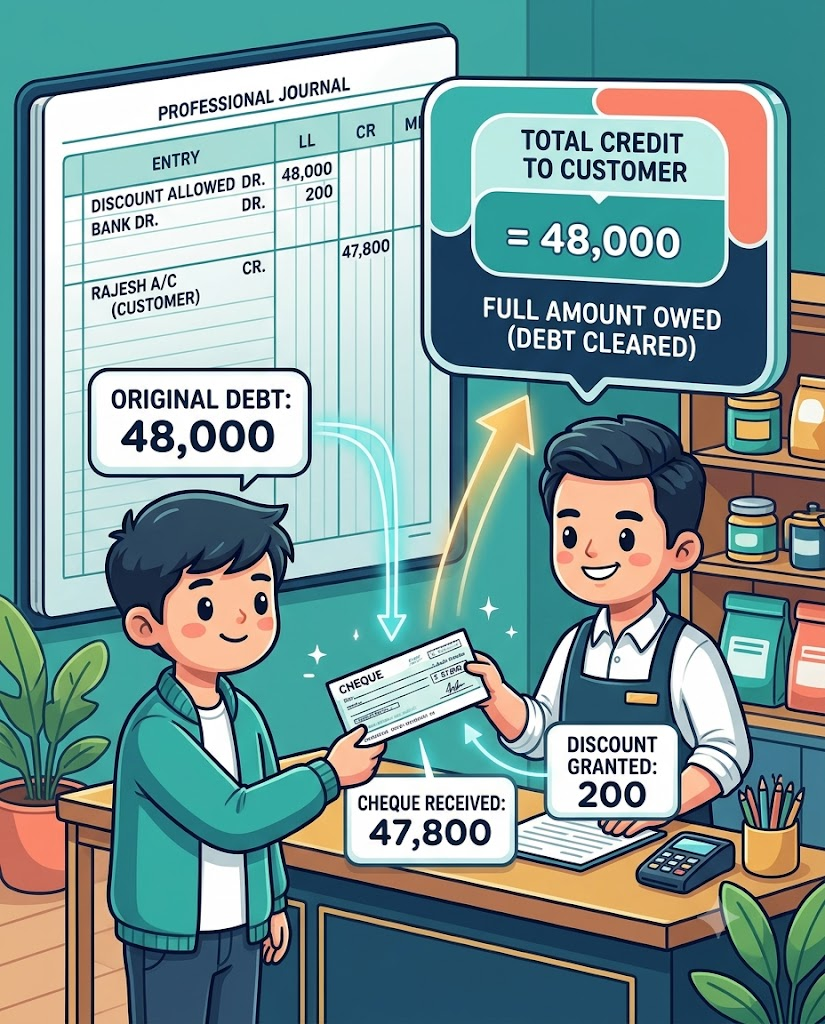
One more clue: Rajesh owes ₹48,000 and pays ₹47,800. The difference is ₹200, which is treated as a discount allowed by Shivali. That settlement balances exactly.
Journal of Shivali Chadha for January 2012
| Date | Particulars | Debit (₹) | Credit (₹) |
|---|---|---|---|
| Jan. 1 | Cash A/c Dr. | 2,50,000 | — |
| To Capital A/c | — | 2,50,000 | |
| (Being business commenced with cash) | |||
| Jan. 2 | Bank A/c Dr. | 35,000 | — |
| To Cash A/c | — | 35,000 | |
| (Being cash deposited into bank) | |||
| Jan. 3 | Purchases A/c Dr. | 50,000 | — |
| To Praveen Chauhan A/c | — | 50,000 | |
| (Being goods purchased on credit) | |||
| Jan. 3 | Rajesh Agarwal A/c Dr. | 48,000 | — |
| To Sales A/c | — | 48,000 | |
| (Being goods sold on credit) | |||
| Jan. 7 | Purchases A/c Dr. | 16,450 | — |
| To Ram Chand Sahai A/c | — | 16,450 | |
| (Being goods purchased on credit) | |||
| Jan. 8 | Wages A/c Dr. | 8,000 | — |
| To Cash A/c | — | 8,000 | |
| (Being wages paid in cash) | |||
| Jan. 8 | Manish Chugh A/c Dr. | 18,000 | — |
| To Sales A/c | — | 18,000 | |
| (Being goods sold on credit) | |||
| Jan. 10 | Bank A/c Dr. | 47,800 | — |
| Discount Allowed A/c Dr. | 200 | — | |
| To Rajesh Agarwal A/c | — | 48,000 | |
| (Being cheque received from Rajesh and discount allowed in full settlement) | |||
| Jan. 10 | Bank A/c Dr. | 10,000 | — |
| To Cash A/c | — | 10,000 | |
| (Being cash deposited into bank) | |||
| Jan. 11 | Ramesh A/c Dr. | 7,000 | — |
| To Cash A/c | — | 7,000 | |
| (Being payment made to Ramesh in cash) | |||
| Jan. 12 | Rent A/c Dr. | 4,000 | — |
| To Cash A/c | — | 4,000 | |
| (Being rent paid in cash) | |||
| Jan. 15 | Purchases A/c Dr. | 17,000 | — |
| To Khanna & Khanna A/c | — | 17,000 | |
| (Being goods purchased on credit) | |||
| Jan. 15 | Electricity Expenses A/c Dr. | 2,800 | — |
| To Cash A/c | — | 2,800 | |
| (Being electricity bill paid in cash) |
Three entries to understand, not just memorise
1. Rajesh’s settlement on 10 January
Rajesh owed ₹48,000 but paid ₹47,800.
\[ ₹48,000-₹47,800=₹200 \]
Bank is debited by ₹47,800, Discount Allowed is debited by ₹200, and Rajesh’s account is credited by ₹48,000. His debt is fully settled.
2. Depositing cash into the bank
On 2 January and 10 January, Bank A/c is debited, and Cash A/c is credited. The business is moving money between two asset accounts; it is not incurring an expense.
3. Purchases from suppliers
Praveen Chauhan, Ram Chand Sahai and Khanna & Khanna are credited because the purchases are assumed to be on credit. Purchases A/c is debited because the goods are bought for resale.
A source-check note
The entries for payment to Ramesh and the payment methods for purchases and expenses rely on assumptions because the question does not supply all the details. If Ramesh was not a creditor, or if a payment was made by cheque rather than cash, the relevant entry must be changed. The original question or image would be needed to confirm those points.
Exam-ready takeaway
Journalising means recording transactions in date order by debiting the accounts that receive the debit and crediting the corresponding accounts. A discount allowed to a customer is debited, while the customer’s account is credited for the full amount of the debt settled.
Memory line: Record the full debt, the amount received, and the discount separately—then check that debit and credit totals agree.