Imagine walking into a high-tech control room where every item your business owns has a tracking tag, balancing down to the last cent. No missing money, no mysterious disappearances—just pure, beautiful financial equilibrium.
Welcome back to the heart of bookkeeping, where two fundamental rules rule the entire commercial universe: The Accounting Equation and The Capital Shifters (Revenue & Expenses)! Let’s break them down so crisply that they get permanently locked into your brain. 🚀
Part 1: What is an Accounting Equation? ⚖️🏢
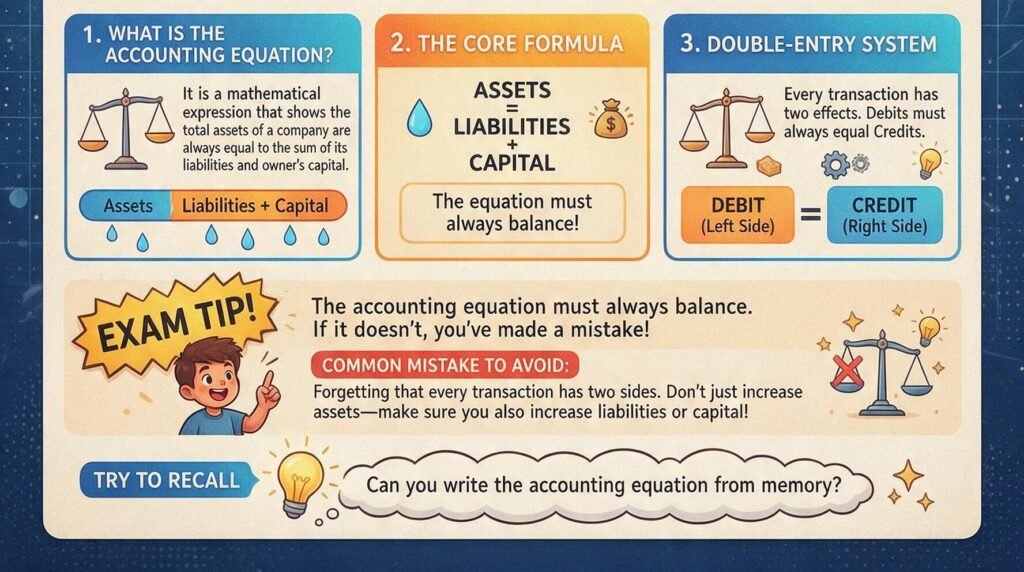
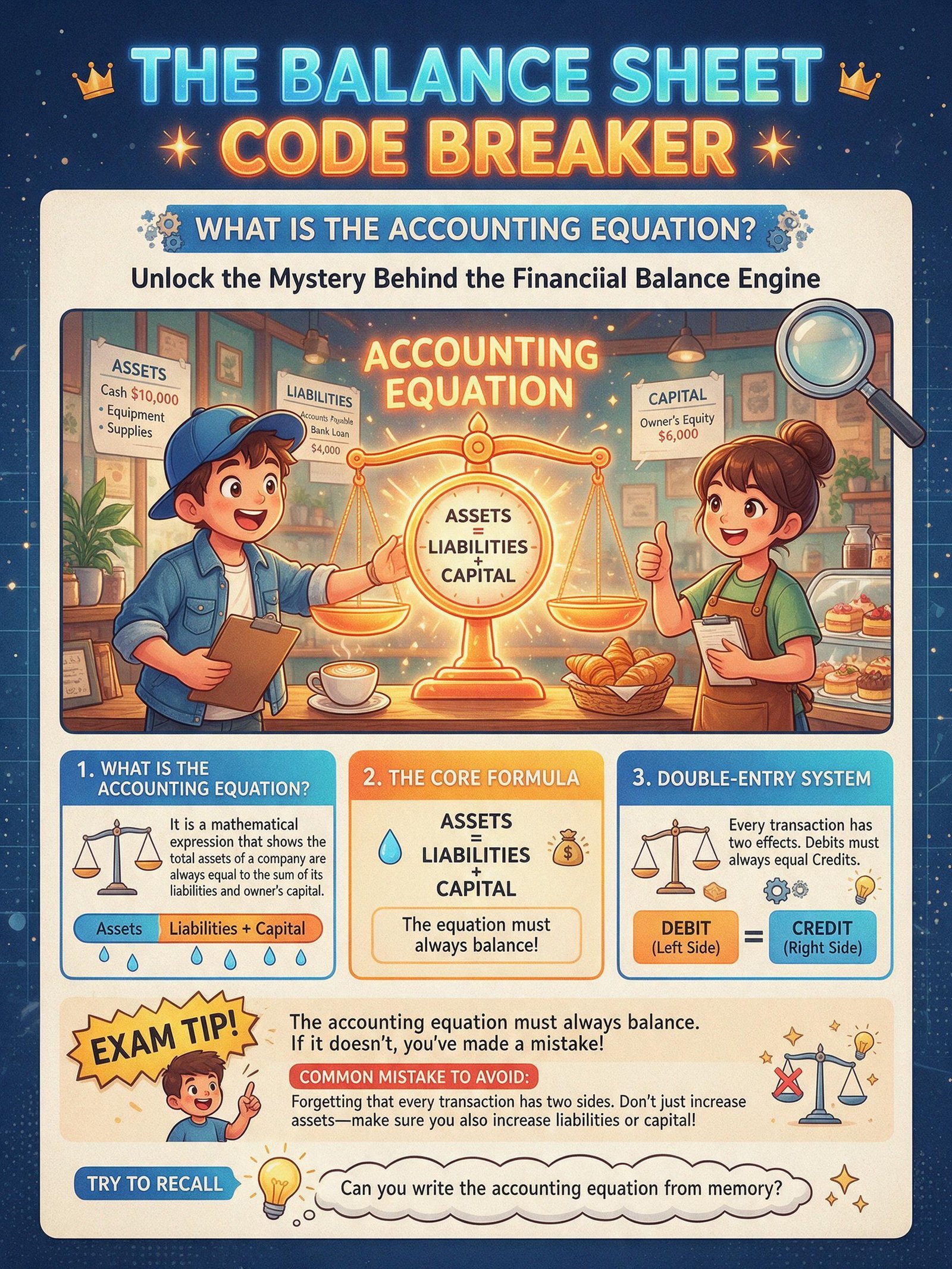
- Simple Answer: An accounting equation is a mathematical expression showing that a company’s total assets always equal the sum of its liabilities and owner’s capital. It proves that everything a business owns is financed either by borrowing from others or by the owner’s investment.
- The Behind-the-Scenes Secret: Think of the equation Assets=Liabilities+Capital as a see-saw that can never tip over. The left side holds everything the business has (its assets), while the right side tells you who paid for it—either outside lenders (liabilities) or you (capital).
- Real-World Scenario: Imagine your cafe owns $10,000 worth of property and equipment. That exact value must be accounted for by what you owe to suppliers or banks plus what you invested yourself. If you took a $4,000 bank loan and put in $6,000 of your own savings, the sides match up instantly:
\text{Assets ($10,000)} = \text{Liabilities ($4,000)} + \text{Capital ($6,000)}
Part 2: How are Revenue and Expense Treated in the Accounting Equation? 📈📉
- Simple Answer: Revenues increase overall capital because they bring earnings into the business, whereas expenses decrease capital because they consume resources to run operations. All gains and losses flow directly into the owner’s equity component.
- The Behind-the-Scenes Secret: Capital isn’t static—it’s a living, breathing score tracker! Every time your business wins (makes a sale), your capital score goes up. Every time your business pays a cost to keep the lights on, that score drops.
- Real-World Scenario: Think about your daily cafe hustle. Every time you collect daily sales revenue from customers, your cash goes up, and your capital grows. But when you pay the monthly electricity bill to keep the coffee grinders spinning, that expense subtracts directly from your total capital because resources were consumed to run operations.
Quick-Recall Concept Summary Table 📊
| Financial Concept | In Plain English | Where It Lives in the Equation | Real-World Cafe Example |
|---|---|---|---|
| Accounting Equation | Total assets always equal liabilities plus capital. | The Master Balance Formula | Owning $10,000 in property funded by a $4,000 loan + $6,000 savings. |
| Revenue | Earnings brought into the business by selling goods/services. | Increases Capital | Collecting daily cash sales from hungry customers. |
| Expense | Costs incurred to run daily operations. | Decreases Capital | Paying the monthly electricity bill to power the ovens. |
🧠⚡ Mind-Blowing Facts to Lock It In Forever
- The Ultimate Truth: No matter how massive a corporation gets—whether it’s a local bakery or a global tech titan—its balance sheet must always follow the core accounting equation. It’s the unbreakable law of financial gravity.
- Capital is a Sponge: Revenue acts like a sponge soaking up profits into the owner’s equity, while expenses act like evaporation shrinking the pool. At the end of the day, net profit is just the net change in capital!
- The Dopamine Hit: Once you realize that every single business transaction is just a ripple affecting assets, liabilities, or capital, reading financial statements feels like seeing right through the matrix. Total clarity unlocked!