Imagine you are sitting at a roadside tea stall, watching the vendor pour piping-hot chai into a glass. You hand him ₹20. He hands you the tea.
Boom. Right there, in the dust and aroma of cardamom, a tiny economic miracle just took place.
To most people, it’s just a cup of tea. But to an accountant, your brain should be releasing pure dopamine right now because you just witnessed the beating heart of commerce: A Business Transaction!
Let’s tear down the boring textbook definitions and look at why business transactions are actually the most thrilling, high-stakes puzzle pieces in the universe.
Part 1: What on Earth is a Business Transaction, Anyway?
In plain, human terms, a business transaction is any economic event between two or more parties that reshapes a company’s financial position and can be measured reliably in cold, hard cash.
Notice the two golden rules hidden in that sentence:
- It involves two parties: You can’t have a transaction by yourself. (Daydreaming about buying a Ferrari doesn’t count, sadly). There must be a giver and a receiver.
- It must affect the financial position: It changes assets, liabilities, or capital.
The Ultimate Test: Transaction vs. Non-Transaction
- Scenario A: The CEO of a company fires a lazy manager. Is this a business transaction? No! It’s an administrative decision. No money moved, no goods changed hands.
- Scenario B: The company pays that same manager their final severance paycheck of ₹50,000. Is this a business transaction? YES! Dopamine spike! Cash left the building, and an expense was recorded.
Part 2: The DNA of Every Transaction — The “Give and Take” Law of the Universe
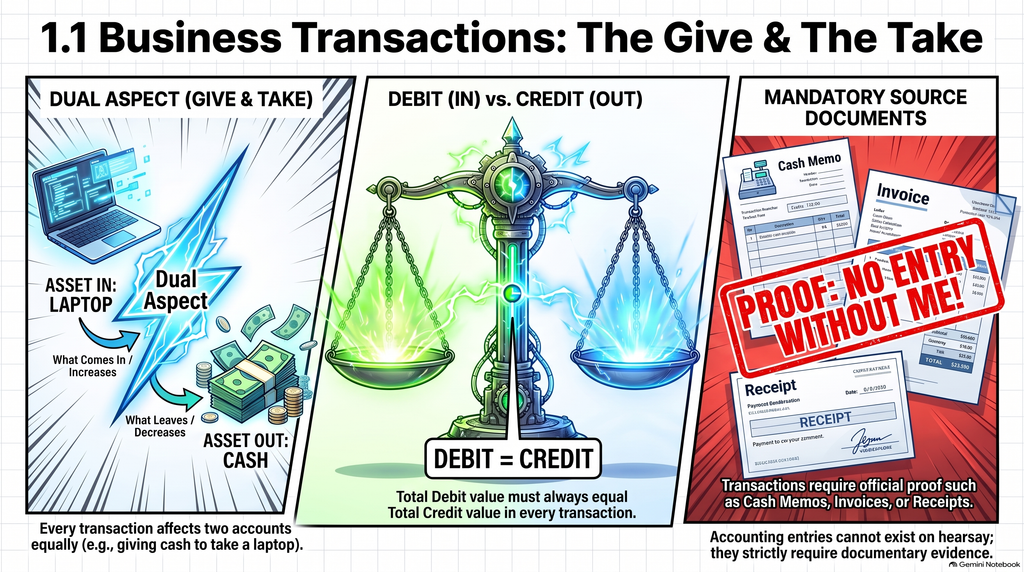
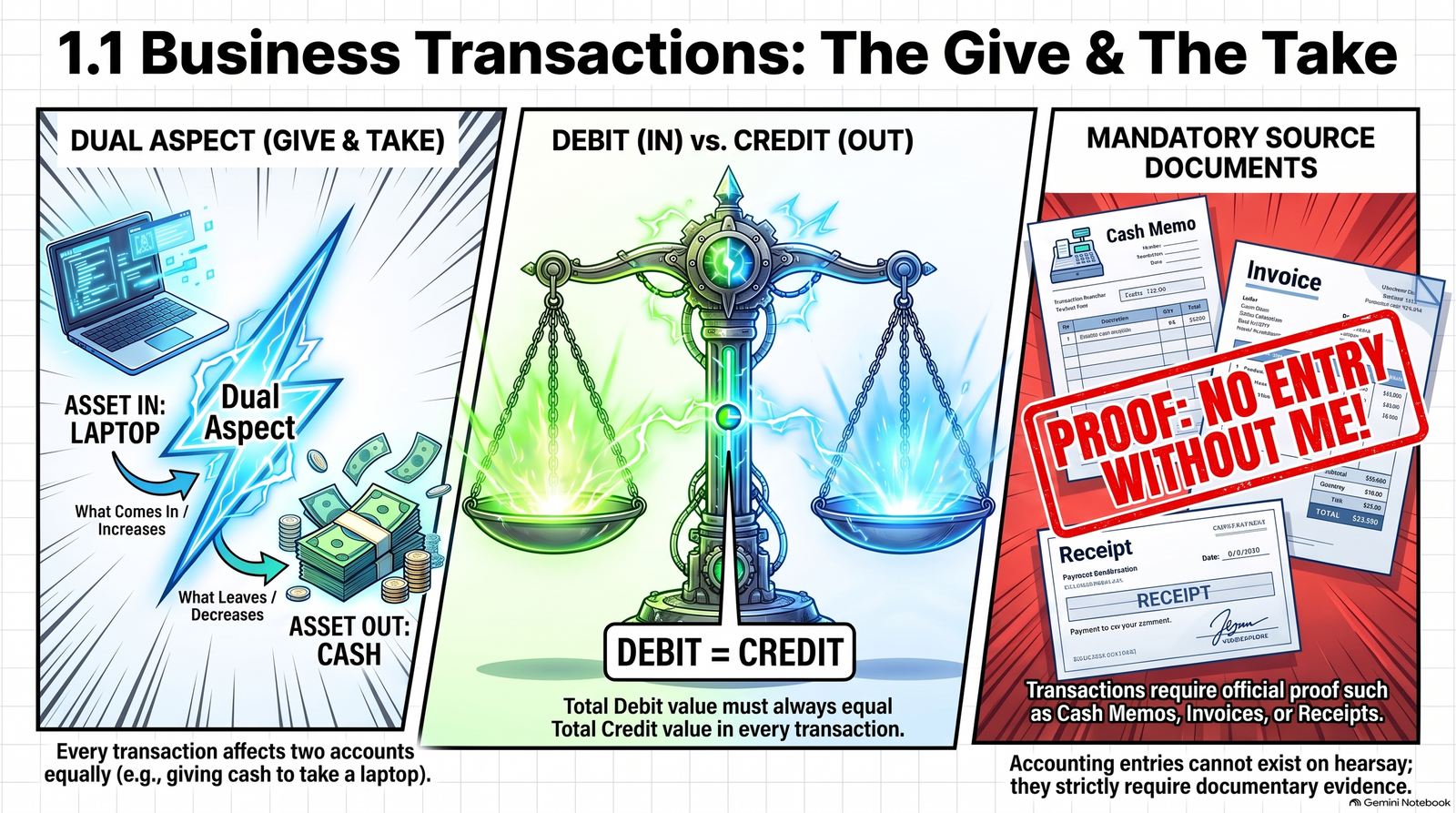
Every single business transaction in existence—whether it’s a trillion-dollar tech merger or buying a packet of chewing gum—obeys one immutable law: The Dual Aspect (Give and Take).
Nothing in business comes for free. If you get something, you must give something else of equal value.
- Take Aspect (What comes in): Usually represented as a Debit.
- Give Aspect (What goes out): Usually represented as a Credit.
Real-Life Scenario: The Laptop Obsession
Picture this: You just launched a startup building viral apps. You walk into an electronics store and buy a sleek MacBook Pro for ₹1,00,000 in cash.
Let’s look at what just happened in your business ecosystem:
- What you got (Take): A brand new MacBook (An Asset enters your business).
- What you gave (Give): Cash of ₹1,00,000 (An Asset leaves your business).
Your total wealth didn’t magically vanish; it just changed form. Cash turned into hardware. That, my friend, is the elegance of accounting harmony.
Part 3: The Secret Life of Source Documents (The Paper Trail or It Didn’t Happen!)
Have you ever wondered how law enforcement tracks down corporate fraudsters? They don’t guess—they hunt for Source Documents.
In accounting, we live by a sacred rule: “No document, no entry.” You can’t just walk up to an accountant and say, “Trust me bro, I spent ₹5,000 on client entertainment.” You need proof!
Source documents are the physical or digital birth certificates of a business transaction. They include:
- Cash Memos: Proof that cash changed hands instantly (like buying groceries).
- Invoices / Bills: Proof of credit sales (when you buy now and promise to pay later like a true boss).
- Receipts: The acknowledgment that someone actually paid you.
Without these, the whole financial skyscraper collapses into chaos.
Mind-Blowing Fast Facts to Impress Your Friends
- The Universe Balance Equation: Every transaction you ever record will always keep the fundamental accounting equation balanced:Assets=Liabilities+CapitalIt is more mathematically consistent than gravity!
- Mental Replacement: Long before computers, keeping track of business transactions was the only way humans could outsource their memory. The moment merchants started trading across cities in ancient Mesopotamia, transaction recording was invented—meaning accounting actually predates modern alphabets!
- The Emotional Hook: The next time you buy a coffee or pay your phone bill, pause for a second. Visualize the invisible tug-of-war between the cash leaving your pocket and the utility entering your life. You aren’t just spending money; you are keeping the entire global ledger alive.
Now go look at the world differently. Every swipe, tap, cash exchange, and invoice is a story waiting to be balanced.