July is a busy month for a business. Goods are bought and sold, suppliers are paid, customers settle their debts, and bills arrive. But three transactions hide accounting traps: a supplier grants a discount, a customer pays less than the amount owed, and the proprietor pays rent for a building used partly as a home.
The accountant’s job is to record each transaction correctly without confusing discount received with discount allowed, or business expenses with personal expenses.
Before entering the transactions, two assumptions need to be made clear:
- The sale to M/s Balakishan & Sons on 25 July is treated as a credit sale because no cash or cheque payment is mentioned.
- The payment to M/s Balbir Singh & Sons implies an amount due of ₹12,000, because ₹11,900 was paid and ₹100 was granted as a discount. The earlier transaction creating that debt is not included in the supplied list.
Journal entries for July 2012
Payments without a specified method are assumed to be made in cash. Dates and amounts follow the supplied question.
| Date | Particulars | Debit (₹) | Credit (₹) |
|---|---|---|---|
| July 1 | Cash A/c Dr. | 2,00,000 | — |
| To Capital A/c | — | 2,00,000 | |
| (Being business commenced with cash) | |||
| July 2 | Purchases A/c Dr. | 1,00,000 | — |
| To Vivek A/c | — | 1,00,000 | |
| (Being goods purchased on credit from Vivek) | |||
| July 8 | Cash A/c Dr. | 22,000 | — |
| To Sales A/c | — | 22,000 | |
| (Being goods sold for cash) | |||
| July 9 | M/s Anuj & Co. A/c Dr. | 10,000 | — |
| To Sales A/c | — | 10,000 | |
| (Being goods sold on credit) | |||
| July 15 | M/s Balbir Singh & Sons A/c Dr. | 12,000 | — |
| To Cash A/c | — | 11,900 | |
| To Discount Received A/c | — | 100 | |
| (Being payment made and discount received) | |||
| July 25 | M/s Balakishan & Sons A/c Dr. | 8,600 | — |
| To Sales A/c | — | 8,600 | |
| (Being goods sold on credit) | |||
| July 27 | Bank A/c Dr. | 9,750 | — |
| Discount Allowed A/c Dr. | 250 | — | |
| To M/s Anuj & Co. A/c | — | 10,000 | |
| (Being cheque received in full settlement and discount allowed) | |||
| July 31 | Electricity Charges A/c Dr. | 3,100 | — |
| To Cash A/c | — | 3,100 | |
| (Being electricity charges paid) | |||
| July 31 | Salary A/c Dr. | 2,000 | — |
| To Cash A/c | — | 2,000 | |
| (Being salary paid) | |||
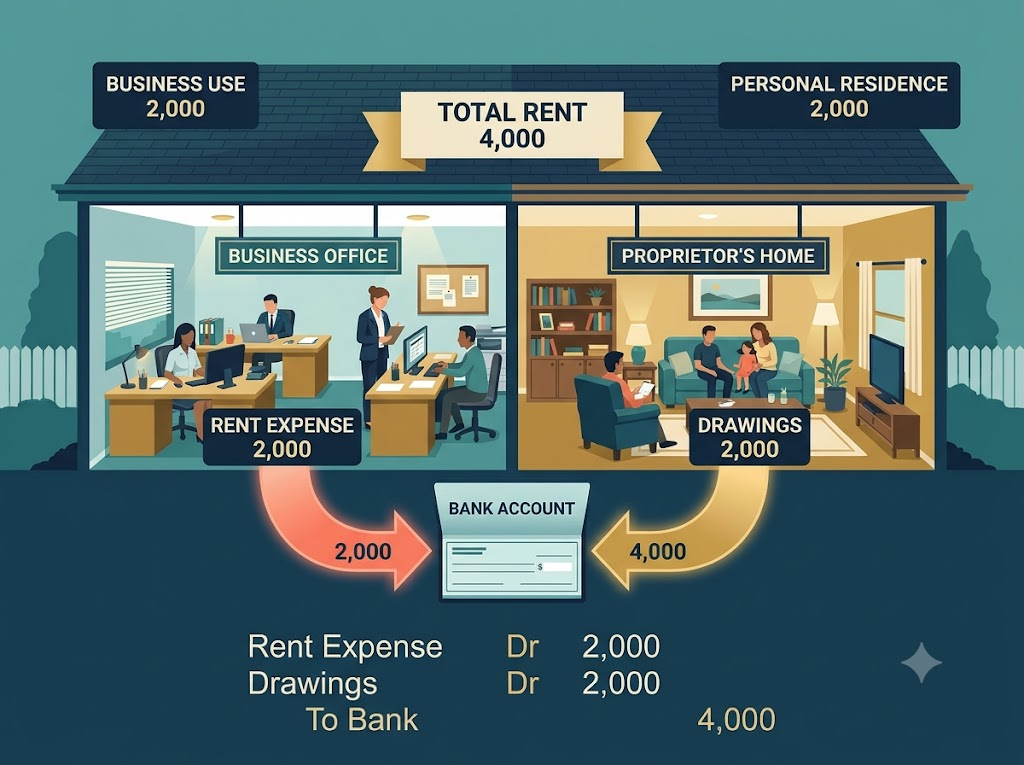
| July 31 | Rent A/c Dr. | 2,000 | — |
| Drawings A/c Dr. | 2,000 | — | |
| To Bank A/c | — | 4,000 | |
| (Being building rent paid by cheque, half for business and half for proprietor’s residence) | |||
| July 31 | Drawings A/c Dr. | 1,500 | — |
| To Cash A/c | — | 1,500 | |
| (Being cash withdrawn for private use) |
Three accounting traps explained
1. Discount received from the supplier
The business owes ₹12,000 but pays only ₹11,900. The supplier forgives the remaining ₹100.
\[ ₹11,900+₹100=₹12,000 \]
The supplier’s account is debited for ₹12,000, Cash is credited for ₹11,900, and Discount Received is credited for ₹100.
2. Discount allowed to Anuj & Co.
Anuj & Co. owes ₹10,000 but settles the debt by paying ₹9,750.
\[ ₹10,000-₹9,750=₹250 \]
The business receives ₹9,750 in the bank and allows a discount of ₹250. Therefore, Bank and Discount Allowed are debited, while Anuj & Co.’s account is credited.
3. Rent paid for business and residence
The total rent is ₹4,000, but only half the building is used for business.
- Business rent: ₹4,000 ÷ 2 = ₹2,000
- Personal residential portion: ₹4,000 ÷ 2 = ₹2,000
Rent A/c is debited for ₹2,000, Drawings A/c is debited for ₹2,000, and Bank A/c is credited for ₹4,000. The proprietor’s personal rent must not be treated as a business expense.
The exam-ready takeaway
Discount Received is credited; Discount Allowed is debited. When an expense covers both business and personal use, only the business portion is charged as an expense, while the personal portion is treated as drawings.
Memory line: A supplier’s discount benefits the business; a customer’s discount costs the business; personal spending belongs to drawings.