

Introduction
When a business requires large amounts of capital, professional management, and long-term continuity, a joint stock company can be a suitable form of organisation. It allows many people to invest in a business by purchasing shares while the company operates as a separate legal entity.
Meaning of Joint Stock Company
A Joint Stock Company is a company incorporated under law, with a separate legal identity and capital divided into shares. The people who own its shares are called shareholders.
In India, companies are principally governed by the Companies Act, 2013.
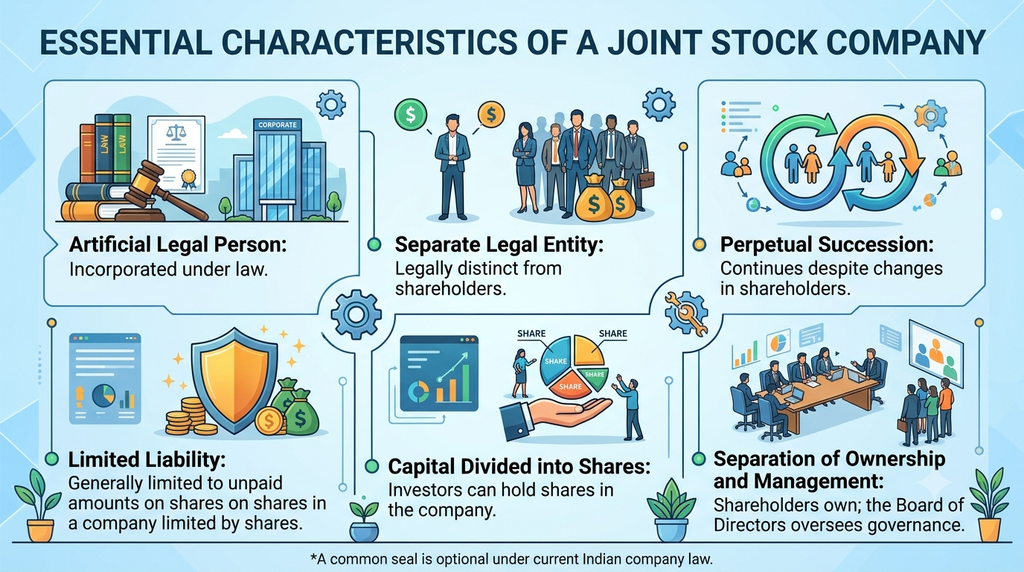
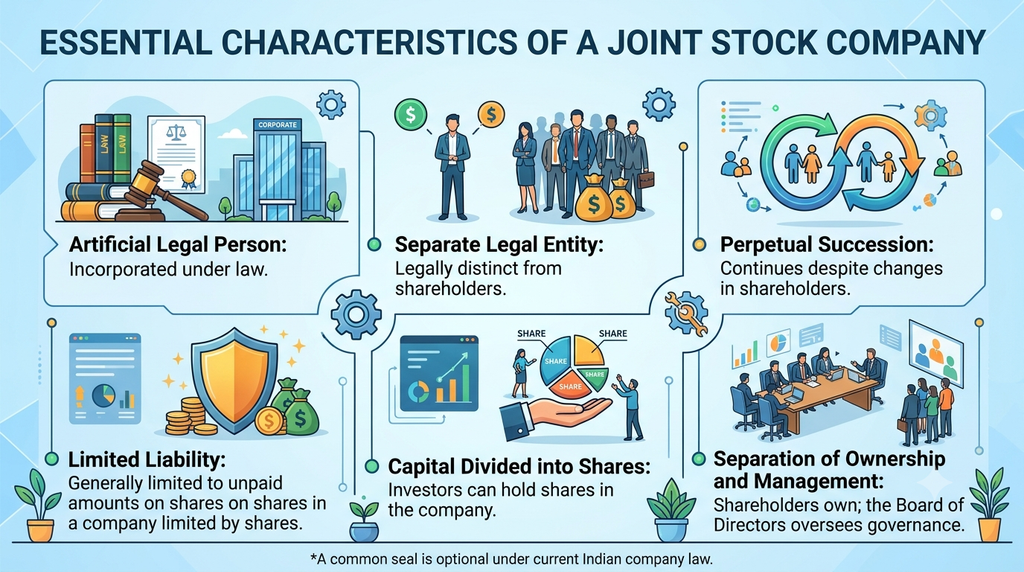
Essential Characteristics of a Joint Stock Company
1. Artificial Legal Person
A company is created through incorporation under law. It can own property, enter contracts, employ workers, and take legal action in its own name.
2. Separate Legal Entity
The company has a legal identity distinct from its shareholders. Company property and liabilities are generally separate from the personal property and liabilities of shareholders.
3. Perpetual Succession
The company can continue operating despite the death, retirement, or transfer of shares by individual shareholders.
4. Limited Liability
In a company limited by shares, shareholders’ liability is generally limited to the amount unpaid on their shares. Personal assets are ordinarily protected from the company’s debts, subject to legal exceptions.
5. Capital Divided into Shares
The company’s capital is divided into shares, which may be held by one or many investors depending on the type of company.
6. Separation of Ownership and Management
Shareholders own the company through their shareholding, while the Board of Directors oversees its management and governance. Day-to-day activities may be handled by professional managers.
7. Common Seal
A common seal may be adopted by a company, but it is not compulsory under current Indian company law. A company can execute documents through other legally permitted methods.
Types of Joint Stock Companies
1. Private Limited Company
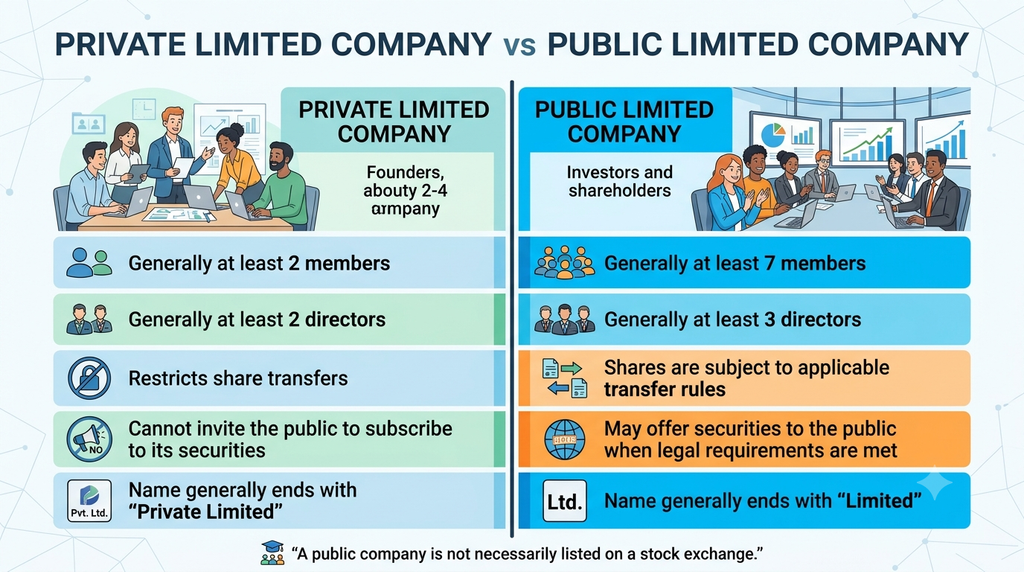
A private company restricts the transfer of its shares through its articles, limits the number of members as prescribed by law, and cannot invite the public to subscribe to its securities.
In India, a private company generally requires at least two members and two directors. Its name ends with “Private Limited” or “Pvt. Ltd.”
Example: ZapTech Software Pvt. Ltd. is established by four engineers who want to keep ownership within a limited group of founders and investors.
2. Public Limited Company
A public company is subject to the legal requirements applicable to public companies. It generally requires at least seven members and at least three directors. There is no statutory maximum number of members comparable to the private-company limit.
A public company may offer securities to the public when it meets the applicable legal and regulatory requirements. However, not every public company is listed on a stock exchange.
Its name generally ends with “Limited” or “Ltd.”
Example: A growing company may raise funds from a large number of investors by offering shares to the public, subject to the applicable requirements.
Merits of a Joint Stock Company
- Large Capital Resources: Funds can be raised from multiple investors.
- Limited Liability: Shareholders generally risk only the amount unpaid on their shares.
- Continuity: The company’s existence does not depend on the continued participation of any one shareholder.
- Professional Management: Directors and managers can bring specialised knowledge and experience.
- Growth Opportunities: A company may be better positioned to finance large projects and expand its operations.
Limitations of a Joint Stock Company
- Complex Formation: Incorporation involves legal formalities and documentation.
- Compliance Requirements: Companies must follow applicable filing, reporting, and governance rules.
- Higher Costs: Establishment and ongoing compliance may be expensive.
- Separation of Ownership and Control: Shareholders may have limited involvement in everyday decisions.
- Slower Decisions: Formal approval procedures can delay certain business actions.
Practical Business Example
Tata Motors Limited operates as a separate legal entity. If an investor sells their shares, the company continues its business operations. If the company undertakes a major project, its contracts and liabilities generally belong to the company rather than to individual shareholders.
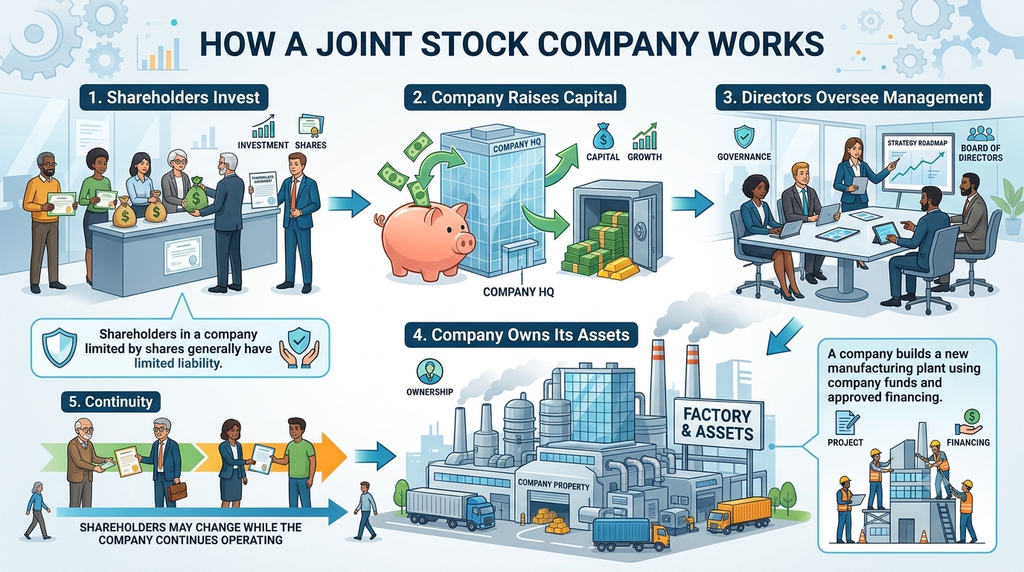
This illustrates separate legal identity, continuity, and the distinction between ownership and management.
Conclusion
A joint stock company is suitable for businesses that require substantial capital, long-term continuity, and structured management. Although it involves more formalities and compliance obligations, it can support large-scale operations and investment by many shareholders.