

Introduction
Industry is an important part of business and economic development. It helps produce goods, process raw materials, and provide useful products to people. Industries also create employment opportunities, support trade, and contribute to the growth of a country’s economy.
Meaning of Industry
Industry refers to economic activities concerned with the production of goods, processing of raw materials, extraction of natural resources, or development of useful products.
Industries convert raw materials into finished goods or make natural resources available for use by people and other businesses.
Examples:
- A cotton textile industry converts cotton into cloth.
- A sugar industry processes sugarcane to produce sugar.
- A mining industry extracts coal and iron ore from the earth.
Different Types of Industries
Industries are commonly classified into three main types:
- Primary Industry
- Secondary Industry
- Tertiary Industry
1. Primary Industry
Primary industries are concerned with extracting natural resources or producing goods directly from nature. They provide raw materials for other industries.
Primary industries are divided into two main categories.
A. Extractive Industry
Extractive industries obtain natural resources from the earth, water, or forests.
Examples:
- Mining coal and iron ore.
- Fishing in rivers and seas.
- Extracting petroleum and natural gas.
- Collecting timber from forests under permitted and sustainable practices.
B. Genetic Industry
Genetic industries involve breeding and raising plants and animals for further use or production.

Examples:
- Agriculture and crop cultivation.
- Dairy farming.
- Poultry farming.
- Fish farming.
- Plant nurseries.
Importance of Primary Industry
- Supplies raw materials to other industries.
- Provides food and other necessities.
- Creates employment in rural and resource-producing areas.
- Supports the development of manufacturing industries.
2. Secondary Industry
Secondary industries use raw materials to manufacture finished goods or convert materials into more useful products. They also include construction activities.
Secondary industries are divided into two main categories.
A. Manufacturing Industry
Manufacturing industries convert raw materials or semi-finished goods into finished products with the help of labour, machinery, and technology.
Examples:
- A cotton textile factory converts cotton into cloth.
- A sugar factory processes sugarcane into sugar.
- A steel plant converts iron ore and other inputs into steel.
- A furniture factory converts wood into tables and chairs.
- A car factory assembles vehicles using different components.
B. Construction Industry
Construction industries are involved in building infrastructure and structures needed by people and businesses.
Examples:
- Construction of houses and office buildings.
- Building roads and bridges.
- Construction of dams.
- Developing factories and warehouses.
Importance of Secondary Industry
- Converts raw materials into useful products.
- Adds value to natural resources.
- Creates jobs in factories and construction.
- Supports infrastructure development.
- Encourages technological progress and industrial growth.
3. Tertiary Industry
Tertiary industries provide services that support production, distribution, and consumption. They generally do not produce physical goods directly; instead, they help other industries and consumers carry out their activities.
Examples:
- Transport: Moving goods from factories to markets.
- Banking: Providing loans and payment services to businesses.
- Insurance: Protecting businesses against certain financial risks.
- Warehousing: Storing goods until they are needed.
- Communication: Providing telephone and internet services.
- Trade: Buying and selling goods through wholesalers and retailers.
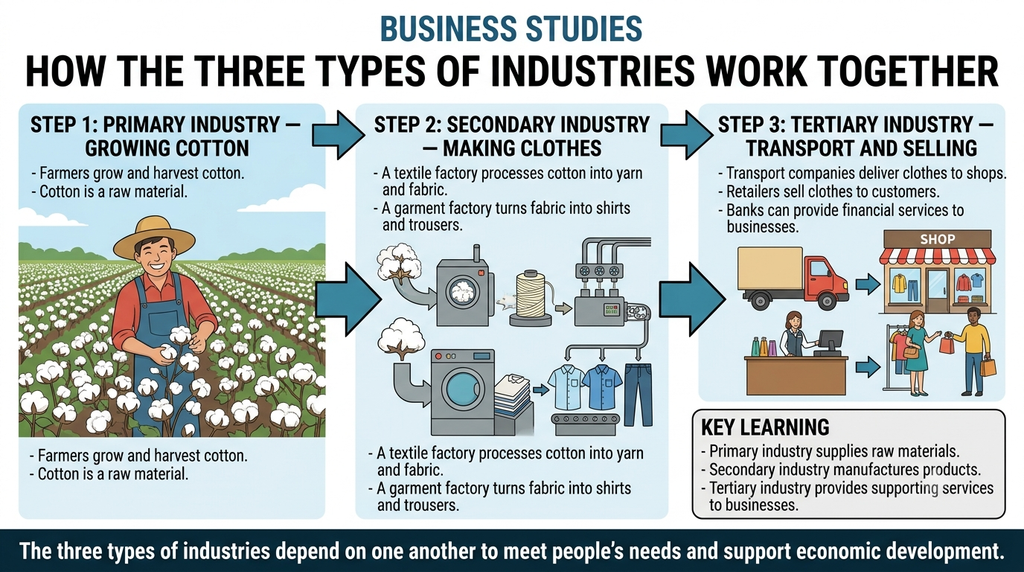
For example, a clothing factory manufactures shirts, a transport company delivers them to shops, and a retailer sells them to customers. The factory belongs to the secondary sector, while transport and retail services belong to the tertiary sector.
Importance of Tertiary Industry
- Helps move goods from producers to consumers.
- Supports banking, finance, and communication.
- Creates employment in service-related activities.
- Helps businesses operate efficiently.
- Connects producers with domestic and international markets.
Difference Between the Three Types of Industries
| Basis | Primary Industry | Secondary Industry | Tertiary Industry |
|---|---|---|---|
| Main activity | Obtaining resources or producing from nature | Manufacturing goods or constructing structures | Providing services |
| Main output | Raw materials and natural products | Manufactured goods and constructed structures | Services |
| Examples | Farming, fishing, mining | Textile factories, steel plants, construction | Banking, transport, insurance |
| Role | Supplies raw materials | Converts materials into useful products | Supports production and distribution |
How the Three Types of Industries Work Together
The three types of industries are closely connected. One industry often depends on the products or services of another.
Example: Cotton Textile Industry
- Primary industry: Farmers grow cotton.
- Secondary industry: A textile factory converts cotton into cloth and garments.
- Tertiary industry: Transport companies deliver the garments, banks provide financial services, and retailers sell them to customers.
This example shows how primary, secondary, and tertiary industries work together to satisfy human needs and support economic development.
Importance of Industry in the Economy
Industries play an important role in the development of a country.
- Employment: Industries create jobs for workers, technicians, managers, and service providers.
- Production: They provide goods and services required by people.
- Economic Growth: Industrial activities increase production and income.
- Trade: Industries supply products for domestic and international markets.
- Infrastructure: Industrial growth encourages the development of roads, power, transport, and communication.
- Innovation: Industries encourage the use of new technologies and improved production methods.
- Standard of Living: The availability of useful goods and services can improve people’s quality of life.
Conclusion
Industry is an essential part of business and economic development. Primary industries obtain natural resources, secondary industries convert raw materials into useful products, and tertiary industries provide services that support production and distribution. These three types depend on one another and work together to meet people’s needs, create employment, and contribute to the growth of the economy.