
Introduction
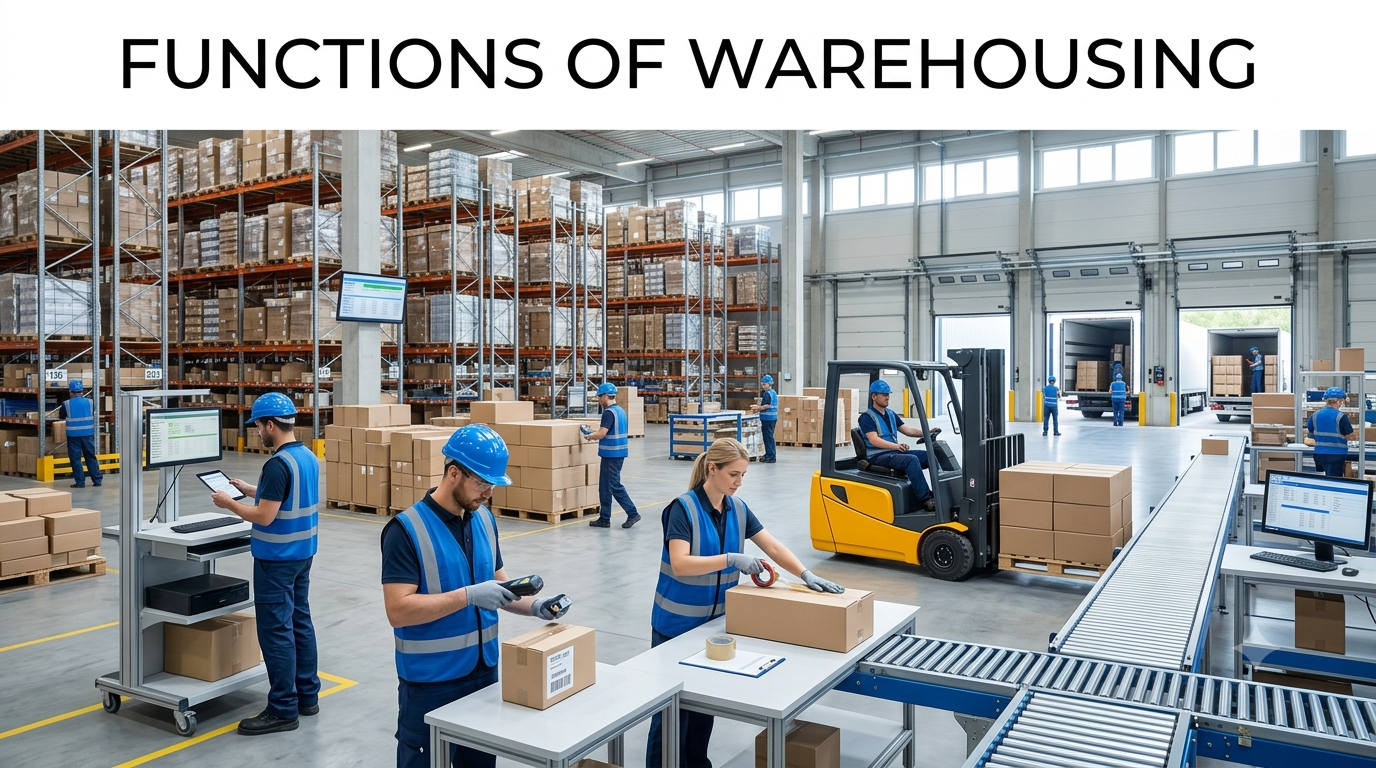
Warehousing is not limited to storing goods. Modern warehouses perform several important functions that help businesses manage their products and distribute them efficiently.
These functions support manufacturers, wholesalers, retailers, and customers.
Meaning of Warehousing
Warehousing means keeping goods safely in a warehouse until they are required for sale, distribution, or further use.
It also includes activities such as protecting goods, handling inventory, packing products, and preparing orders for delivery.
Main Functions of Warehousing
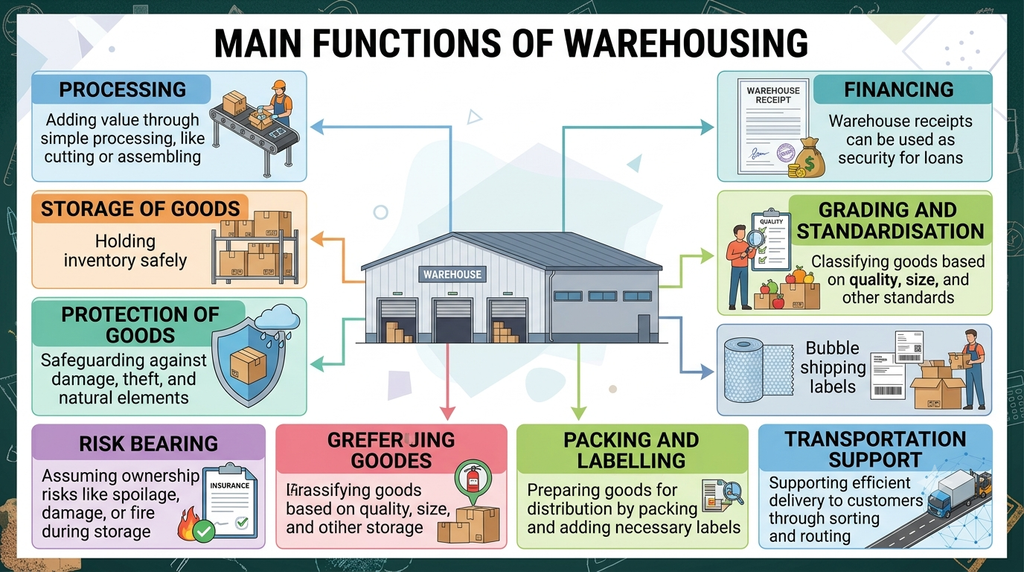
1. Storage of Goods
The primary function of warehousing is to store goods safely until they are needed.
Businesses can store raw materials, semi-finished goods, and finished products in warehouses.
Example: A furniture manufacturer stores wooden boards and finished furniture in a warehouse.
2. Protection of Goods
Warehouses protect goods from theft, fire, rain, dust, insects, and other possible risks.
Special storage facilities are also used for products that require particular temperature or humidity conditions.
Example: Medicines are stored under suitable conditions to maintain their quality.
3. Risk Bearing
Goods stored in warehouses may face risks such as fire, theft, spoilage,e and damage.
Warehouse operators may take precautions and arrange insurance to reduce the financial impact of such risks.
4. Financing
Warehouse receipts can act as proof that goods have been stored in a warehouse.
In certain cases, businesses can use these receipts as supporting documents to obtain loans from banks or financial institutions, subject to their rules.
Example: A farmer storing agricultural produce may use a warehouse receipt to support a loan application.
5. Grading and Standardisation
Some warehouses provide facilities for sorting and grading goods according to quality, size, weight,ght and other standards.
This helps buyers identify products more easily and supports fair business transactions.
Example: Agricultural products such as wheat and rice may be graded according to quality.
6. Packing and Labelling
Warehouses may provide packing and labelling services before goods are sent to customers or retailers.
Proper packing protects products during transportation, while labelling provides important product information.
7. Processing and Value-Added Services
Some warehouses perform simple activities such as cleaning, sorting, assembling, blending, and repacking.
These activities help prepare goods for sale or further distribution.
8. Transportation and Distribution Support
Warehouses help businesses collect goods from different suppliers and distribute them to various markets.
They may also act as distribution centres from which products are sent to retailers and customers.
9. Inventory Management
Modern warehouses use computer systems, barcode scanners, and inventory software to record the quantity and location of goods.
This helps businesses track stock and avoid unnecessary shortages or excess inventory.
10. Order Processing and Dispatch
Warehouses receive customer orders, select the required products, pack them,m and prepare them for delivery.
This function is especially important for online shopping businesses.

Practical Example
An online shopping company receives products from different manufacturers and stores them in a large warehouse.
When a customer places an order:
- The warehouse receives the order details.
- Workers locate the required product.
- The product is checked and packed.
- A delivery label is attached.
- The product is handed over to the delivery service.
This process shows how warehousing supports modern business operations.

Conclusion
Warehousing performs several important functions beyond storage. It protects goods, supports financing, grading, packing, inventory management, and distribution. These functions help businesses operate smoothly and deliver products to customers efficiently.