
1. Meaning of an Entrepreneur
An entrepreneur is a person who identifies a business opportunity, arranges the necessary resources, takes calculated risks and establishes an enterprise to earn profit.
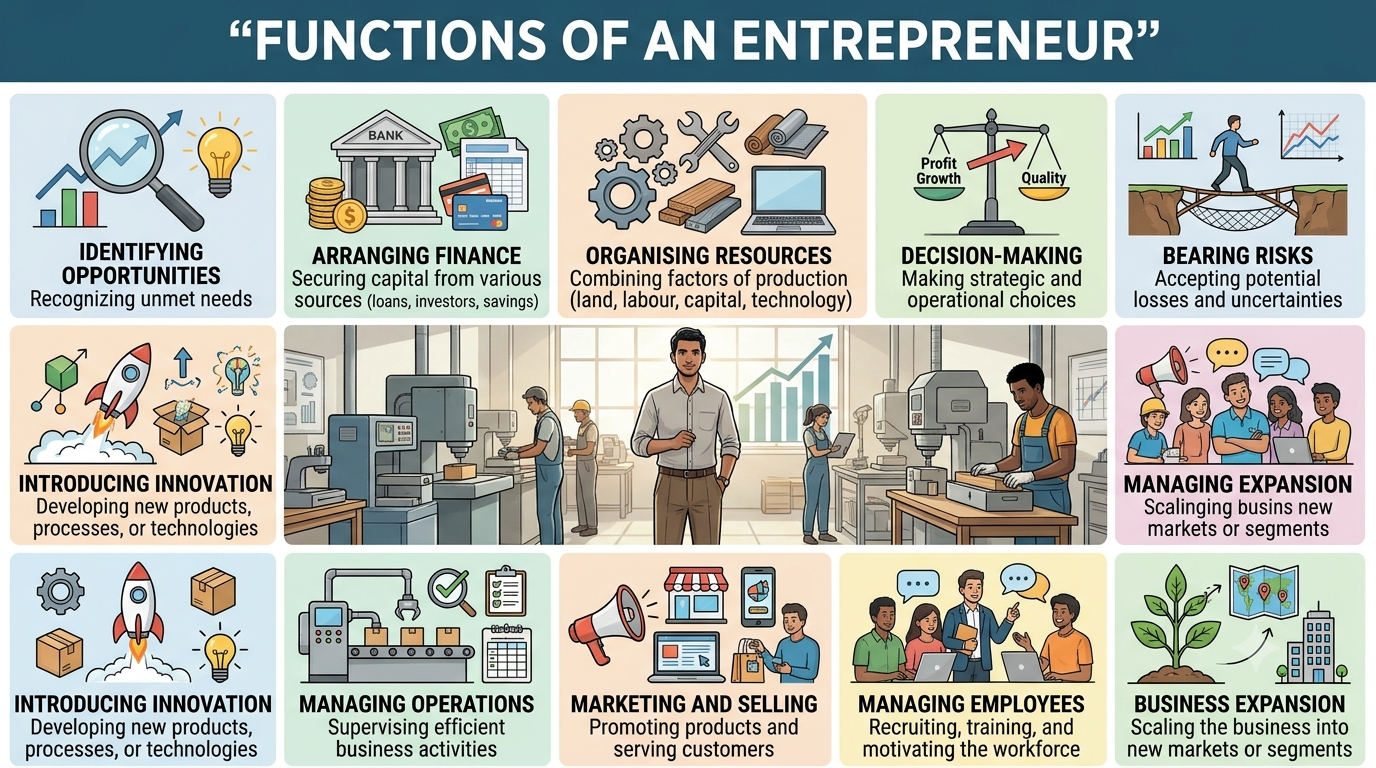
An entrepreneur performs several functions to ensure the smooth operation and growth of a business.
2. Functions of an Entrepreneur
The important functions of an entrepreneur are explained below:
1. Identifying Business Opportunities
An entrepreneur studies the market, understands customer needs and identifies opportunities for starting a new business.
Example: Identifying the demand for affordable and good-quality ball pens among students and office workers.
2. Arranging Finance
An entrepreneur estimates the capital required and arranges funds through personal savings, loans or other suitable sources.
3. Organising Resources
An entrepreneur brings together the necessary resources, such as land, labour, machinery, raw materials, technology and capital.
4. Taking Business Decisions
An entrepreneur makes important decisions relating to production, pricing, purchasing, marketing and investment.
5. Bearing Risks
An entrepreneur bears business risks arising from changes in demand, competition, production costs and market conditions.
6. Introducing Innovation
An entrepreneur introduces new products, improved designs, better production methods and innovative business practices.
7. Managing Business Operations
An entrepreneur supervises daily business activities and ensures that production, purchasing, sales and other operations are carried out properly.
8. Marketing and Selling
An entrepreneur identifies customers, promotes products, fixes prices and develops suitable distribution channels.
9. Managing Employees
An entrepreneur recruits, guides and motivates employees to improve business performance.
10. Expanding the Business
An entrepreneur studies growth opportunities and takes steps to increase production, enter new markets and improve business operations.

3. Starting a Small Enterprise to Produce Ball Pens
Suppose a person wants to start a small enterprise to manufacture ball pens. Several factors should be considered before starting the business.
1. Market Demand
The entrepreneur should study the demand for ball pens among students, teachers, office workers, shops and other customers.
They should identify the types of pens customers prefer, such as low-cost pens, premium pens, refillable pens or colourful pens.
2. Capital Requirement
The entrepreneur should estimate the total investment required for starting and operating the business.
Capital may be needed for:
- Purchasing machinery and equipment.
- Buying raw materials.
- Renting a workplace.
- Paying workers.
- Packaging and transportation.
- Advertising and promotion.
- Meeting daily operating expenses.
3. Location of the Enterprise
The entrepreneur should select a suitable location for the manufacturing unit.
The location should have access to raw materials, electricity, water, transportation facilities and labour.
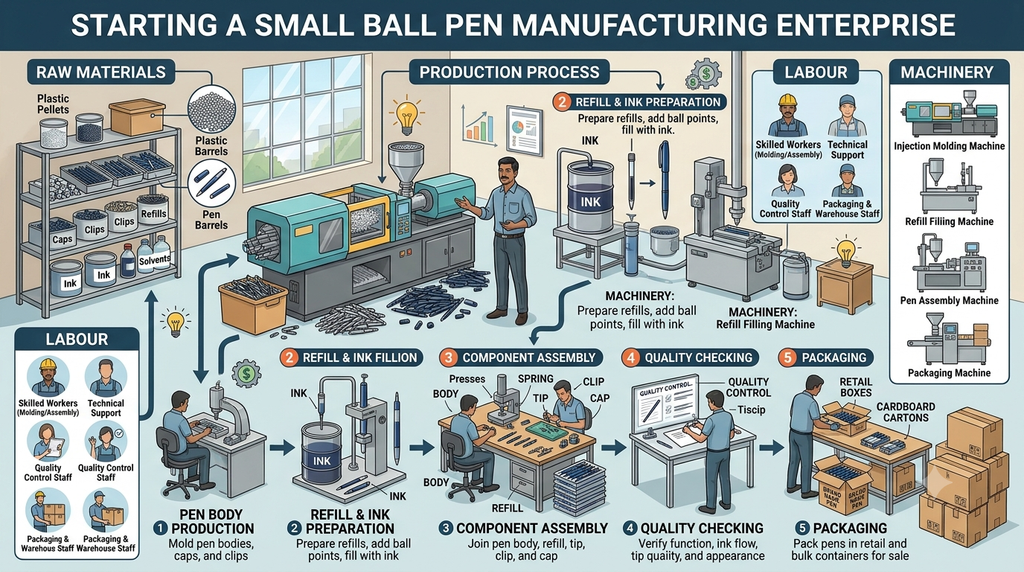
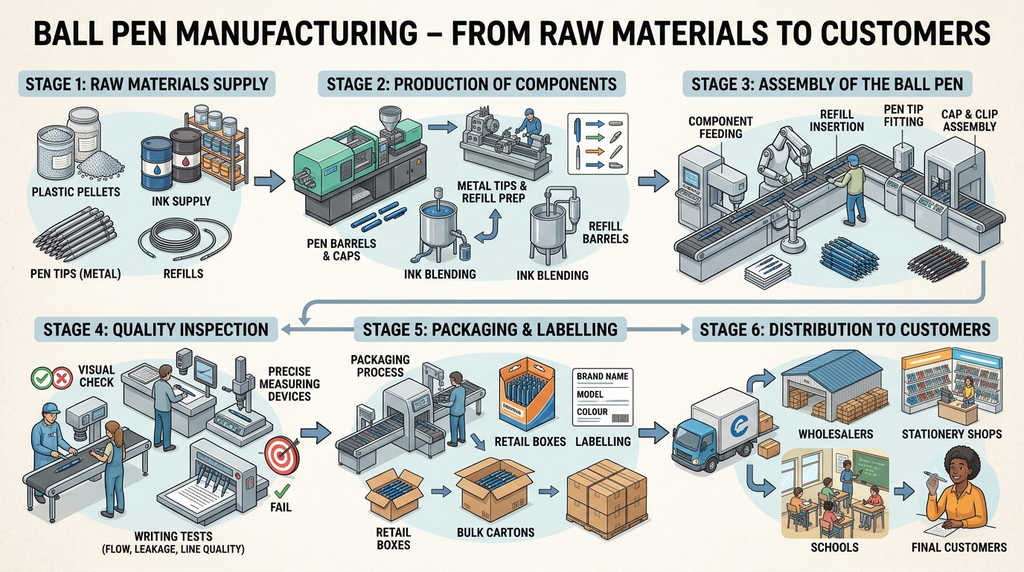
4. Availability of Raw Materials
The entrepreneur should identify reliable suppliers of the materials required to manufacture ball pens.
Important materials include:
- Plastic or other suitable materials for pen bodies.
- Refills and ink.
- Pen tips and metal components.
- Caps and other fittings.
- Packaging materials.
5. Machinery and Technology
The entrepreneur should identify suitable machinery and production technology according to the planned production capacity.
The equipment may include moulding machines, assembly equipment, ink-filling arrangements and quality-testing tools.
6. Availability of Skilled Labour
Workers may be required for operating machines, assembling pens, checking quality, packaging and handling materials.
The entrepreneur should ensure that suitable workers are available and properly trained.
7. Production Capacity
The entrepreneur should decide how many pens can be produced daily or monthly according to the expected demand, available capital and machinery.
Production should be planned to avoid unnecessary stock and wastage.
8. Quality of the Product
The pens should be reliable, comfortable to use and reasonably priced.
The entrepreneur should pay attention to:
- Smooth writing performance.
- Ink quality.
- Durability.
- Proper fitting of components.
- Leakage prevention.
- Attractive design.
9. Pricing and Cost Calculation
The entrepreneur should calculate the cost of producing each pen, including raw materials, labour, electricity, packaging and other expenses.
The selling price should be fixed after considering production costs, competitors’ prices and customer expectations.
10. Competition
The entrepreneur should study existing ball pen brands and local manufacturers.
They should identify ways to compete through reasonable prices, attractive designs, good quality and effective distribution.
11. Marketing and Distribution
The entrepreneur should plan how to promote and sell the pens.
Possible methods include:
- Supplying pens to stationery shops.
- Selling to schools and colleges.
- Supplying to offices and institutions.
- Distributing through wholesalers.
- Selling through online platforms.
- Providing bulk discounts.
12. Legal Requirements
The entrepreneur should identify applicable business registration, tax, labour, factory, environmental and product-related requirements before starting production.
4. Simple Business Planning Example
| Business Factor | Planning for Ball Pen Enterprise |
|---|---|
| Product | Affordable ball pens |
| Target Customers | Students, offices and retailers |
| Raw Materials | Plastic bodies, refills, ink and packaging |
| Machinery | Moulding and assembly equipment |
| Labour | Machine operators and packing workers |
| Quality | Smooth writing and leakage control |
| Pricing | Based on cost and market competition |
| Promotion | Retailers, schools and bulk customers |
| Distribution | Wholesalers and stationery shops |
Conclusion
An entrepreneur performs important functions such as identifying opportunities, arranging finance, organising resources, taking risks, making decisions and managing business operations. Before starting a ball pen manufacturing enterprise, the entrepreneur should carefully study market demand, capital, location, raw materials, machinery, labour, product quality, competition, pricing and marketing. Proper planning helps reduce business risks and improves the chances of success.
