
Introduction
Consumers may face problems such as defective goods, deficient services, overcharging and unfair trade practices. When these problems are not resolved, consumers can approach the consumer dispute redressal commissions.
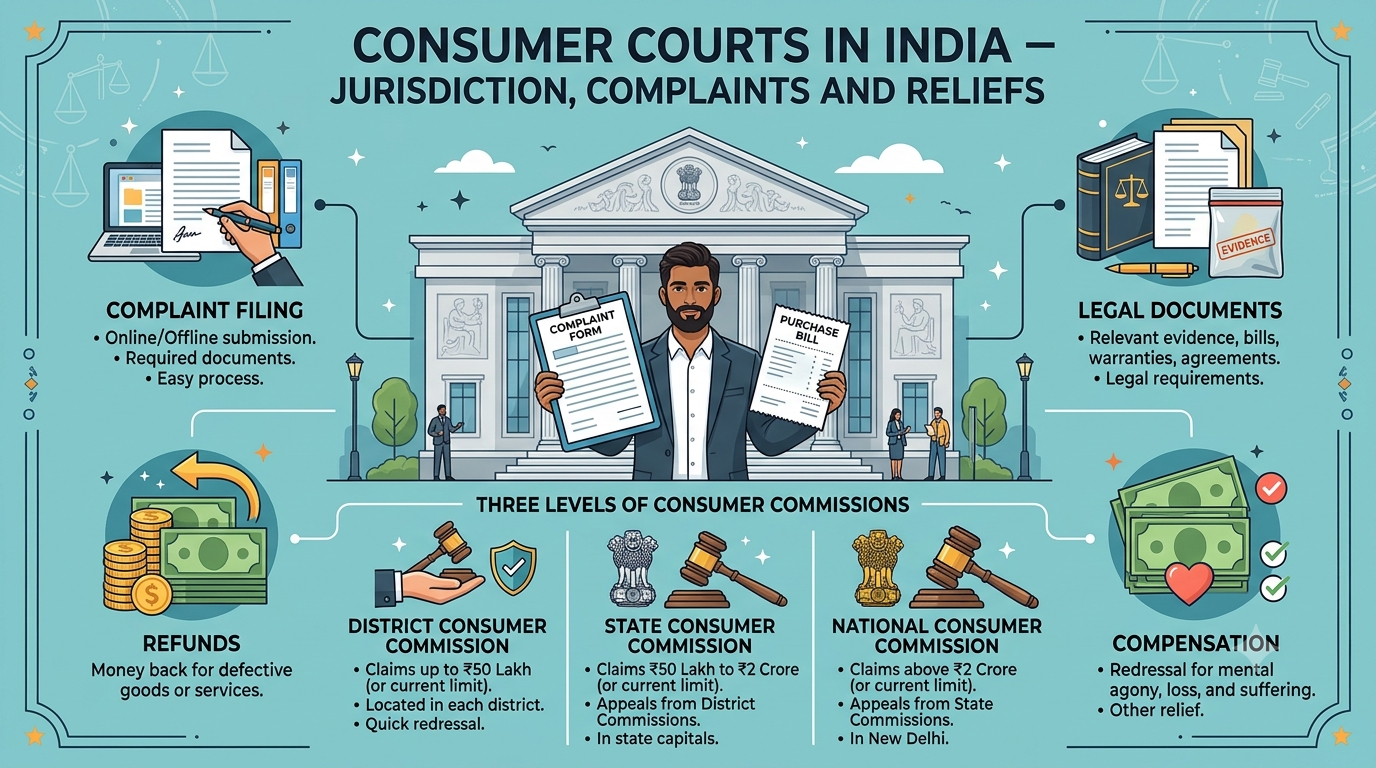
The Consumer Protection Act, 2019 provides a three-level system of consumer commissions to handle consumer disputes.
1. Three Levels of Consumer Commissions in India
The three levels are:
1. District Consumer Disputes Redressal Commission
The District Commission operates at the district level.
It deals with consumer complaints where the value of the goods or services paid as consideration does not exceed ₹50 lakh.
2. State Consumer Disputes Redressal Commission
The State Commission operates at the state level.
It deals with complaints where the value of the goods or services paid as consideration is more than ₹50 lakh but does not exceed ₹2 crore.
It also hears appeals against orders of District Commissions.

3. National Consumer Disputes Redressal Commission
The National Commission operates at the national level.
It deals with complaints where the value of the goods or services paid as consideration exceeds ₹2 crore.
It also hears appeals against orders of State Commissions, subject to the provisions of the Act.
2. Pecuniary Jurisdiction of Consumer Commissions
Pecuniary jurisdiction refers to the financial value of a consumer dispute that a particular consumer commission is authorised to hear.
Under the Consumer Protection (Jurisdiction of the District Commission, the State Commission and the National Commission) Rules, 2021, the limits are:
| Consumer Commission | Pecuniary Jurisdiction |
|---|---|
| District Commission | Up to ₹50 lakh |
| State Commission | More than ₹50 lakh and up to ₹2 crore |
| National Commission | More than ₹2 crore |
Important: These limits are based on the value of the goods or services paid as consideration, not the compensation amount claimed by the consumer.
3. Information Required While Filing a Consumer Complaint
A consumer complaint should contain the important details needed to understand the dispute.
The following information should generally be included:
1. Details of the Complainant
The complaint should mention the name, description and address of the consumer filing the complaint.
2. Details of the Opposite Party
It should contain the name, description and address of the seller, manufacturer, service provider or other party against whom the complaint is filed.
3. Facts of the Complaint
The complaint should clearly explain:
- What product was purchased or what service was used.
- When the purchase or service took place.
- What problem occurred.
- When and where the problem arose.
- How the consumer was affected.
4. Supporting Documents
The consumer should attach available documents supporting the complaint, such as:
- Purchase bill or cash memo.
- Warranty or guarantee card.
- Payment receipt.
- Relevant correspondence.
- Photographs or videos of defective goods, where available.
- Copies of earlier complaints and responses.
- Relevant service or repair records.

5. Relief Requested
The complaint should clearly state what remedy the consumer wants, such as repair, replacement, refund or compensation.
6. Signature and Required Fee
The complaint should be properly signed or authenticated and accompanied by the prescribed fee and required supporting documents.
4. Possible Reliefs Provided by Consumer Commissions
Under the Consumer Protection Act, 2019, a consumer commission may order one or more suitable remedies when a complaint is proved.
1. Removal of Defects
The commission may direct the opposite party to remove defects from the goods.
2. Replacement of Goods
It may order the seller or manufacturer to replace defective goods with new goods free from defects.
3. Refund of Price
The commission may direct the opposite party to return the amount paid by the consumer, along with interest where appropriate.
4. Removal of Deficiencies in Services
It may order the service provider to correct deficiencies or shortcomings in the service.
5. Payment of Compensation
The commission may direct the opposite party to pay compensation for loss or injury suffered by the consumer.
6. Discontinuation of Unfair Trade Practices
It may direct a business to stop unfair or restrictive trade practices and not repeat them.
7. Withdrawal of Hazardous Goods
The commission may order the withdrawal of hazardous goods from sale.
8. Stopping the Manufacture or Sale of Hazardous Products
It may direct businesses to stop manufacturing hazardous goods or offering hazardous services.
9. Corrective Advertisement
The commission may order the publication of a corrective advertisement to neutralise the effect of a misleading advertisement.

10. Payment of Costs
It may direct the opposite party to pay appropriate costs to the consumer.
Conclusion
Consumer commissions provide an important system for resolving consumer disputes. The District, State and National Commissions handle cases according to their financial jurisdiction. They can order repair, replacement, refund, compensation and other suitable remedies to protect consumer interests.