
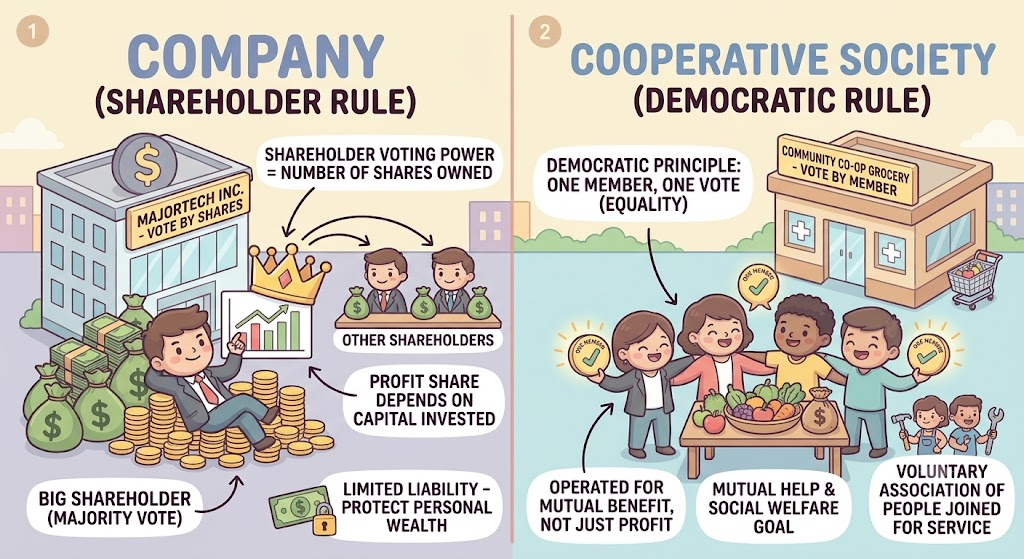
Imagine you and your friends want to set up an organization. In one setup, the rich kid who puts in 90% of the money gets to make 90% of the rules and take 90% of the profits. In the other setup, everyone gets an equal say, no matter how much money they put in, because the main goal is simply helping each other out.
This is the big difference between a Company and a Cooperative Society. It comes down to what matters more: money invested or people working together.
Team 1: The Money & Shareholder Engine (Company)
A Company is a business organization formed by investors called shareholders. Its primary objective is simple: make a financial profit! In a company, power depends on investment—the more shares you own, the more votes you get and the bigger your share of the profits.
- The Main Idea: Profit is king, and voting power belongs to the shares, not just the individual.
- Key Feature: Shareholders enjoy limited liability, which protects their personal wealth if the business goes into debt.
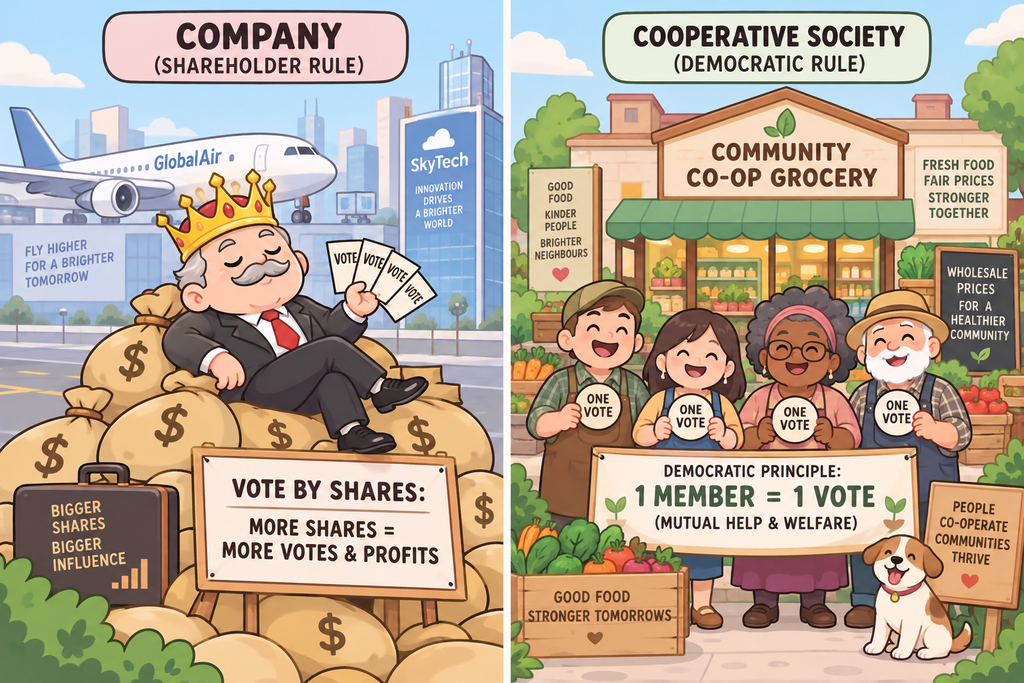
- The Best Examples: Think of a massive publicly traded airline or a global tech corporation where investors buy stock to earn profits and growth.
Team 2: The Democratic Helpers (Cooperative Society)
A Cooperative Society is a voluntary association of people joined together for mutual help and social welfare rather than purely chasing profit. It operates on a true democratic principle: “One member, one vote”. No matter how much capital someone contributes, every member gets equal decision-making power.
- The Main Idea: People and social welfare come first, operating on equal democratic votes.
- Key Feature: Members join voluntarily to get fair prices, direct services, or support for their community.
- The Best Example: Think of a local consumer cooperative store run by neighbors to buy fresh groceries in bulk at wholesale prices, sharing the savings and benefits equally among all members.
A Quick Comparison!
Both forms of organization play massive roles in the economy! Companies drive major technology and global transportation, while cooperatives keep community services fair, affordable, and member-focused.
| Style | Who holds the voting power? | What is the main objective? | Real-World Example |
| Company | Based on Shares Owned (More shares = More votes) | Earn a FINANCIAL PROFIT | Publicly traded airlines or tech corporations. |
| Cooperative Society | 1 Member = 1 Vote (Equal Democratic Rule) | MUTUAL HELP & Social Welfare | Local consumer co-op grocery stores. |