
Introduction
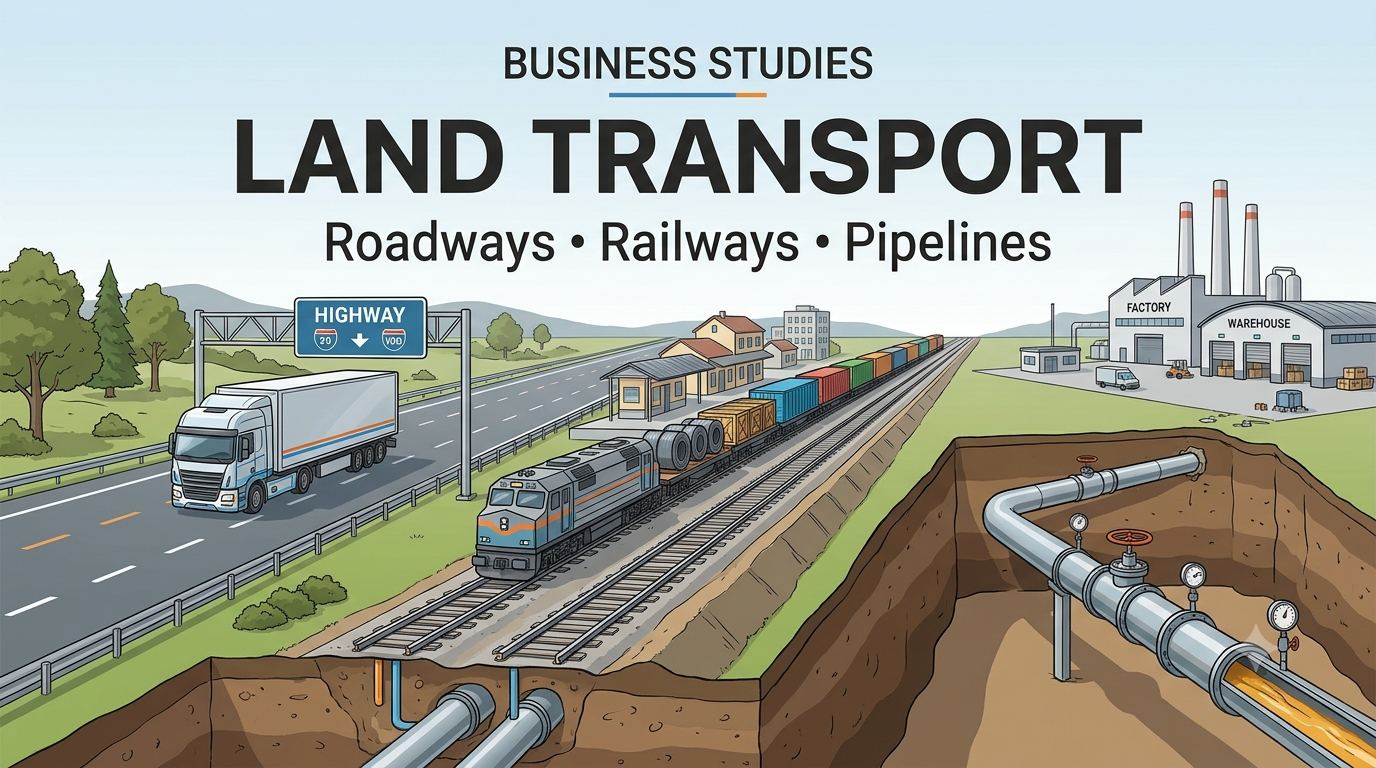
Land transport is the movement of goods and passengers over land. It plays a major role in domestic trade by connecting farms, factories, warehouses, railway stations, ports, shops, and customers.
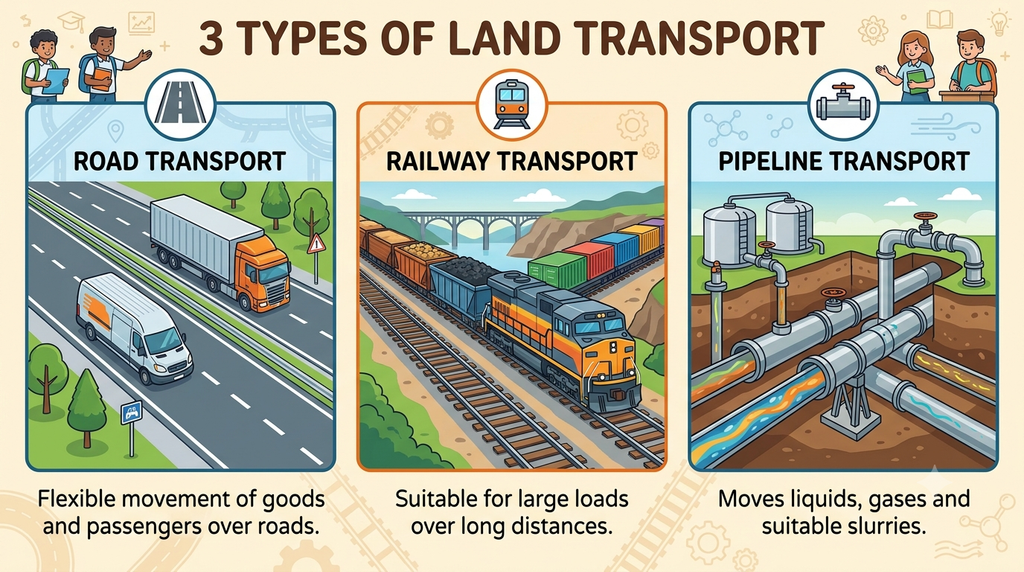
The three main forms of land transport are road transport, railway transport, and pipeline transport.
1. Road Transport
Road transport uses roads and vehicles to move people and goods.
Examples include handcarts, bicycles, auto-rickshaws, motorcycles, delivery vans, buses, and heavy trucks.
Road transport is particularly useful for short-distance deliveries and reaching locations that may not have railway stations or ports.
2. Railway Transport
Railway transport uses trains operating on fixed railway tracks.
It is suitable for moving large quantities of goods over long distances. Common examples include coal, iron ore, cement, steel, and food grains.
A steel manufacturer may use freight trains to transport iron ore and coal from mines to its production facilities.
3. Pipeline Transport
Pipeline transport uses specially designed pipes to carry liquids, gases, and slurries over long distances.
Products Suitable for Pipeline Transport
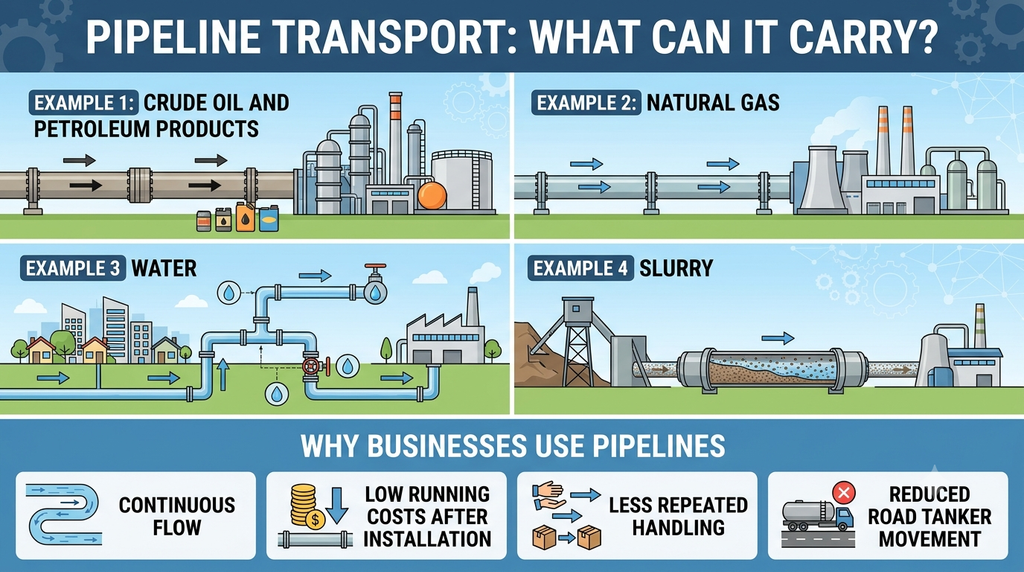
- Petroleum products: Crude oil, petrol, diesel, and kerosene.
- Gases: Natural gas, LPG, and CNG.
- Water: Drinking water and industrial water supplies.
- Slurries: Fine particles of coal or iron ore mixed with water.
Advantages of Pipeline Transport
- Continuous flow: Pipelines can operate continuously, providing a regular supply of materials.
- Low operating costs: Once installed, pipelines can move large quantities with relatively low running costs.
- Reduced handling: Materials travel through enclosed pipes, reducing the need for repeated loading and unloading.
- Reduced road congestion: Pipelines can reduce the need to transport certain materials using tanker trucks.
- Suitable for long distances: They can connect production centres, terminals, refineries, and industrial users.
Limitations of Pipeline Transport
- Initial construction requires substantial investment.
- Pipelines are suitable only for specific materials.
- Routes are relatively fixed and cannot easily be changed.
- Leakage or damage requires specialised inspection and maintenance.
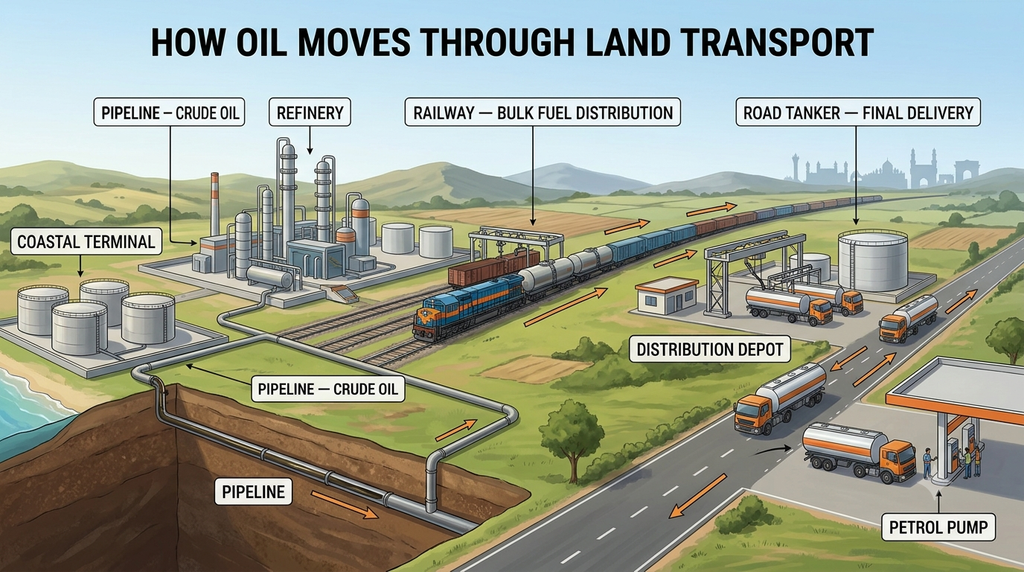
Business Example: An Oil and Gas Company
An oil and gas company may use pipelines to move crude oil to refineries, railways to distribute large quantities of fuel to regional depots, and road tankers to supply petrol pumps.
This illustrates how different forms of land transport can work together in a distribution network.
Conclusion
Roadways provide flexibility, railways handle large loads efficiently, and pipelines support the continuous movement of suitable materials. Businesses often combine these methods to improve the movement of goods from origin to destination.