
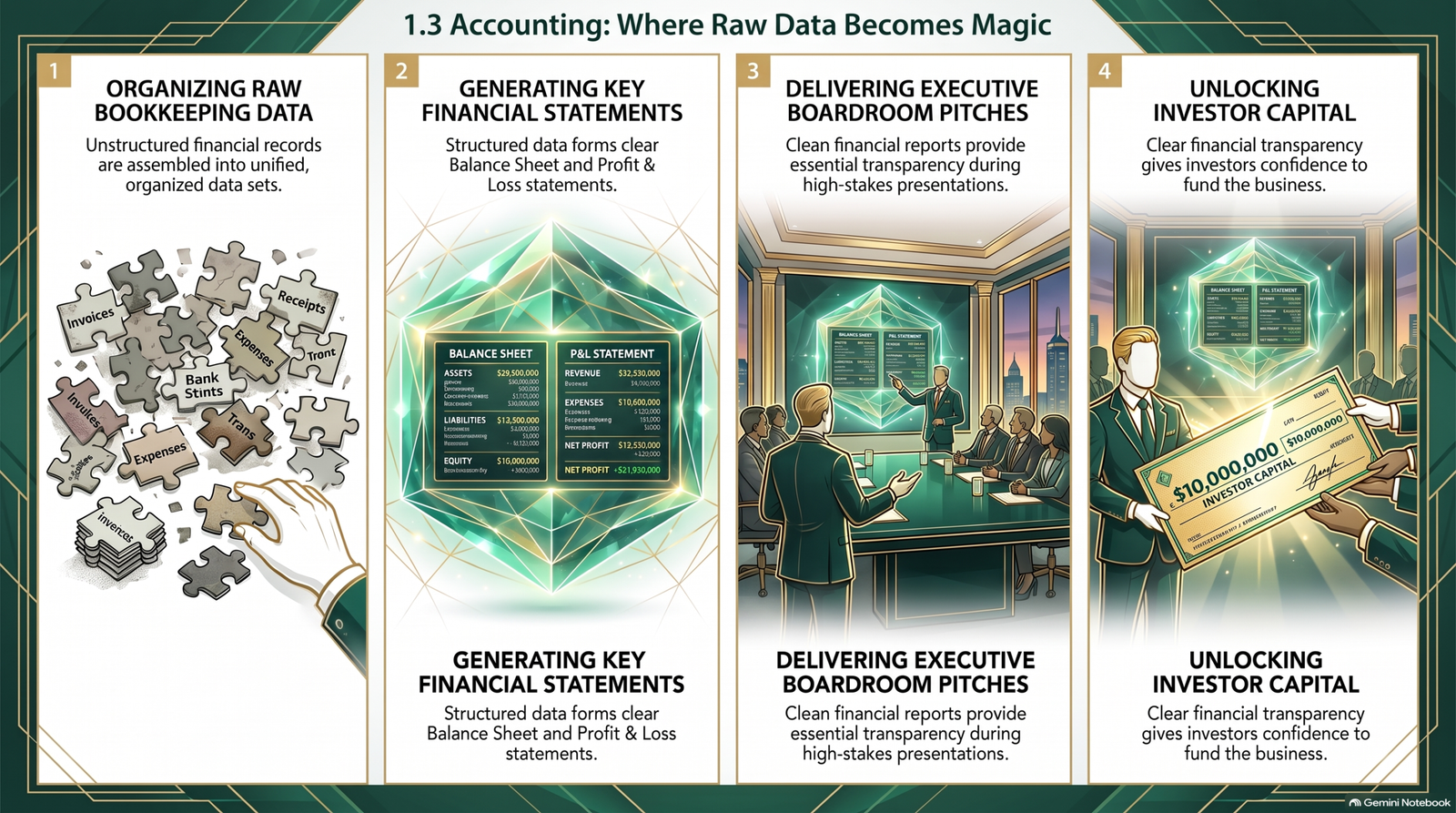
If book-keeping is collecting the puzzle pieces and storing them in a box, Accounting is sitting down at the velvet table, snapping the final pieces into place, and revealing a masterpiece that tells you if you’re a multi-millionaire or two seconds away from bankruptcy.
Let’s take everything we’ve built so far—transactions and book-keeping—and watch them transform into the high-powered, decision-making engine known as Accounting. Prepare for a dopamine rush, because this is where money finally starts talking back to you.
Part 1: What is Accounting, Anyway?
According to the American Accounting Association, accounting is the systematic process of identifying, measuring, recording, classifying, summarizing, analyzing, and communicating economic information to help people make smart, informed decisions.
Look at how much bigger that is than mere book-keeping! Accounting doesn’t just stop at writing things down. It takes those messy columns of numbers and answers the ultimate questions:
- Did we actually make a profit, or are we just burning cash?
- How strong is our financial muscle right now?
- Should we expand into a new city, or hold our ground?
The 5-Star Lifecycle of Accounting
Accounting operates like a brilliant kitchen line chef, taking raw ingredients and serving a 5-star meal through clear steps:
- Identifying: Spotting the actual financial transactions.
- Measuring & Recording: Quantifying them in money and writing them down (Book-keeping territory).
- Classifying & Summarizing: Grouping them into ledgers, trial balances, and final financial reports (Trading Account, Profit & Loss Account, and Balance Sheet).
- Analyzing & Interpreting: Figuring out what those reports actually mean for the future.
- Communicating: Handing those insights over to the people who need them (investors, banks, and the boss).
Part 2: Real-Life Scenario — The Shark Tank Moment
Imagine you built a booming online gaming lounge. You’ve been diligently keeping your books for a full year. You walk into a room filled with top-tier venture capitalists (investors) on Shark Tank.
One of the sharks looks at you and asks: “Should I hand you ₹50,00,000 of my money? Prove to me your business is worth it.”
If you just hand them a dusty notebook full of daily transaction entries, they’ll laugh you out of the room. That’s raw, unorganized noise!
Instead, you slide a clean, polished Accounting Statement across the table:
- The Income Statement: Shows you generated ₹40,00,000 in revenue with a net profit margin of 30%.
- The Balance Sheet: Shows you own ₹25,00,000 in high-end gaming rigs and have zero heavy debt.
The shark’s eyes widen. They smile. They hand you the check.
That is the sheer superpower of accounting. It translates the silent language of money into a compelling story that commands respect, trust, and massive funding.
Part 3: Who Cares About Accounting? (The VIP Audience)
Accounting doesn’t just sit in a dark room; it broadcasts vital signals to two distinct worlds:
- Internal Users (The Players Inside the Castle):
- Owners/Managers: Need to know if they are winning or losing so they can fix leaking costs and boost sales.
- Employees: Want to know if the company is stable enough to pay next month’s salaries and hand out bonuses.
- External Users (The Watchers Outside the Castle):
- Investors: Looking for a safe place to plant their money and grow it.
- Banks/Lenders: Checking your financial health before approving a multi-lakh loan.
- The Government (Tax Authorities): Waiting to see your net profit so they can calculate corporate taxes fairly.
Mind-Blowing Fast Facts to Flex Your Knowledge
- The Language of Commerce: Accounting is universally recognized as the “Language of Business.” No matter if you are in Tokyo, New York, or Mumbai, a balance sheet uses the same foundational grammar. If you speak accounting, you can do business anywhere on planet Earth.
- From Clay Tablets to Cloud Servers: The oldest accounting records ever found aren’t written on paper—they were carved onto 5,000-year-old clay tablets in ancient Mesopotamia (modern-day Iraq). Humans invented writing primarily because they needed to keep track of taxes and trade transactions!
- The Ultimate Dopamine Hit: There is nothing quite like closing an accounting year, matching your assets to your liabilities, and seeing a pristine net profit figure staring back at you. It is the ultimate confirmation that your hustle, brainpower, and strategy paid off.
