
1. Introduction
Every business uses resources such as money, buildings, workers, and equipment to produce goods and services.
The costs of using these resources can be divided into explicit costs and implicit costs.
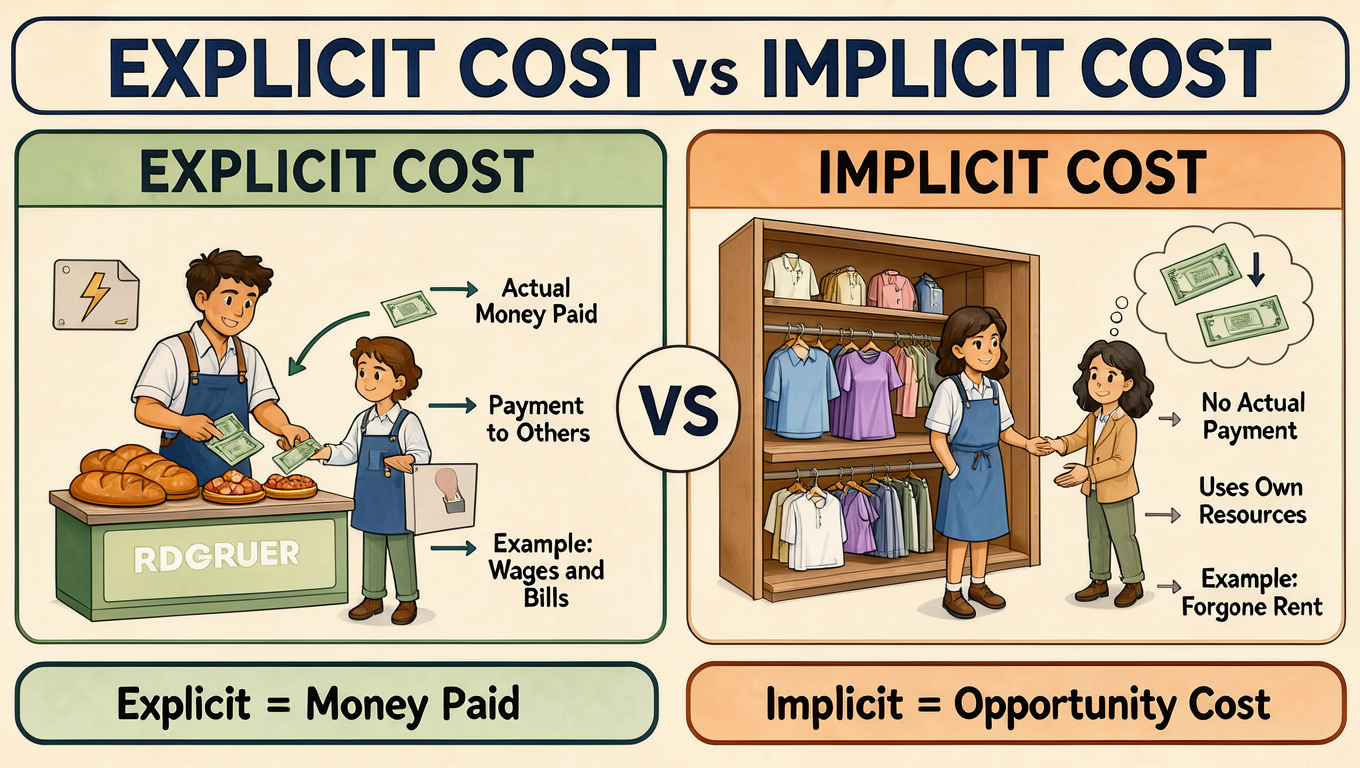
The main difference is that explicit costs involve actual payments, while implicit costs are the value of opportunities given up when using resources owned by the business owner.
2. Explicit Cost
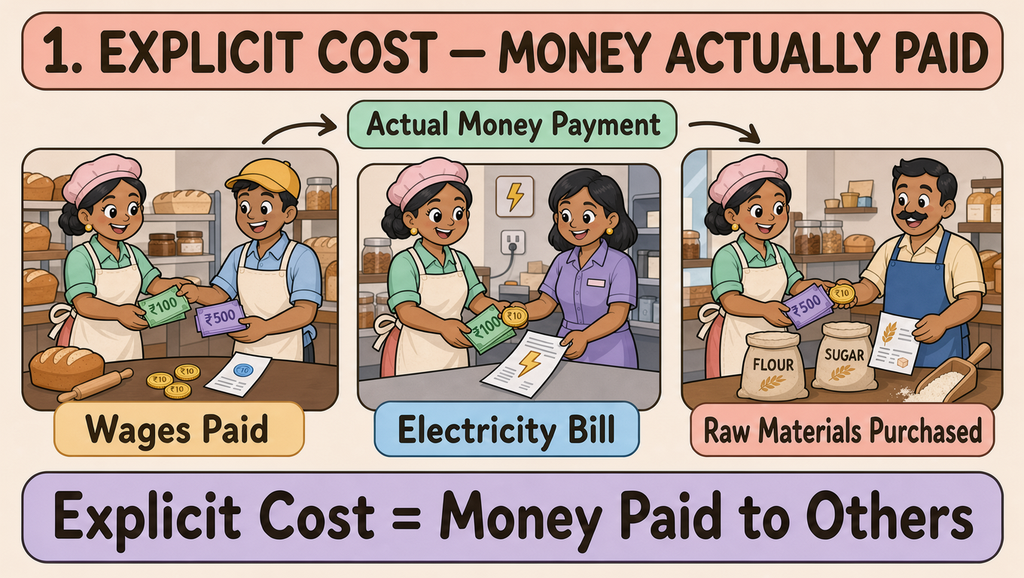
Explicit costs are the actual money payments a business makes to outsiders for goods and services.
These payments are recorded in the business’s account books.
Example: A bakery pays ₹15,000 in wages to hired workers and ₹5,000 for electricity. Both are explicit costs because the bakery actually pays money.
ation boxes, arrows, and large readable English text. Make it simple enough for Class 10 Economics students to understand at a glance. Landscape 16:9, correct spelling, no photorealism, no 3D effects, and no clutter.
3. Implicit Cost
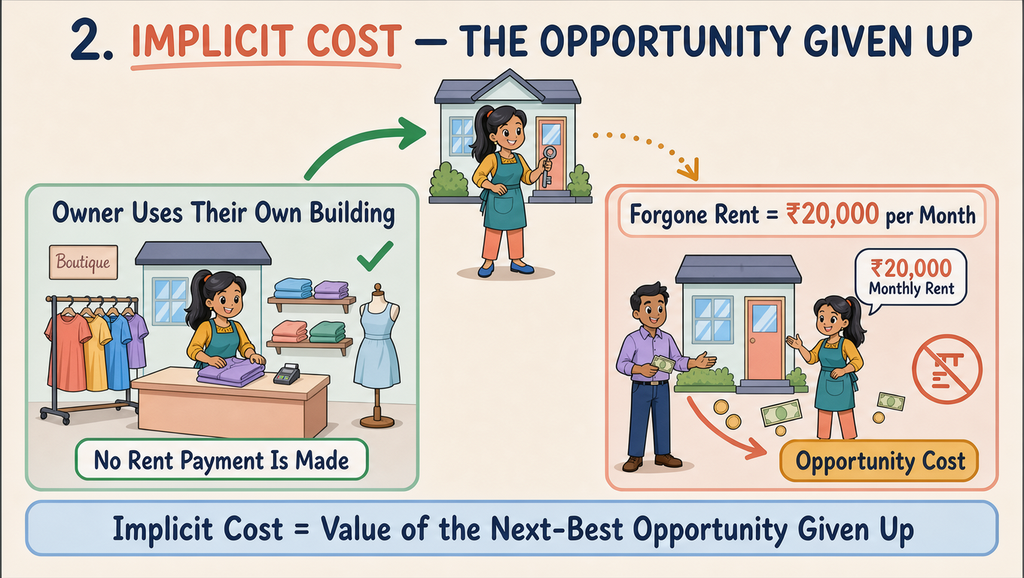
Implicit costs are the estimated value of using resources owned by the business owner instead of using them for their next-best alternative.
No actual money payment is made to another person for these resources. These costs represent opportunity costs.
Example: A person owns a building and uses it for a clothing shop. If the person could have earned ₹20,000 per month by renting the building to someone else, that forgone rent is an implicit cost.
4. Differences Between Explicit Cost and Implicit Cost
| Basis | Explicit Cost | Implicit Cost |
|---|---|---|
| Meaning | Actual monetary payment made to outsiders. | Estimated value of using self-owned resources. |
| Cash payment | Involves an actual payment. | Does not involve an actual payment to someone else. |
| Accounting | Generally recorded in account books. | Usually not recorded as an actual expense in financial accounts. |
| Nature | Direct monetary expense. | Opportunity cost of using owned resources. |
| Example | Wages, electricity bills, and raw material payments. | Rent given up by using one’s own building for business. |

5. Quick Revision
- Explicit cost: Money actually paid, such as wages or electricity bills.
- Implicit cost: The value of an opportunity given up, such as rent forgone by using your own building.
Easy way to remember: Explicit cost = actual payment; implicit cost = opportunity cost.