
Economics is a subject that helps us understand how people spend money, how businesses make decisions, why prices change, and how a country’s economy works.
But have you ever wondered why some economic questions are about one person or one business, while others are about an entire country?
For example:
- Why does the price of a chocolate bar increase?
- How does a shopkeeper decide the price of a product?
- Why do prices rise across the country?
- Why are some people unemployed?
- How does a government try to improve the country’s economy?
Although all these questions are related to economics, they do not all study the same thing.
To understand them more easily, economics is divided into two main branches:
- Microeconomics
- Macroeconomics
Let’s understand each branch with simple explanations and everyday examples.
1. What Are the Two Branches of Economics?
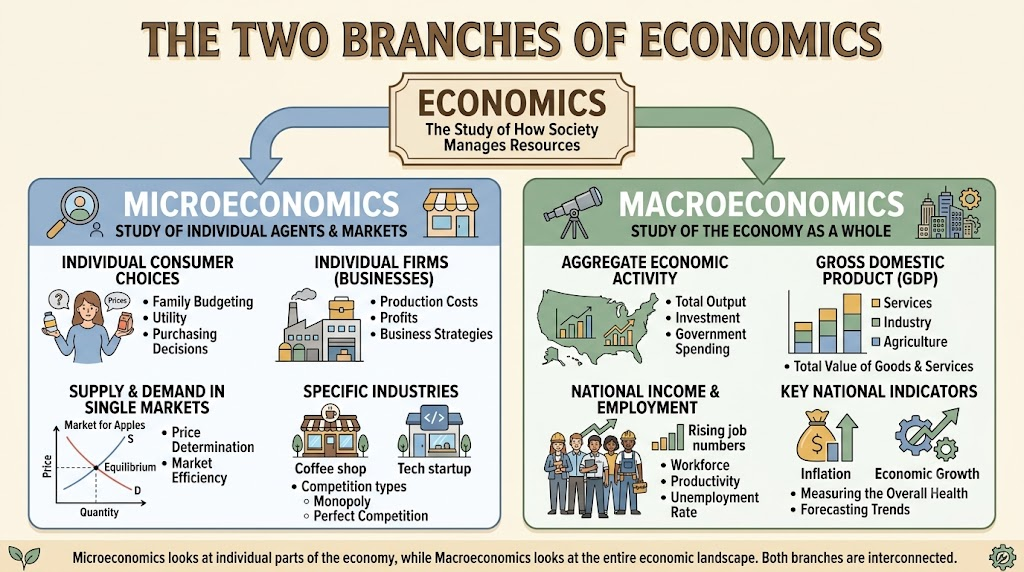
The two main branches of economics are microeconomics and macroeconomics.
Microeconomics studies the economic decisions of individuals, households, businesses, and individual markets.
Macroeconomics studies the economy as a whole, including national income, total spending, inflation, unemployment, and economic growth.
Think of it this way: microeconomics looks at a smaller part of the economy, while macroeconomics looks at the bigger picture.
LEFT PANEL — MICROECONOMICS
- Heading: “MICROECONOMICS”
- Meaning: “Studies individual parts of the economy”
- Show a customer buying groceries, a shopkeeper selling products, and a small business setting prices.
- Add these short labels: “Individual Buyers”, “Individual Sellers”, “Prices of Products”, “Production Decisions”.
RIGHT PANEL — MACROECONOMICS
- Heading: “MACROECONOMICS”
- Meaning: “Studies the economy as a whole”
- Show a country with factories, roads, offices, shops, and many people.
- Add these short labels: “National Income”, “Inflation”, “Unemployment”, “Economic Growth”.
At the bottom, add a memorable comparison in large, readable text:
“MICRO = SMALL PART”
“MACRO = WHOLE ECONOMY”
Use arrows, simple illustrations, clear visual separation, large readable fonts, and correct spelling. Make the information understandable within five seconds. Ensure all text is readable and properly aligned. No unnecessary paragraphs, decorative clutter, logos, or watermarks.
2. Microeconomics: Understanding the Smaller Parts of the Economy
The word “micro” means very small.
Therefore, microeconomics studies economic activities at an individual or smaller level. It examines the decisions made by individual buyers, sellers, producers, and businesses.
In simple words, microeconomics helps us understand how individual people and businesses make economic decisions.
A. Decisions Made by Buyers
Every day, people buy different goods and services to satisfy their needs and wants.
However, most people have a limited amount of money. They cannot buy everything they want, so they must decide what to purchase and how much to spend.
For example, imagine you have ₹500 to spend on snacks and stationery. You want chocolates, notebooks, pens, and a packet of biscuits.
You must decide how much money to spend on each item while staying within your budget.
Microeconomics studies these types of decisions made by buyers.
B. Decisions Made by Sellers
Sellers also make economic decisions.
A shopkeeper must decide how many products to sell, what price to charge, and how to manage costs to earn a profit.
For example, a fruit seller buys apples from a wholesaler and sells them to customers. The seller must consider the purchase cost, selling price, expected demand, and the quantity of apples to offer.
These decisions are part of microeconomics.
C. How Are Prices Determined?
Have you ever wondered why a packet of biscuits costs ₹20 while another packet costs ₹40?
Prices can depend on factors such as demand, supply, production costs, competition, and the type of product.
Microeconomics studies how prices are determined in individual markets and how buyers and sellers respond to price changes.
For example, if many customers want mangoes but only a small quantity is available, the price may increase. If the supply becomes plentiful, the price may fall, depending on other market conditions.
D. Decisions Made by Producers
Producers make goods and provide services. They must decide how to use resources such as workers, machinery, raw materials, land, and money.
Their aim may be to produce goods efficiently, control costs, and earn a profit.
For example, a bakery makes cakes using flour, sugar, milk, electricity, and workers’ time. The bakery owner must decide how much to produce and how to combine these resources without wasting them.
Microeconomics studies these production decisions.

SECTION 1: BUYERS
Illustration: A student choosing notebooks, pens, and snacks with a limited ₹500 budget.
Text: “BUYERS — Decide what to buy and how much to spend.”
SECTION 2: SELLERS
Illustration: A fruit seller arranging apples and bananas at a market stall.
Text: “SELLERS — Decide what quantity to sell and at what price.”
SECTION 3: PRICES
Illustration: A market stall with mangoes, customers, and a simple price tag.
Text: “PRICES — Demand and supply help influence market prices.”
SECTION 4: PRODUCERS
Illustration: A bakery owner using flour, an oven, and workers to make bread.
Text: “PRODUCERS — Decide how to use resources and control costs.”
At the bottom, include this summary:
“MICROECONOMICS = INDIVIDUAL BUYERS + SELLERS + MARKETS + PRODUCTION”
Make the illustrations instantly understandable. Use large, readable text, short sentences, clear headings, and simple visual symbols. Keep all labels inside their correct sections. No unnecessary paragraphs, logos, or watermarks.
3. Macroeconomics: Understanding the Economy as a Whole
The word “macro” means very large.
Unlike microeconomics, which studies individual economic decisions, macroeconomics studies the economy as a whole.
It examines the economic conditions of an entire country or society and the effects of economic decisions on the wider economy.
For example, a country has millions of people, thousands of businesses, government departments, farms, factories, and service providers. Macroeconomics helps us understand how these different parts contribute to the country’s overall economic performance.
Let’s explore its major areas of study.
A. National Income
National income helps us understand the income earned by a country’s people and the overall economic activity of the country.
Imagine that millions of people earn money through farming, teaching, manufacturing, banking, transport, and other activities.
When economists study income and production at the national level, they can better understand the size and performance of the economy.
The study of national income is an important part of macroeconomics.
B. Aggregate Consumption Expenditure
Consumption expenditure means the money people spend on goods and services.
For example, a family may spend money on food, clothing, transport, electricity, and education.
When we combine the consumption expenditure of all individuals or households in an economy, we obtain an aggregate measure of consumption expenditure.
Microeconomics can examine the spending decisions of one household. Macroeconomics examines consumption spending across the economy.
C. Inflation or a General Rise in Prices
Have you noticed that the prices of everyday items sometimes rise over time?
When the general price level of goods and services increases over a period, it is called inflation.
For example, if food, transport, clothing, and several other goods and services become more expensive across the economy, households may find that their money buys fewer things than before.
Inflation affects many people and businesses. Economists study its causes, effects, and possible ways of controlling it as part of macroeconomics.
D. Unemployment
Unemployment is another important subject in macroeconomics.
It concerns people who are available for work and seeking work but cannot find a job.
When unemployment affects many people across a country, it can influence household incomes, spending, production, and the wider economy.
Macroeconomics helps us understand unemployment and the economic conditions associated with it.
E. Economic Growth and Development
Economic growth generally refers to an increase in the production of goods and services in an economy over time.
Economic development is broader and includes improvements in living standards, education, healthcare, and other aspects of people’s lives.
For example, when a country expands its production, builds infrastructure, creates employment opportunities, and improves access to essential services, these developments can influence the country’s overall economic progress.
Macroeconomics studies economic growth and other changes affecting the economy as a whole.
F. Government Policies
Governments make decisions about taxation, public expenditure, welfare programmes, and public services.
For example, a government may collect taxes and spend money on roads, schools, hospitals, and other facilities that serve the public.
Such decisions can affect employment, spending, production, and the economy’s overall performance.
Macroeconomics helps us study the effects of these policies on the wider economy.
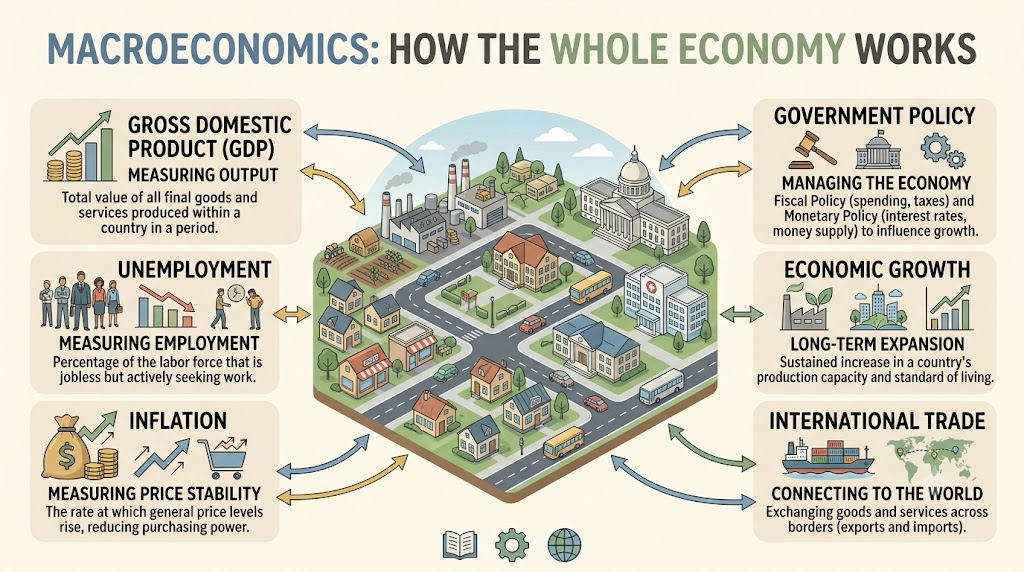
PANEL 1: NATIONAL INCOME
Illustration: People working in farms, offices, and factories.
Text: “Studies income earned across the country.”
PANEL 2: TOTAL CONSUMPTION
Illustration: Families buying food, clothes, and services.
Text: “Studies total household spending.”
PANEL 3: INFLATION
Illustration: A shopping basket beside price tags with upward arrows.
Text: “Studies general rises in prices.”
PANEL 4: UNEMPLOYMENT
Illustration: Job seekers looking at a job notice board.
Text: “Studies unemployment across the economy.”
PANEL 5: ECONOMIC GROWTH
Illustration: Factories, infrastructure, and expanding production.
Text: “Studies increases in economic output.”
PANEL 6: GOVERNMENT POLICIES
Illustration: A government building connected to a school, hospital, and road.
Text: “Studies how policies affect the economy.”
At the bottom, write:
“MACROECONOMICS = THE ECONOMY AS A WHOLE”
Make every heading and sentence clearly readable. Use simple illustrations, logical connections, short text, and generous spacing. The reader should understand the six concepts at a glance. Check spelling and avoid tiny text, unnecessary details, logos, or watermarks.
4. Microeconomics vs Macroeconomics: What Is the Difference?
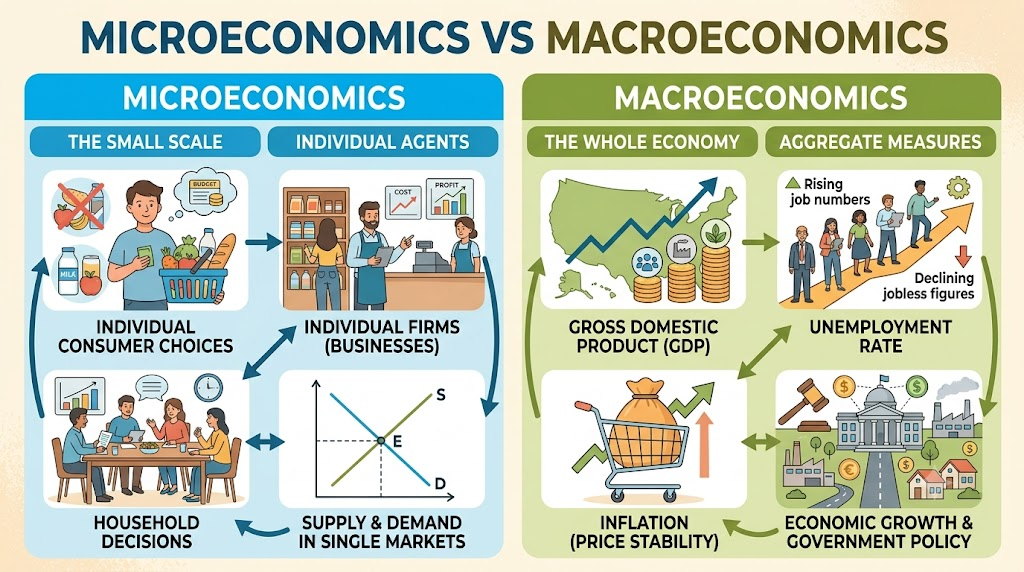
Both branches study economics, but they focus on different levels of economic activity.
Let’s compare them side by side.
| Basis | Microeconomics | Macroeconomics |
|---|---|---|
| Meaning | Studies smaller parts of the economy | Studies the economy as a whole |
| Main focus | Individuals, buyers, sellers, businesses, and individual markets | National income, total spending, inflation, unemployment, and economic growth |
| Level of study | Individual or market level | National or economy-wide level |
| Price example | Price of a particular product | General rise in prices across the economy |
| Income example | Income of an individual or business | National income |
| Spending example | Spending of one household | Aggregate consumption expenditure |
| Production example | Output and costs of an individual producer | Total production in the economy |
| Government example | Effects on a particular market or business | Effects of policies on the whole economy |
Products link