
Human beings have an endless list of wants, from basic hunger to the desire for a luxury car (as seen in Image 2). But these desires can’t be satisfied out of thin air. Instead, we satisfy our wants through consumption. This is just a fancy word for using goods (like food) and services (like a haircut) that are made for us.
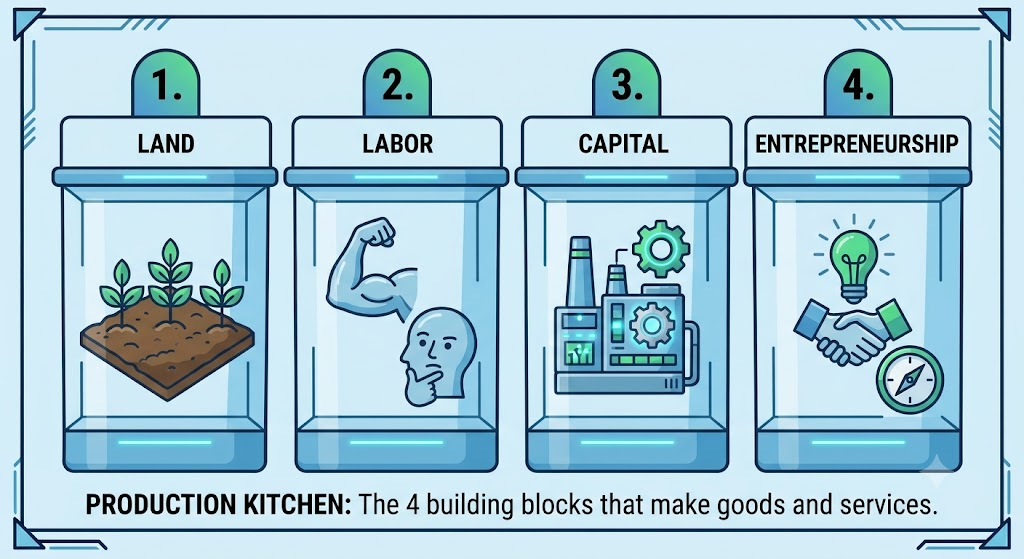
So, where do these goods and services come from? They are produced using fundamental ingredients called Economic Resources. There are four main building blocks of production:
- LAND: All natural resources (raw materials, water, space) from the earth.
- LABOR: The mental and physical effort put in by people.
- CAPITAL: The man-made tools, machinery, and technology used.
- ENTREPRENEURSHIP: The organization and idea that combines the first three resources to create a business and products.
Think of it like cooking: these four resources are the core ingredients of the economic kitchen.
Satisfying Wants: An Example in Action
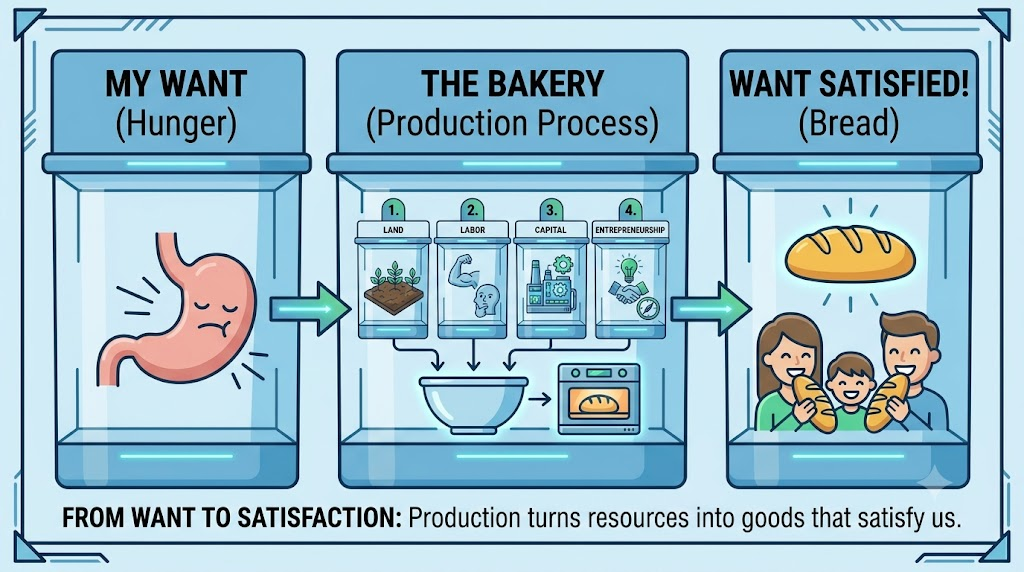
Let’s look at a common example to see exactly how these four resources combine to produce the thing that satisfies our wants. Imagine your want is hunger, and the item that satisfies it is a fresh loaf of bread.
How did that bread appear? A business organized the production like this:
- LAND: The baker uses basic ingredients from the land, like flour (which came from raw wheat grown in soil). This is the land resource.
- LABOR: Real people (bakers) use their knowledge and physical effort (labor) to mix, knead, and work with the ingredients.
- CAPITAL: The bakery uses important tools (capital), specifically a powerful oven to bake the bread and equipment to mix the dough. These are the tools that multiply labor.
- ENTREPRENEURSHIP: Finally, a business owner (the entrepreneur) brings all three of these resources together. They have the idea, organize the bakery, and take the risk to make the whole process function
Summary
The economy works by transforming raw materials (Land), using human effort (Labor) and tools (Capital), under organized direction (Entrepreneurship). These building blocks combine to produce the flow of goods and services that make our desires satisfied in the moment (as seen in Image 6). When we understand how this production kitchen functions, we can better manage our finite budgets (Image 3) to optimize our choices (Image 4).