Imagine a shop owner closing the accounts on 31 March. The sales have been recorded, the purchases have been entered, and the Trial Balance agrees. Surely the accounts are ready?
Not quite.
Some workers are still owed wages. An insurance payment covers the next accounting period. Unsold goods remain in the storeroom, and the shop’s furniture has lost value through use.
These are the final clues an accountant must investigate before preparing accurate financial statements.
What Is an Adjustment Entry?
An adjustment entry is an entry passed at the end of an accounting period to record necessary adjustments to income, expenses, assets and liabilities before preparing the financial statements.
Adjustments may be required for outstanding expenses, prepaid expenses, income earned but not received, closing stock, depreciation and other relevant items.
Think of adjustment entries as the accountant’s final inspection. They help ensure that income and expenses are recorded in the correct accounting period and that assets and liabilities are shown correctly.
Why Are Adjustment Entries Necessary?
Adjustment entries are necessary because the amounts already recorded in the books may not tell the complete story.
They help to:
- Record expenses incurred during the current period, even when payment is still pending.
- Remove the portion of an expense that belongs to a future period.
- Record income earned but not yet received, where applicable.
- Account for closing stock and depreciation.
- Calculate the correct profit or loss and present the financial position of the business more accurately.
For example, if a business owes ₹5,000 in wages at year-end, those wages must be included in the current period’s expenses. Otherwise, expenses would be understated and profit overstated.
Outstanding Expenses: The Unpaid Bills
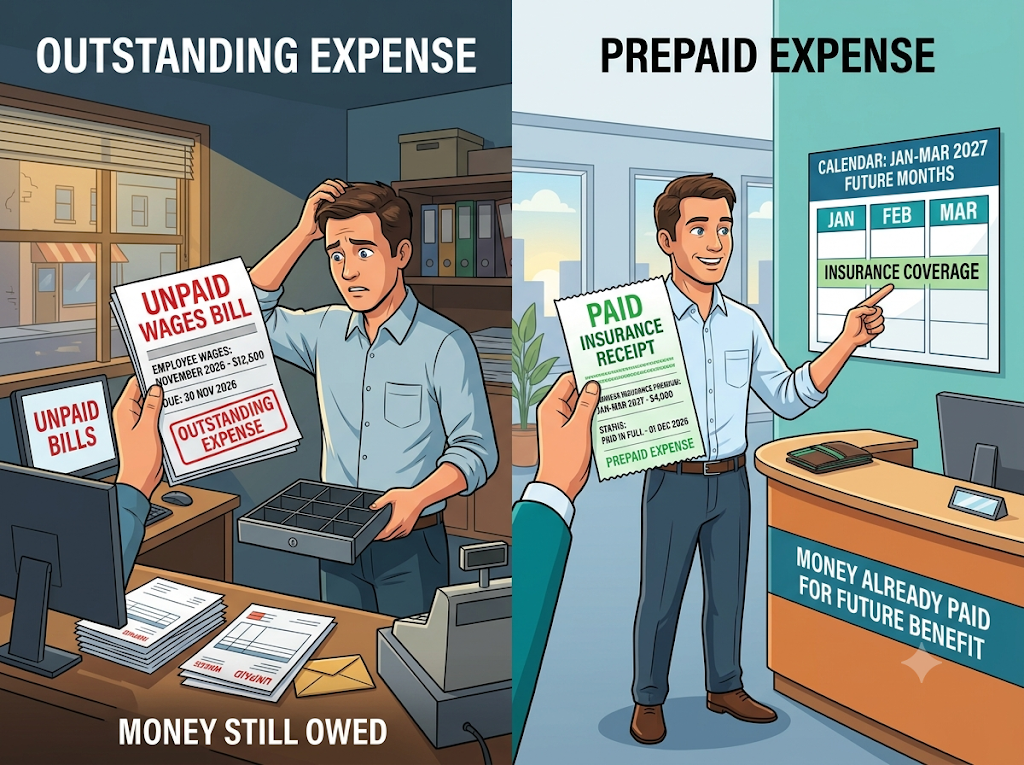
An outstanding expense is an expense incurred during the current accounting period but not yet paid.
Suppose a shop owes its workers ₹2,000 in wages on 31 March. The workers have already earned the money, even though payment will take place in April.
Treatment in financial statements:
- Add ₹2,000 to wages in the appropriate account.
- Show ₹2,000 as a liability in the Balance Sheet.
The expense belongs to the current period, and the unpaid amount is an obligation of the business.
Prepaid Expenses: Payment Made in Advance
A prepaid expense is an expense paid during the current period that relates partly to a future accounting period.
Suppose a business pays ₹1,200 for insurance, of which ₹300 relates to the next accounting period.
Treatment in financial statements:
- Deduct ₹300 from insurance expense in the Profit and Loss Account.
- Show ₹300 as an asset in the Balance Sheet.
Why an asset? The business has already paid for a benefit it has not yet fully used.
Remember the contrast: outstanding expenses are incurred but unpaid; prepaid expenses are paid but not yet fully used.
Closing Stock: Goods Still Waiting to Be Sold
Closing stock means the goods remaining unsold at the end of the accounting period.
Suppose a garment shop has unsold clothes costing ₹25,000 on 31 March. Those goods remain an asset of the business rather than goods already sold.
When closing stock is given as an adjustment outside the Trial Balance:
- Show it on the credit side of the Trading Account.
- Show it as a current asset in the Balance Sheet.
If closing stock is already included in the Trial Balance, its presentation depends on the information and instructions given in the question.
Depreciation: When Fixed Assets Lose Value
Depreciation is the reduction in the recorded value of a fixed asset over time due to use, passage of time or other relevant causes.
Suppose furniture costs ₹10,000 and depreciation is charged at 10% per annum.
Depreciation = ₹10,000 × 10 ÷ 100 = ₹1,000.
The treatment is:
- Show ₹1,000 as an expense in the Profit and Loss Account.
- Deduct ₹1,000 from the furniture’s cost when showing its value in the Balance Sheet.
The furniture will therefore be shown at ₹9,000, assuming no other changes to its recorded value.
The Final Accounting Clue
Each adjustment has a specific purpose. Outstanding expenses increase expenses and liabilities. Prepaid expenses reduce current expenses and create assets. Closing stock appears in the Trading Account and Balance Sheet when given as an adjustment. Depreciation reduces profit and the recorded value of the asset.
Exam-ready answer: Adjustment entries are passed at the end of an accounting period to record necessary adjustments and help ensure that financial statements show the correct profit or loss and financial position of the business.