
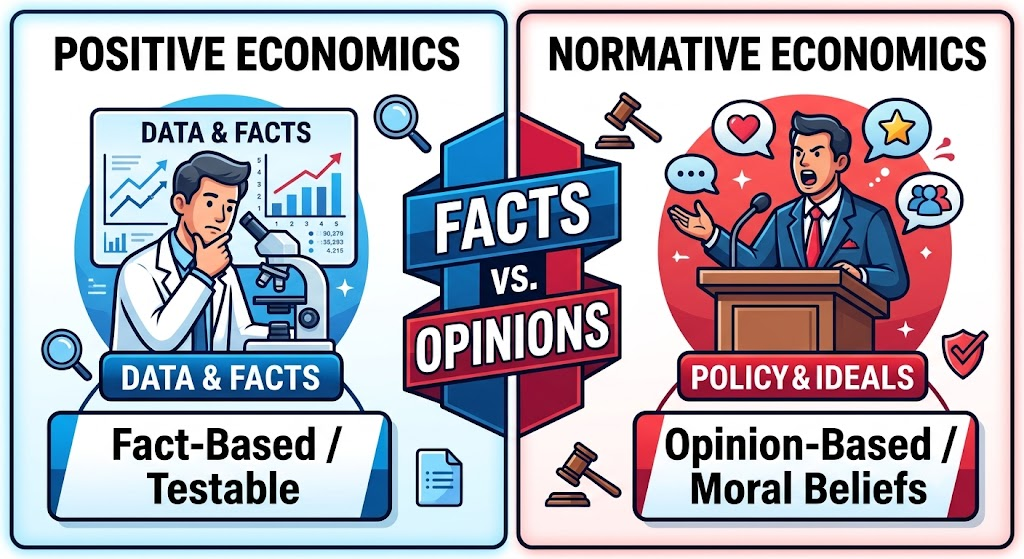
When studying economics, statements are usually split into two main categories: Positive Economics and Normative Economics.
The easiest way to tell them apart is simple:
- Positive Economics deals with facts (what is).
- Normative Economics deals with opinions (what should be).
1. What is Positive Economics? (The Facts)
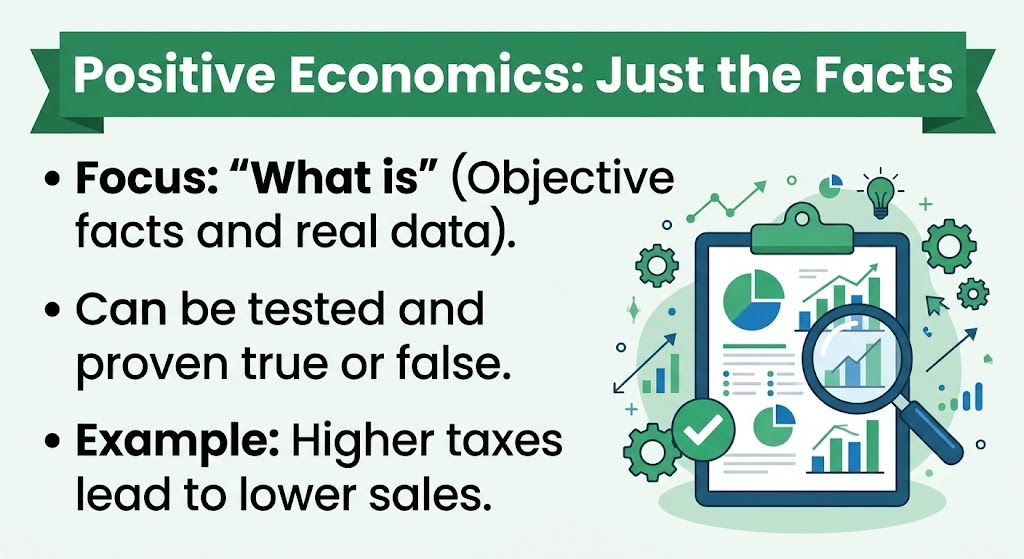
Positive Economics focuses on objective facts and data.
- Main Focus: Explaining “what is” happening using clear evidence.
- Key Trait: It can be tested, proven, or disproven using real numbers and statistics.
- No Judgments: It does not take sides or offer personal opinions about what is right or wrong.
It asks questions like:
- What happens to sales when prices go up?
- How many jobs were created last month?
- How does raising taxes affect spending?
2. What is Normative Economics? (The Opinions)
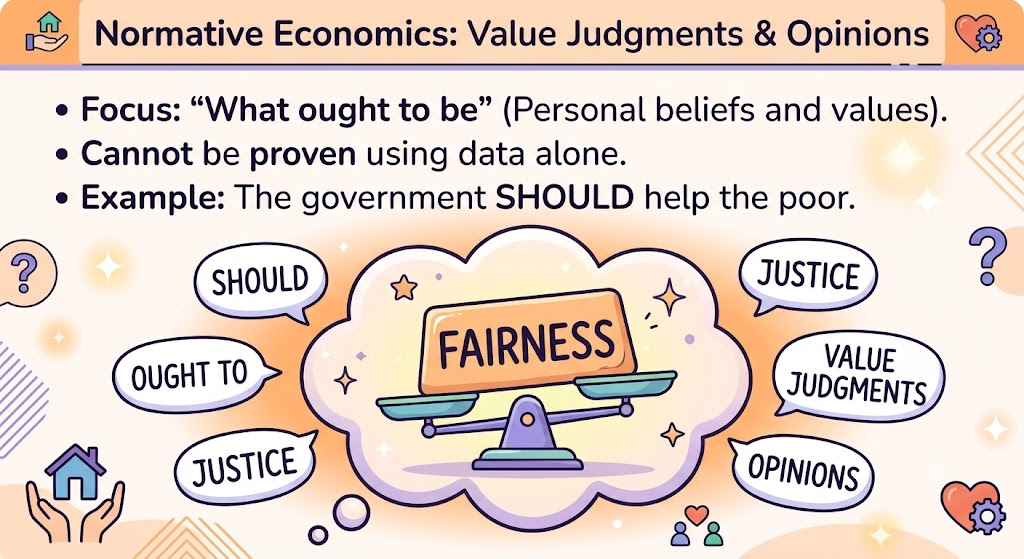
Normative Economics focuses on values, fairness, and opinions.
- Main Focus: Explaining “what ought to be” or “what should happen.”
- Key Trait: It cannot be proven or tested with data because it depends on personal values and beliefs.
- Value Judgments: It expresses what someone believes is fair, good, or bad for society.
It asks questions like:
- Should the government give free college education to everyone?
- Is it fair to tax wealthy people more?
- What should the minimum wage be?
Key Differences at a Glance
Here is a side-by-side comparison to help you quickly spot the differences:
| Feature | Positive Economics | Normative Economics |
| Main Question | What is happening? | What should happen? |
| Basis | Objective facts and measurable data. | Subjective values, ethics, and opinions. |
| Can it be proven? | Yes, by checking real-world data. | No, because it depends on personal views. |
| Key Words | “Causes,” “Results in,” “Is,” “Increases.” | “Should,” “Ought to,” “Deserves,” “Fair.” |
Real-Life Examples
Let’s look at how both approaches view the same topic—cigarette taxes:
- Positive Statement: “An increase in the tax on cigarettes will lower cigarette sales by 10%.”(This is a factual claim. Researchers can track sales numbers to test if this statement is true or false.)
- Normative Statement: “The government should increase taxes on cigarettes because smoking is bad for public health.”(This is an opinion about what policy the government ought to enforce based on what is considered good or bad.)
Summary
- Positive economics looks at the facts and tells us how the economy actually works.
- Normative economics shares opinions and suggests how the economy ought to be run.