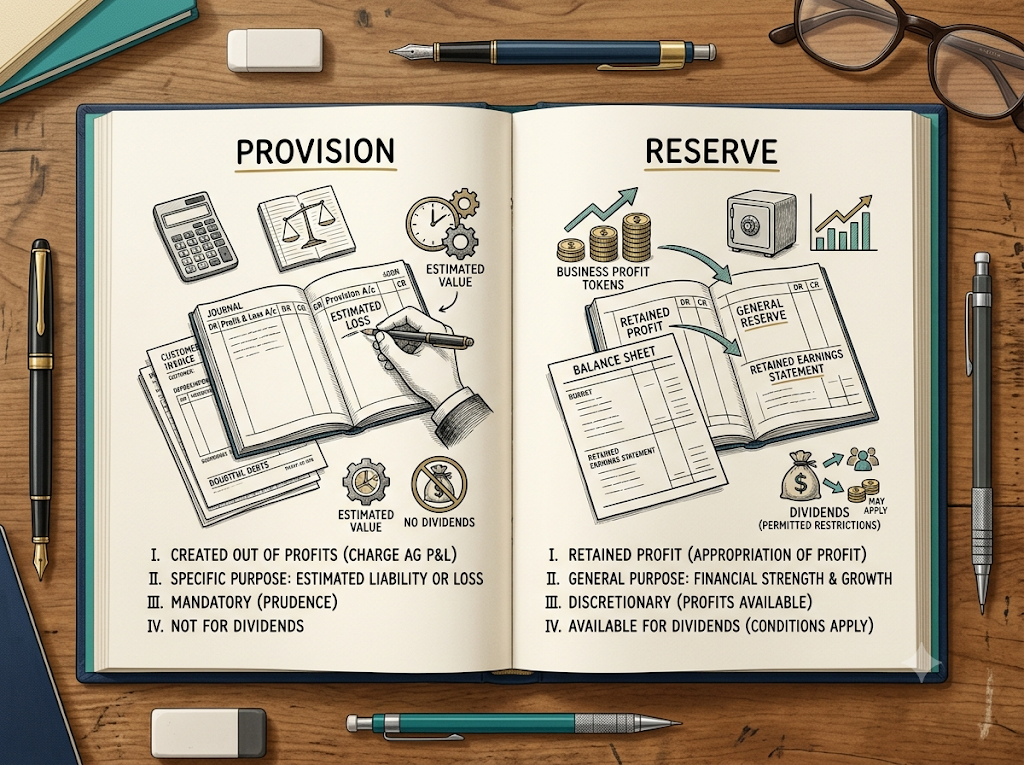
A business faces two situations. Some customers may not pay their debts, and the owner wants to retain part of the profit to strengthen the business. Although both situations involve financial planning, they require different accounting treatments.
The first may require a provision; the second may involve a reserve.
7. Distinguish Between Provision and Reserve (Any Four Points)
| Basis | Provision | Reserve |
|---|---|---|
| 1. Nature | A charge against profit. | An appropriation of profit. |
| 2. Purpose | Created to recognise a known liability or an expected loss or expense. | Created to strengthen the business or provide for future contingencies or specified purposes. |
| 3. Creation | Created when required, even if profits are insufficient. | Generally created by retaining profit. |
| 4. Dividend | Not available for distribution as dividends. | A general reserve may be available for dividends where permitted; restrictions apply to other reserves. |
Understanding the Differences
Nature: A provision is charged against profit because it recognises an expected cost, loss or liability. A reserve is an appropriation of profit after profit has been determined.
Purpose: A provision deals with an expected loss, expense or liability. A reserve helps strengthen the financial position of the business or supports a specified purpose.
Creation: A provision may be necessary even when a business has insufficient profit. A reserve is generally created by retaining profits.
Dividend: A provision cannot be treated as distributable profit. A general reserve may be used for dividends where permitted, but specific and capital reserves may be subject to restrictions.
The balance-sheet presentation also differs: a provision may be shown as a deduction from an asset or as a liability, depending on its nature, while reserves are generally presented within equity or the relevant reserves heading.
The Memory Trick
Think of a provision as recognising a cost and a reserve as retaining profit.
Exam-ready sentence: A provision is a charge against profit created to meet a known liability or expected loss or expense, whereas a reserve is an appropriation of profit retained to strengthen the financial position of the business or meet future needs.