
Introduction
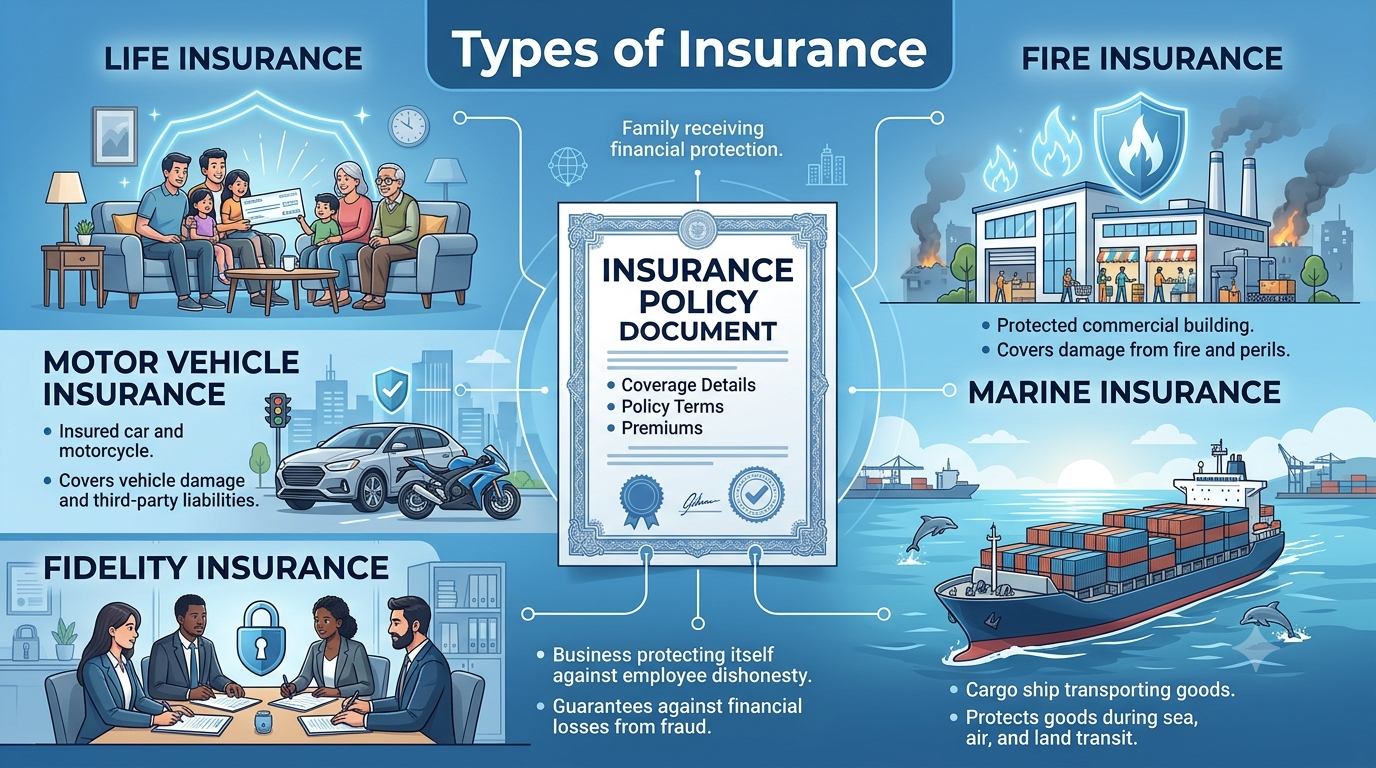
Insurance protects individuals and businesses against different types of financial risks. Different insurance policies are designed to cover different needs.
For example, life insurance provides financial protection connected with human life, fire insurance covers specified fire-related losses, and marine insurance protects against covered risks associated with marine transportation.
1. Life Insurance
Life insurance is a contract under which the insurance company agrees to pay a specified amount to the policyholder or beneficiary on the occurrence of an insured event, such as death, or on maturity, depending on the policy terms.
Types of Life Insurance Policies
A. Whole Life Policy
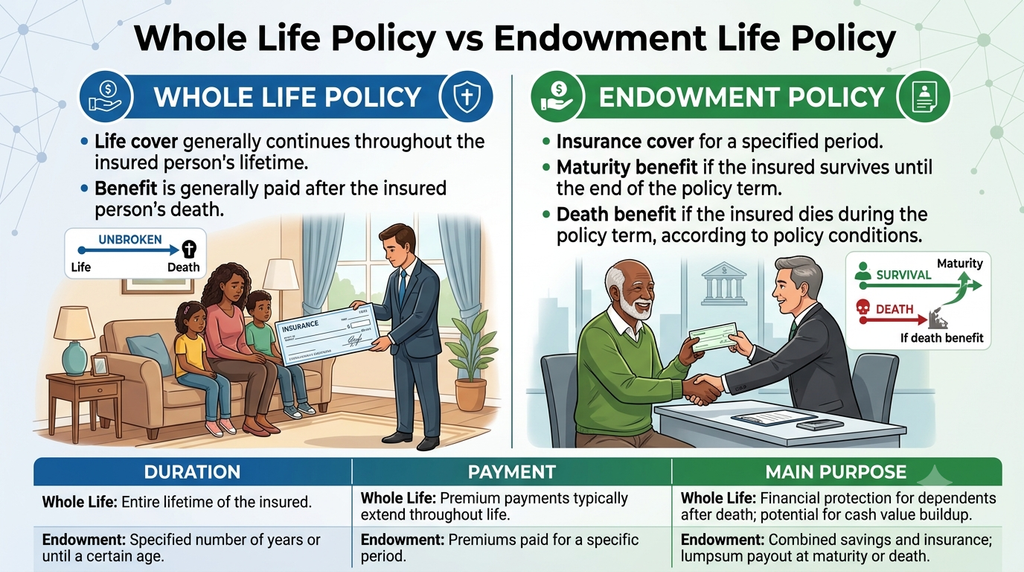
Under a whole life policy, the insurance company provides life cover for the insured person’s entire lifetime, subject to the policy conditions.
The sum assured is generally paid to the nominee or beneficiary after the death of the insured person.
B. Endowment Life Policy
An endowment policy provides life insurance coverage for a specified period. If the insured person survives until the maturity date, the policy provides the maturity benefit according to its terms.
If the insured person dies during the policy term, the death benefit is paid according to the policy conditions.
Difference Between Whole Life Policy and Endowment Policy
| Basis | Whole Life Policy | Endowment Policy |
|---|---|---|
| Duration | Generally provides cover throughout the insured person’s lifetime. | Provides cover for a specified period. |
| Payment | Benefit is generally paid on the insured person’s death. | Benefit may be paid on death during the term or on maturity. |
| Main purpose | Provides long-term life protection. | Combines life protection with a maturity benefit. |
| Maturity | Usually does not have a fixed maturity date. | Has a specified maturity date. |
Why Is Life Insurance Also Called Life Assurance?
Life insurance is also called life assurance because death is a certain event, although the time of death is uncertain. The insurance company promises to pay the agreed benefit when the insured event occurs, subject to the policy terms.
2. Fire Insurance
Fire insurance is a contract under which the insurance company agrees to compensate the insured for specified financial losses caused by fire, subject to the policy terms and exclusions.
Risks Covered by Fire Insurance
- Damage to buildings due to covered fire incidents.
- Loss of stock and goods due to fire.
- Damage to machinery and equipment.
- Certain additional risks, such as lightning or explosions, when included in the policy.
3. Marine Insurance
Marine insurance provides financial protection against specified risks associated with the transportation of goods and vessels.
It is particularly important for exporters, importers, shipping companies and other businesses involved in international trade.
Types of Marine Insurance Policies
A. Voyage Policy
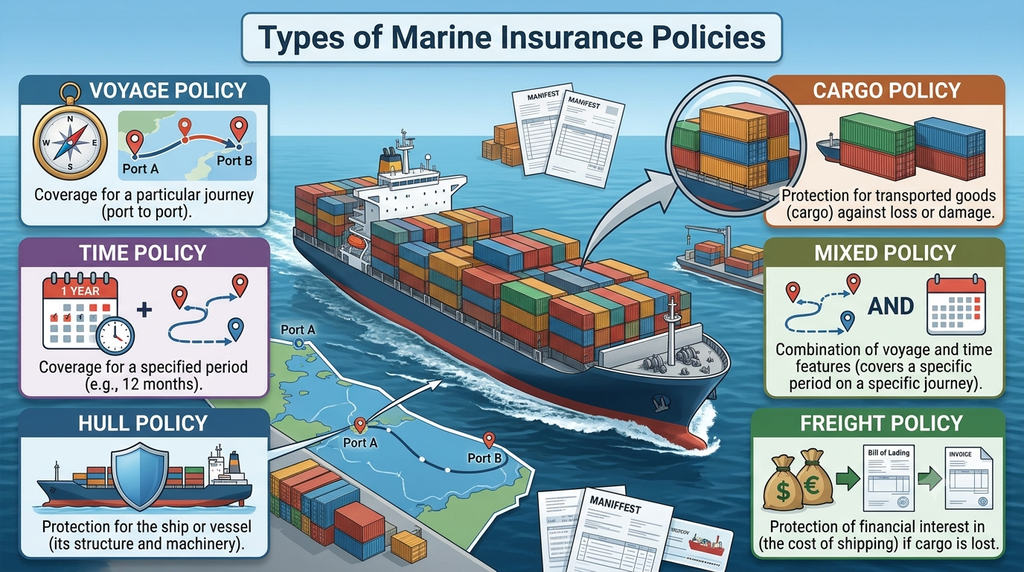
A voyage policy provides insurance coverage for a particular journey or voyage between specified places.
Example: An exporter insures goods being transported from Mumbai to London for a particular voyage.
B. Time Policy
A time policy provides insurance coverage for a specified period, usually in connection with a ship or other insured marine interest.
C. Hull Policy
A hull policy covers the ship or vessel itself against specified risks.
It may cover damage to the ship caused by covered marine accidents and other insured events.
D. Cargo Policy
A cargo policy covers goods being transported against specified risks during transit.
E. Mixed Policy
A mixed policy combines features of a voyage policy and a time policy, providing coverage based on both the journey and a specified period.
F. Freight Policy
A freight policy covers the financial interest in freight that may be lost due to specified marine risks.
4. Motor Vehicle Insurance
Motor vehicle insurance provides financial protection against specified risks associated with vehicles such as cars, motorcycles and commercial vehicles.
Risks Covered by Motor Vehicle Insurance
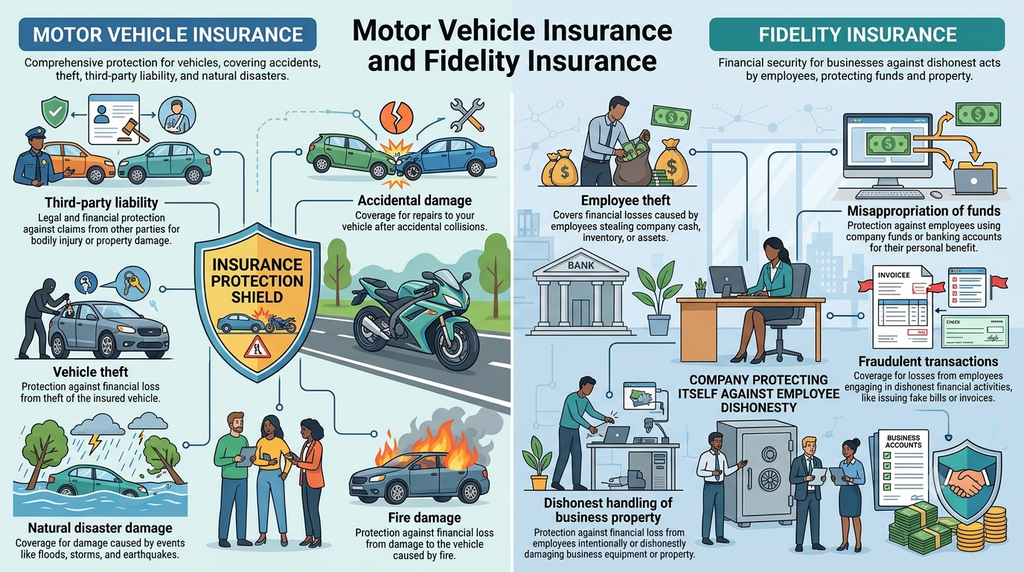
- Third-Party Liability: Covers specified legal liability for injury, death or property damage caused to third parties.
- Accidental Damage: Own-damage cover may compensate for damage to the insured vehicle due to covered accidents.
- Theft: A comprehensive or applicable own-damage policy may cover vehicle theft.
- Natural Disasters: Certain policies cover vehicle damage caused by events such as floods, storms and earthquakes.
- Fire Damage: Damage caused by fire may be covered under applicable vehicle insurance policies.
The exact coverage depends on the type of policy, its terms and exclusions.
5. Fidelity Insurance
Fidelity insurance protects an employer or business against certain financial losses caused by dishonest acts of employees, such as fraud or embezzlement, as covered by the policy.
Risks Covered by Fidelity Insurance
- Theft of business money by an employee.
- Misappropriation of funds.
- Fraudulent financial transactions.
- Dishonest handling of business property.
- Other specified dishonest acts by employees.
Example: If an employee dishonestly steals money from the organisation, a valid fidelity insurance policy may compensate the employer for the covered loss.
Conclusion
Different types of insurance protect different interests. Life insurance provides protection connected with human life, fire insurance covers specified fire losses, marine insurance protects shipping interests, motor insurance covers vehicle-related risks, and fidelity insurance protects businesses against certain employee dishonesty losses.