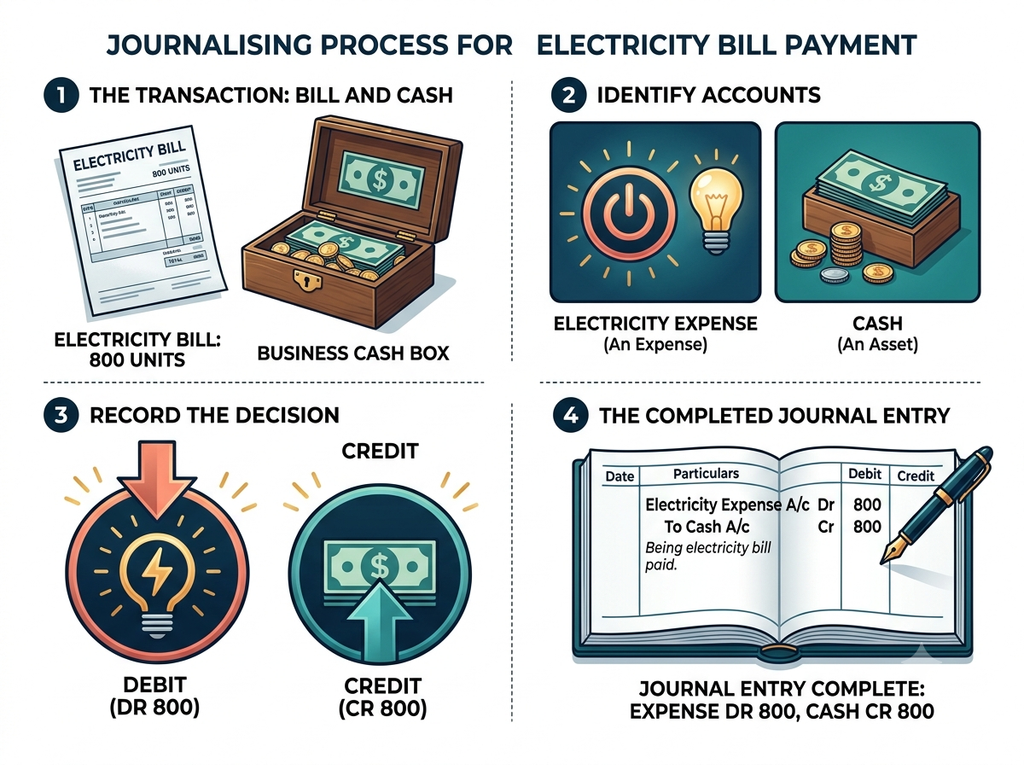
The electricity bill has arrived. The shopkeeper pays ₹800 in cash. Simple enough—but an accountant cannot just scribble “electricity paid” in a notebook and call it a day.
The transaction must be examined, the correct accounts identified, and the debit and credit decided before the entry is recorded. This process is called journalising.
Think of it as an accounting detective’s mission. Every transaction leaves clues, and the accountant must follow them in the correct order.
Step 1: Identify the transaction
First, examine the available source document, such as a cash memo, invoice, receipt, or bill. It provides evidence of the transaction and helps establish what happened.
In our case, the electricity bill and payment receipt tell us that the business paid ₹800 for electricity.
Detective’s question: What actually happened?
Step 2: Identify the accounts affected
Next, determine which accounts are affected by the transaction.
Paying the electricity bill affects two accounts:
- Electricity Expense Account — the business has incurred an expense.
- Cash Account — the business’s cash has decreased.
Detective’s question: Which accounts tell the story of this transaction?
Step 3: Apply the rules of debit and credit
Now decide which account should be debited and which should be credited.
Using the traditional rules of accounting:
- Expenses are debited.
- Cash, an asset, is credited when it decreases.
Therefore, the Electricity Expense Account is debited, and the Cash Account is credited.
Detective’s question: Which account receives the debit, and which receives the credit?
Step 4: Record the journal entry
Finally, enter the transaction in the journal with the date, account names, debit and credit amounts, and a brief explanation called the narration.
Here is the completed entry, assuming the electricity bill was paid in cash on 27 October 2026.
| Particulars | Debit (₹) | Credit (₹) |
|---|---|---|
| Electricity Expense A/c Dr. | 800 | — |
| To Cash A/c | — | 800 |
| (Being electricity bill paid in cash) |
Notice that the debit total and credit total are both ₹800. The entry is balanced.
The four steps at a glance
1. Identify
Examine the transaction and its source document.
2. Find the accounts
Determine which accounts are affected.
3. Apply debit and credit rules
Decide the correct debit and credit sides.
4. Record the entry
Write the date, particulars, amounts, and narration.
The exam-ready answer
Journalising is the process of recording business transactions in the journal. Its main steps are identifying the transaction from source documents, determining the accounts affected, applying the rules of debit and credit, and recording the date, account names, amounts,s and narration in the journal.
Memory line: Identify → Find accounts → Apply debit and credit → Record.