
Introduction
Water transport supports business by moving goods through inland waterways and across international seas. Businesses must understand the difference between inland and ocean transport, as well as the types of ships used in marine trade.
Inland Water Transport vs Ocean Transport
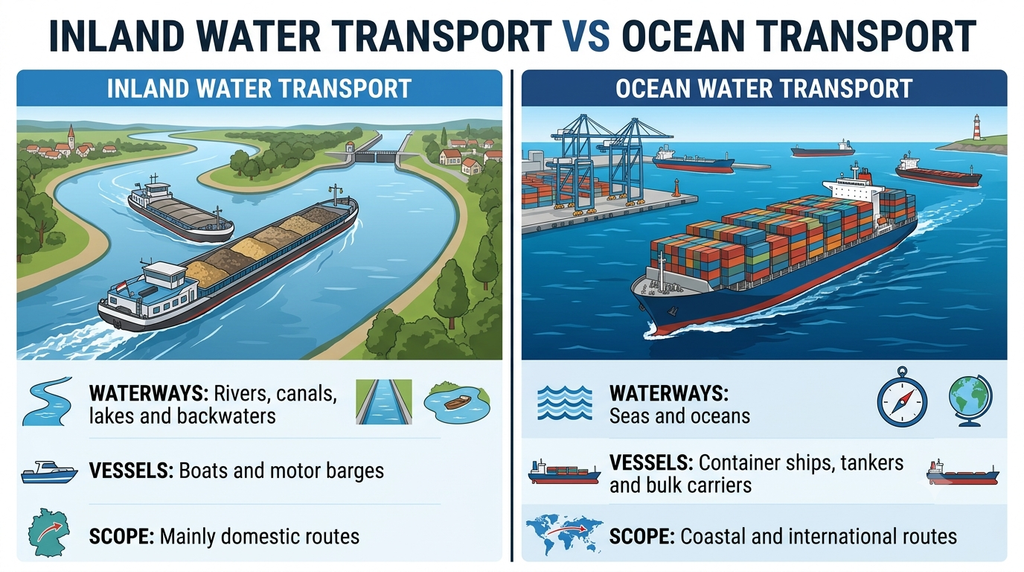
| Basis | Inland Water Transport | Ocean Water Transport |
|---|---|---|
| Waterways used | Rivers, canals, lakes, and backwaters | Seas and oceans |
| Geographic scope | Mainly domestic | Domestic coastal and international routes |
| Typical vessels | Boats, motor barges, river vessels | Container ships, tankers, bulk carriers |
| Typical cargo | Goods suitable for navigable inland waterways | Containers, crude oil, ores, grain, and vehicles |
| Infrastructure | Inland terminals and navigable waterways | Seaports and marine terminals |
Inland Water Transport
Inland water transport moves goods along navigable waterways within a country.
Example: A cement company may use motor barges to move cement along the Ganga from Varanasi towards Kolkata.
Ocean Water Transport
Ocean transport moves goods between coastal ports, including ports in different countries. It is especially useful for large shipments and international trade.
Example: A petroleum company may use oil tankers to transport crude oil from the Persian Gulf to Indian ports.
What Are Liners?
Liners are ships that operate on fixed routes and regular schedules.
Their main characteristics include:
- Fixed or published routes.
- Regular departure schedules.
- Services available to multiple shippers.
- Freight charges based on the service and cargo booked.
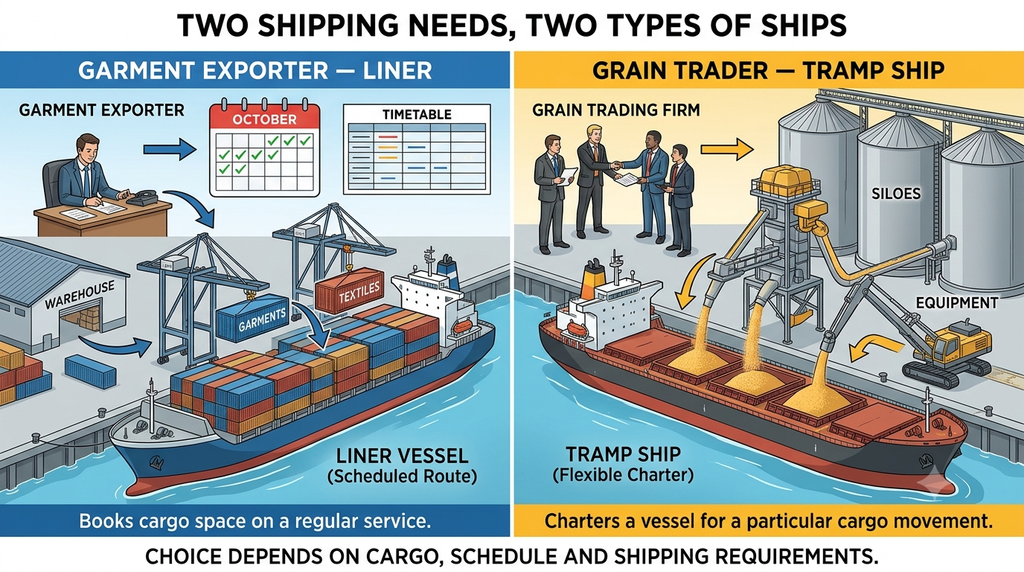
Business example: A garment exporter books space for two containers on a scheduled cargo liner travelling from Mumbai to Rotterdam.
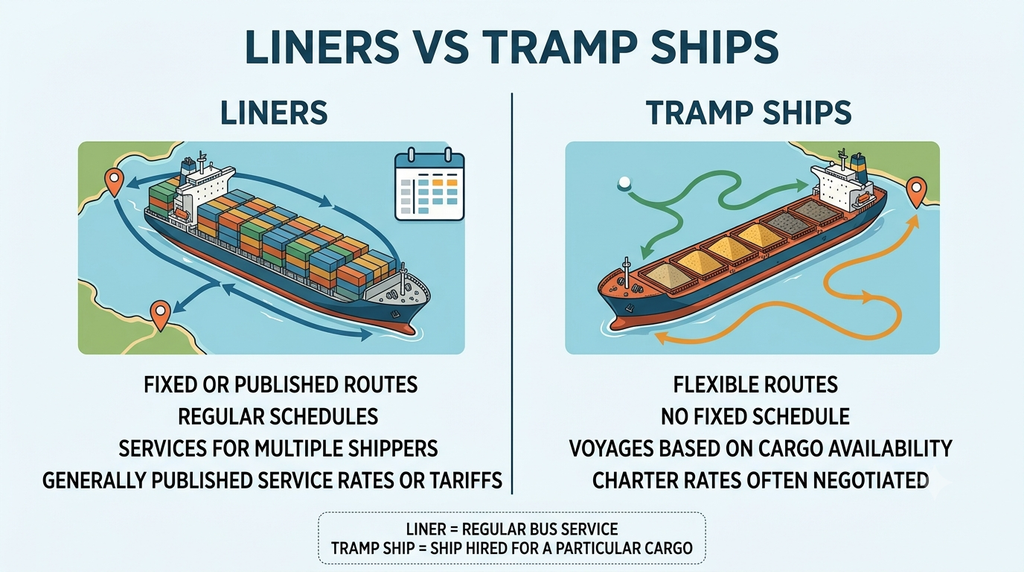
A liner can be compared to a bus that follows a regular route and timetable.
What Are Tramps?
Tramp ships do not follow fixed routes or regular schedules. They travel where cargo is available and are commonly hired to carry bulk commodities.
Their main characteristics include:
- Flexible routes and schedules.
- Voyages arranged according to cargo demand.
- Freight or charter rates negotiated according to market conditions.
- Frequent use for bulk cargo such as coal, grain, ore, and crude oil.
Business example: A grain trading company hires an entire ship to carry a large wheat shipment and negotiates the charter terms with the shipowner.
A tramp ship can be compared to a taxi hired for a particular journey.
Key Difference Between Liners and Tramps
| Basis | Liners | Tramps |
|---|---|---|
| Routes | Fixed or published | Flexible |
| Schedules | Regular | Based on cargo availability |
| Freight arrangements | Generally published service rates or tariffs | Often negotiated charter rates |
| Typical use | General cargo and container shipments | Large bulk shipments |
Conclusion
Inland and ocean transport serve different geographical needs. Within ocean shipping, liners provide regular scheduled services, while tramps offer flexibility for transporting bulk cargo according to demand.