
Introduction
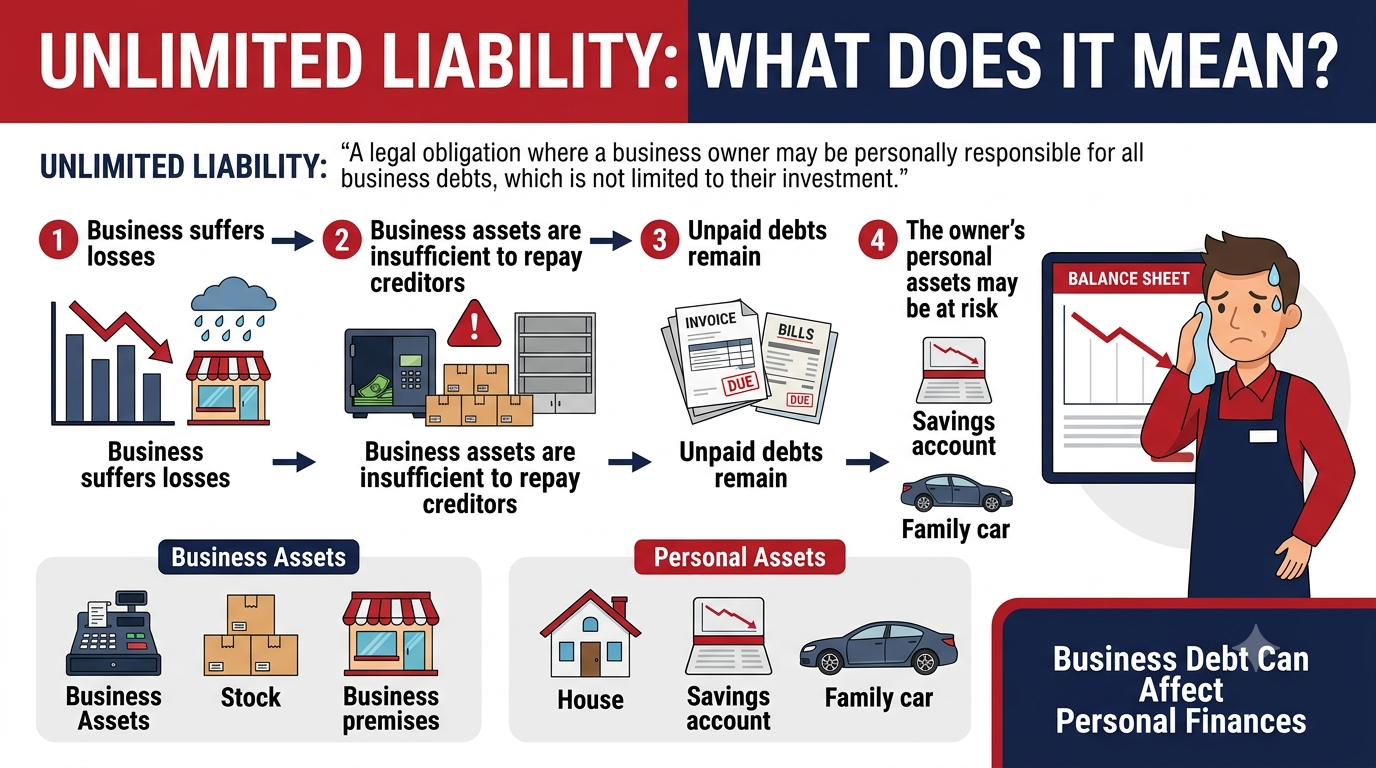
Every business needs money to purchase goods, pay employees, maintain premises, and meet other expenses. Sometimes, a business may suffer losses and become unable to repay its debts. In certain forms of business organisation, the owner may be personally responsible for these unpaid debts. This is known as unlimited liability.
Meaning of Unlimited Liability
Unlimited liability means that the owner’s responsibility for business debts is not restricted to the money invested in the business. If the business assets are insufficient to repay its creditors, the owner’s personal assets may also be used to meet the outstanding liabilities, subject to applicable law and legal procedures.
Personal assets may include personal savings, a private vehicle, or other property owned by the individual.
Unlimited liability is an important feature of a sole proprietorship and generally applies to partners in a traditional partnership.

Practical Business Example
Consider Karan, who owns an electronics showroom as a sole proprietor.
- Total unpaid business debt: ₹15,00,000
- Amount recovered from business assets: ₹9,00,000
- Remaining unpaid debt: ₹6,00,000
Karan’s showroom suffers losses, and he is unable to repay all his suppliers. After selling the remaining inventory, furniture, and display racks, he recovers ₹9,00,000. However, he still owes ₹6,00,000.
Because Karan operates a sole proprietorship with unlimited liability, creditors may seek recovery of the remaining debt from his personal assets through the applicable legal process.
Main Features of Unlimited Liability
- Personal Responsibility: The owner may be personally responsible for business debts.
- Risk to Personal Assets: Personal property may be at risk if business assets cannot cover outstanding liabilities.
- No Fixed Liability Limit: The owner’s liability is not necessarily restricted to the original capital invested.
- Greater Financial Risk: Business failure can affect the owner’s personal financial position.

Conclusion
Unlimited liability places a significant financial responsibility on business owners. It is important for entrepreneurs to understand this risk before choosing a business structure. Careful financial planning, borrowing decisions, and risk assessment can help reduce the chances of serious financial difficulties.