
Introduction
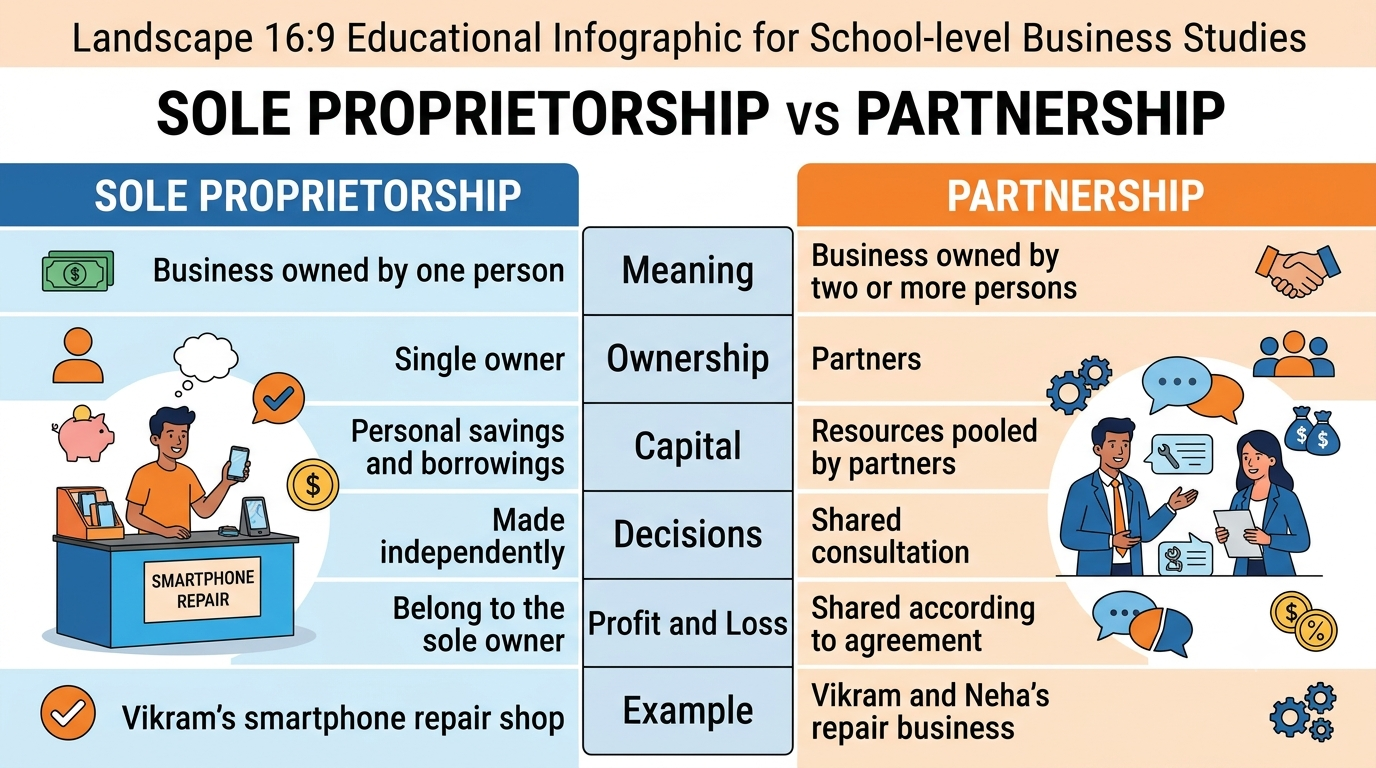
Sole proprietorship and partnership are two common forms of business organisation. The main difference between them is the number of owners. A sole proprietorship is owned and managed by one person, whereas a partnership is owned and managed by two or more persons who agree to run a business together.
Meaning of Sole Proprietorship
A sole proprietorship is a form of business owned, managed, and controlled by a single individual. The owner invests capital, makes business decisions, receives all profits, and bears all losses.
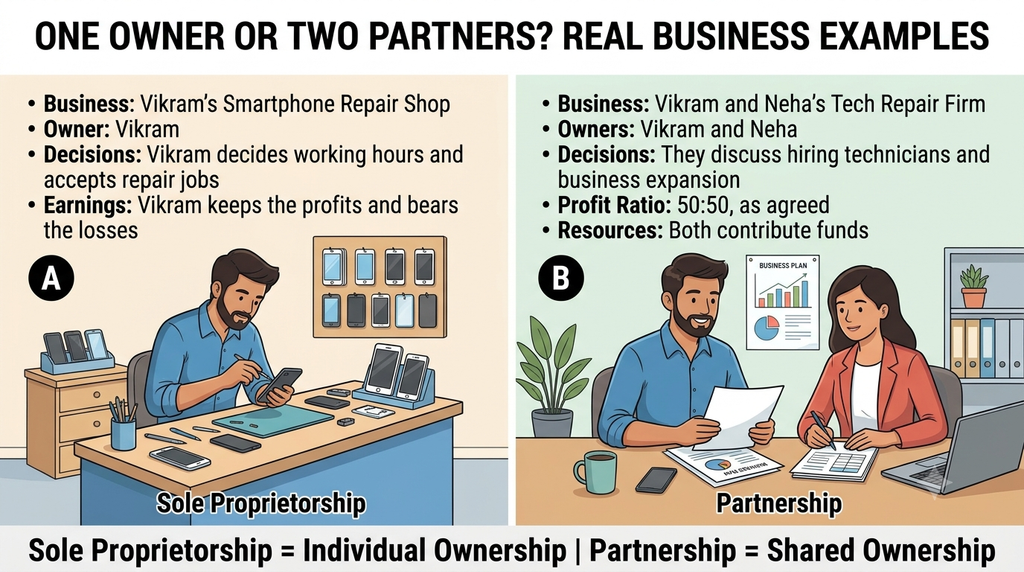
Example: Vikram owns a smartphone repair shop and independently manages its daily activities.
Meaning of Partnership
A partnership is a form of business in which two or more persons agree to carry on a business and share its profits according to an agreed arrangement.
Example: Vikram and Neha jointly operate a smartphone repair business, contribute capital, share responsibilities, and divide profits according to their agreed ratio.
Differences Between Sole Proprietorship and Partnership
- Number of Owners: A sole proprietorship has one owner, while a partnership generally has two or more partners, subject to applicable legal limits.
- Formation: A sole proprietorship can generally be started by one person without a partnership agreement. A partnership is formed through an agreement between the partners.
- Capital Resources: A sole proprietor usually depends on personal savings and borrowings. Partners can pool their financial resources to raise more capital.
- Decision-Making: A sole proprietor can make decisions independently. Partners may need to consult one another before making important decisions.
- Sharing of Profits and Losses: A sole proprietor receives all profits and bears all business losses. In a partnership, profits and losses are shared according to the partnership agreement or applicable law.
- Liability: In a traditional sole proprietorship, the owner has unlimited liability. In a traditional partnership, partners generally have unlimited liability for the firm’s obligations, subject to applicable law.
- Governing Law: A sole proprietorship is not governed by a single specific statute equivalent to the Indian Partnership Act, 1932, which governs partnerships in India.

Conclusion
Both forms of business have their own advantages. Sole proprietorship is suitable for small businesses requiring quick decisions and individual control. Partnership is suitable when people want to combine their capital, skills, knowledge, and experience to operate a business together.