
Introduction
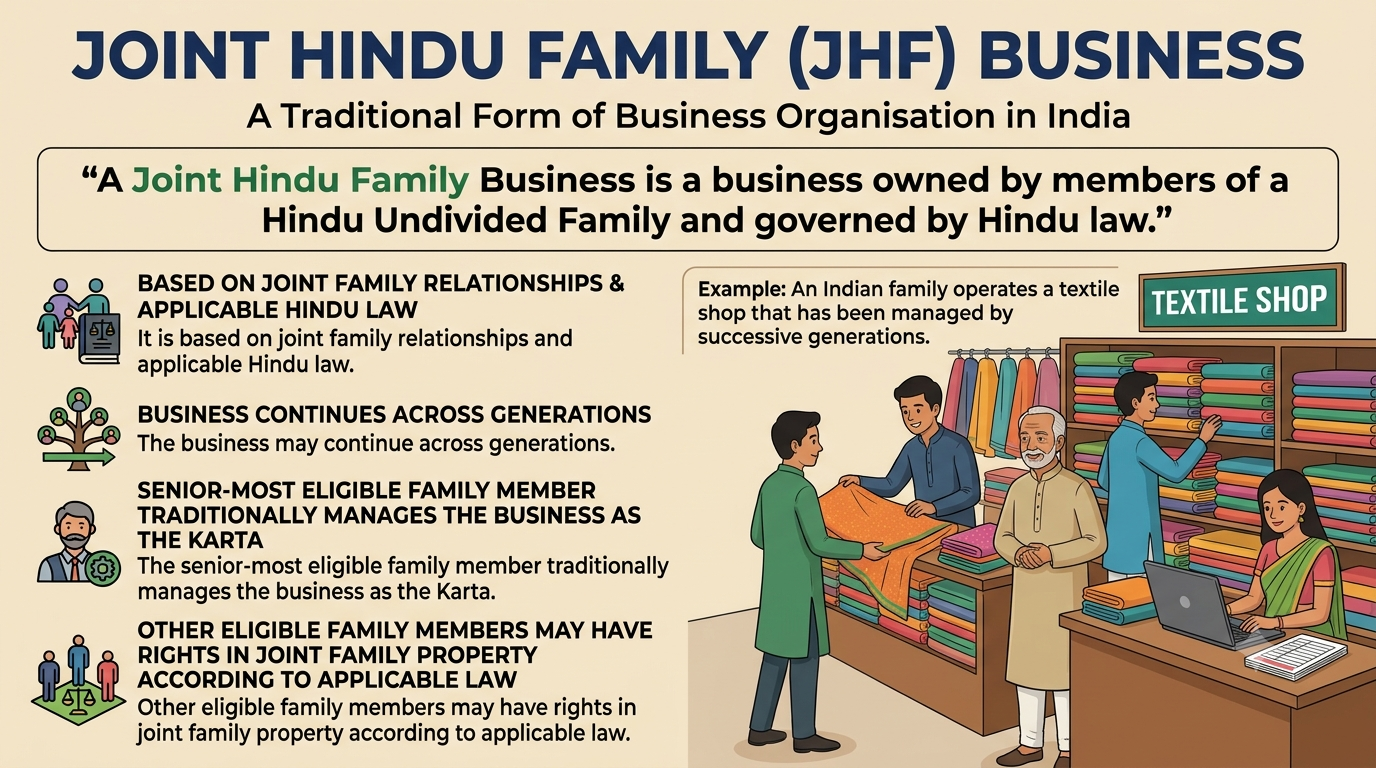
A Joint Hindu Family (JHF) Business is one of the oldest forms of business organisation in India. It is owned and carried on by members of a Hindu Undivided Family (HUF) under the rules of Hindu law. The business is traditionally managed by the senior-most member of the family, known as the Karta.
This form of business is based on family relationships, shared ownership, and the continuity of the family business across generations.
Meaning of Joint Hindu Family Business
A Joint Hindu Family Business is a business organisation owned by members of a Hindu Undivided Family and governed by Hindu law. Membership and rights in the family business arise through family status and applicable law rather than solely through a contractual agreement.
The Karta manages the business, while other eligible family members are known as coparceners in the context of Hindu joint family property.
Example: A family operates a textile shop that has been managed by successive generations. The senior-most eligible family member manages its daily operations, while other eligible family members have rights in the family property according to applicable law.
Key Features of Joint Hindu Family Business
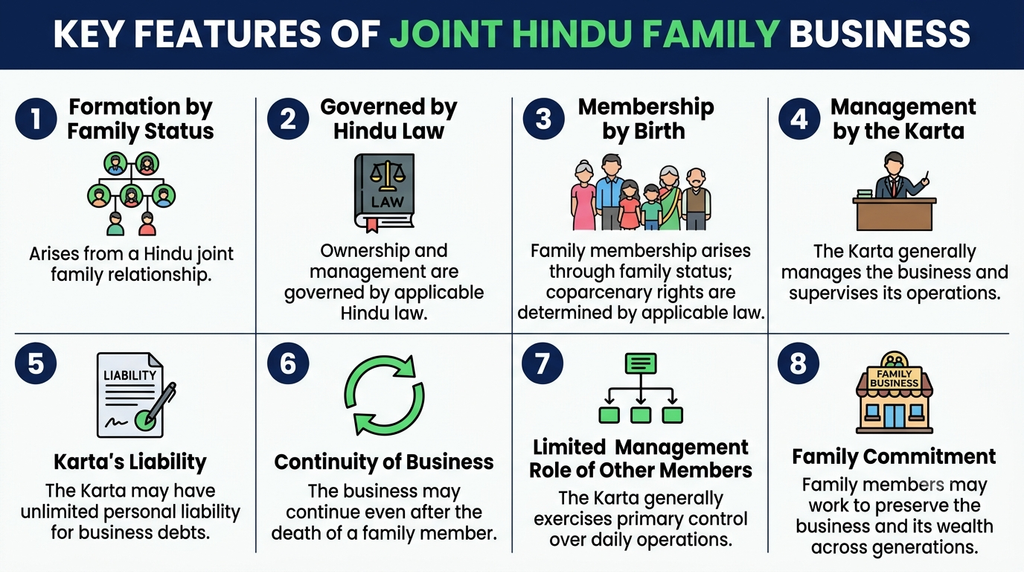
1. Formation by Family Status
A Joint Hindu Family Business arises from a Hindu joint family relationship. Unlike a partnership, it does not depend solely on an agreement between two or more people to establish the business.
2. Governed by Hindu Law
The business is governed by applicable Hindu law and the rules relating to joint family property. Its ownership and management structure differ from those of other business organisations.
3. Membership by Birth
Under the traditional description of this form of business, membership in the joint family arises by birth. Under modern Hindu law, daughters also have equal coparcenary rights in Mitakshara joint family property, subject to applicable legal provisions.
4. Managed by the Karta
The Karta is the person responsible for managing the business. Traditionally, the Karta is the senior-most member of the family, subject to applicable law and the circumstances of the family.
The Karta makes business decisions, supervises operations, and represents the family business in its dealings with outsiders.
5. Liability of the Karta
The Karta may have unlimited personal liability for the debts and obligations of the business. The liability of other family members is generally limited to their interests in the joint family property, subject to applicable law.
6. Continuity of Business
The business may continue even when a family member dies. The death of a member does not automatically require the business to close, because ownership and rights are governed by family law and the nature of the family property.
7. Limited Control of Other Members
The Karta generally has primary authority over the management of the business. Other family members may have rights in the joint family property, but they do not necessarily participate equally in everyday management.
8. Personal Interest and Commitment
Family members may have a strong interest in the success of the business because it is connected with family wealth and long-term security. This can encourage commitment and continuity across generations.
Summary Table
| Feature | Explanation |
|---|---|
| Formation | Based on joint family status and applicable Hindu law |
| Governing law | Hindu law and relevant legal provisions |
| Membership | Arises through family status; coparcenary rights are governed by law |
| Management | Primarily handled by the Karta |
| Karta’s liability | May be unlimited |
| Other members’ liability | Generally limited to their interests in joint family property, subject to law |
| Continuity | Business may continue despite the death of a member |
| Management authority | The Karta generally exercises primary control |
Practical Example
Suppose a family has operated a grocery wholesale business for three generations. The Karta supervises purchasing, sales, payments, and daily business activities. Other eligible family members have rights in the joint family property under applicable law.
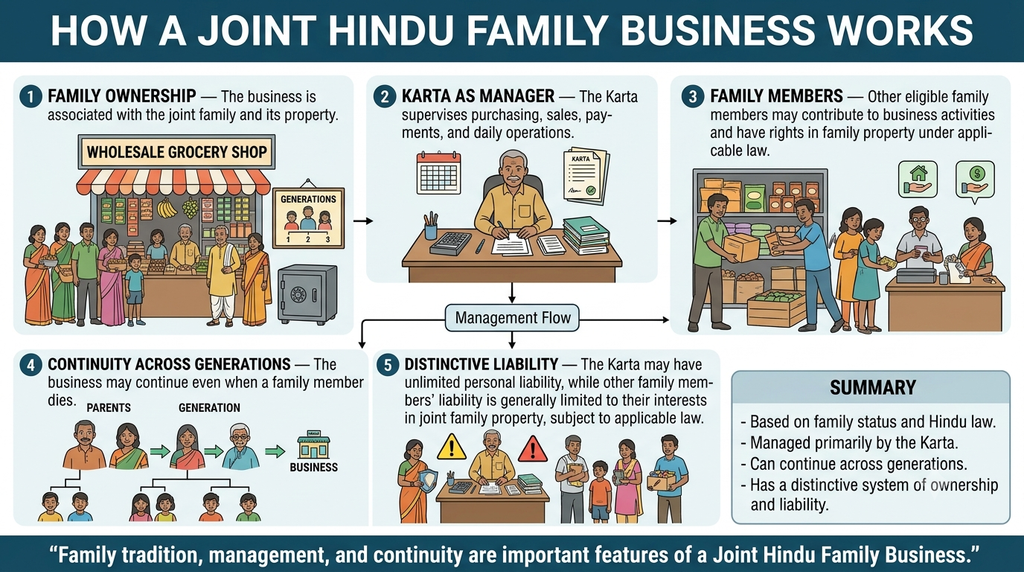
When a family member dies, the business may continue operating under the existing family arrangement rather than automatically closing. This illustrates the continuity associated with a Joint Hindu Family Business.
Conclusion
A Joint Hindu Family Business is a traditional form of business organisation in India based on family status and Hindu law. Its important features include membership through family relationships, management by the Karta, continuity across generations, and a distinctive system of liability.
It can help preserve family business traditions and wealth, although the concentration of management authority in the Karta may limit the participation of other family members in daily decisions.