Imagine playing your favorite video game—say, an open-world RPG or a strategy game—and the game refuses to show you your health bar, your inventory, or your gold count. You’d be flying completely blind, right? You wouldn’t know if you’re winning, losing, or about to get ambushed by a goblin.
In the real world of business, Book-Keeping is your permanent, bulletproof HUD (Heads-Up Display) and score tracker.
If business transactions (which we just conquered) are the actions happening in the game, book-keeping is the diligent archivist writing down every single win, loss, and item collected. Let’s unlock why this is one of the most satisfying, low-key superpowers you can ever learn.
Part 1: What is Book-Keeping, Anyway?
Stripped of all the dusty academic jargon, book-keeping is the art and science of systematically recording business transactions in the books of accounts.
Notice three powerful words in that definition:
- Systematically: It’s not scribbled on random napkins or stored randomly in your brain. It follows a structured, chronological rhythm.
- Recording: Every time a rupee enters or leaves, it gets logged.
- Books of Accounts: The sacred registers (or digital spreadsheets) where financial history is carved in stone.
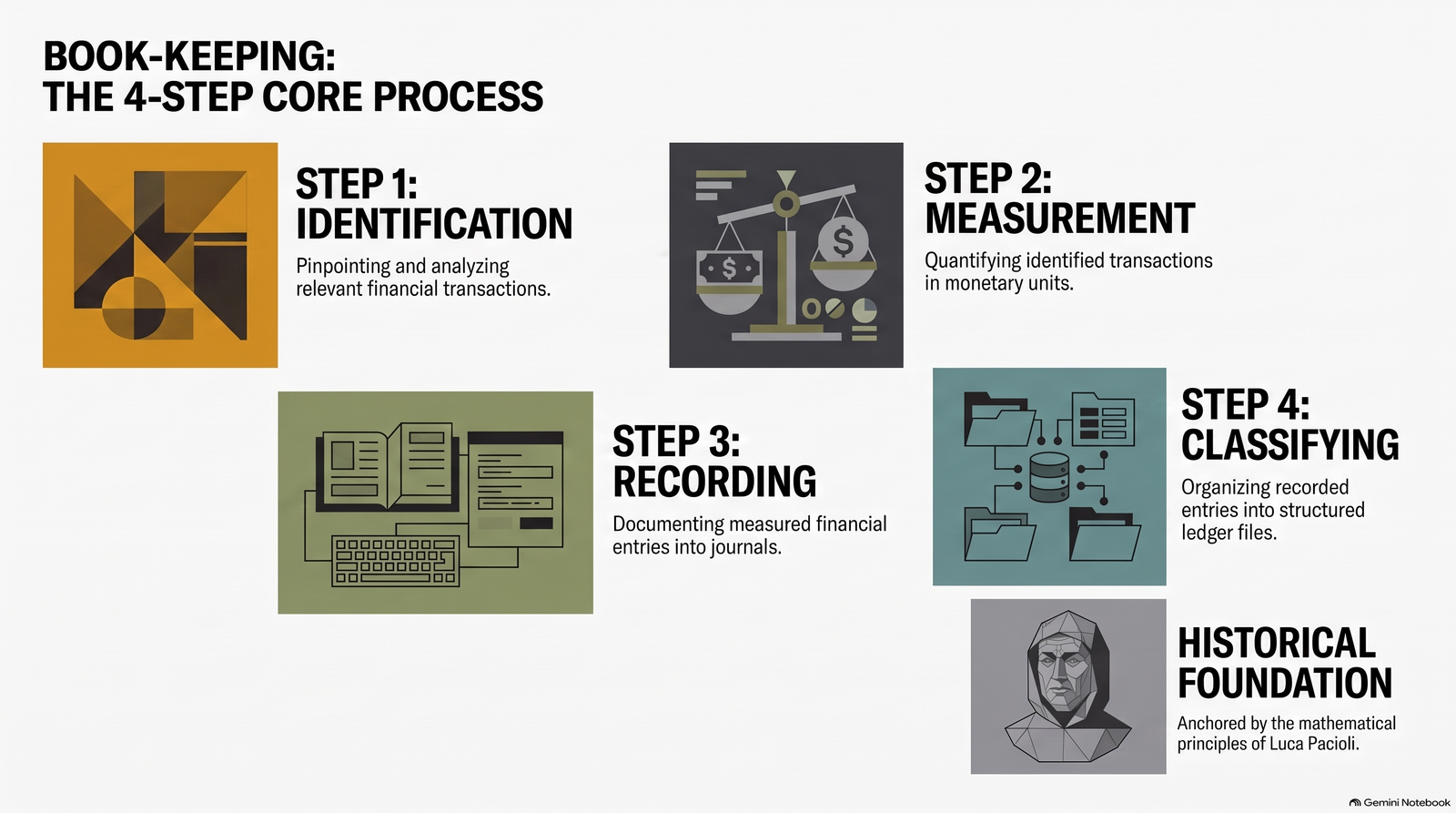
The 4-Step Rhythm of a Book-Keeper
Book-keeping isn’t just a random blob of tasks; it follows a clean, hypnotic assembly line:
- Step 1: Identification — Spotting which events are actually financial transactions (Remember: firing a manager = no; paying their salary = yes).
- Step 2: Measurement — Translating those events into cold, hard currency (How much cash? What’s the value?).
- Step 3: Recording — Writing it down chronologically in a book called the Journal (Think of it as a daily diary of money).
- Step 4: Classifying — Sorting all those entries into separate categories in a book called the Ledger (Think of it as organized folders: all rent expenses in one place, all cash receipts in another).
Part 2: Book-Keeping vs. Accounting — The Ultimate Showdown
People throw these two words around like they mean the exact same thing. Big mistake! They are wildly different, like two different players on the same championship team.
- Book-Keeping is the Foot Soldier: It’s routine, mechanical, and rule-bound. Its job is purely to collect, sort, and record data accurately. You don’t need to reinvent the wheel; you just need razor-sharp precision.
- Accounting is the General: It starts right where book-keeping ends. Accountants take that clean data, analyze it, interpret it, build strategies, figure out taxes, and help CEOs make multi-million dollar decisions.
Analogy Time: Book-keeping is like collecting all the puzzle pieces and keeping them safe in a box. Accounting is sitting down and looking at the finished puzzle to see what picture it creates. You can’t have a masterpiece without the person sorting the pieces first!
Part 3: Real-Life Scenario — The Epic Journey of a Sneaker Reseller
Let’s bring this down to earth. Imagine your friend Leo starts a side hustle flipping limited-edition sneakers.
- On Monday, Leo buys a pair of retro Jordans for ₹10,000 cash.
- On Wednesday, he sells them to a collector for ₹15,000 cash.
If Leo just keeps the money in his hoodie pocket, he’s going to lose track of his profits, spend his capital on pizza, and crash his business in a week.
Instead, Leo practices book-keeping. He opens a notebook:
- Monday Entry: Recorded “Purchased Inventory – ₹10,000” under the asset column.
- Wednesday Entry: Recorded “Sales Revenue – ₹15,000” and “Cost of Goods Sold – ₹10,000”.
Boom! By simply keeping his books straight, Leo instantly calculates his profit: ₹5,000. He feels that dopamine rush of seeing his hard work pay off on paper. That’s the power of clean records.
Mind-Blowing Fast Facts to Flex Your Knowledge
- The Godfather of Book-Keeping: The double-entry book-keeping system we use today wasn’t invented by a massive corporation—it was written down in 1494 by an Italian friar and mathematician named Luca Pacioli. He was basically the rockstar monk of commerce.
- Leonardo da Vinci was a Fan: Luca Pacioli was such a legend that he was friends with Leonardo da Vinci. They even collaborated on a book about math and geometry! So every time you balance a book, you’re sharing DNA with Renaissance royalty.
- The Dopamine Loop of Balance: Accountants and book-keepers get an unmatched psychological high when their ledger columns match to the exact paisa at the end of the day. It’s the original digital satisfaction, long before video games ever existed.