
Introduction
A sole proprietorship is one of the simplest forms of business organisation. It is owned, managed, and controlled by one individual. The owner receives the profits and bears the risks of the business.
This form of business is common in grocery shops, tailoring shops, small bakeries, beauty salons, and other small businesses. It has several advantages, but it also has certain limitations.
Advantages of Sole Proprietorship
1. Easy Formation and Closure
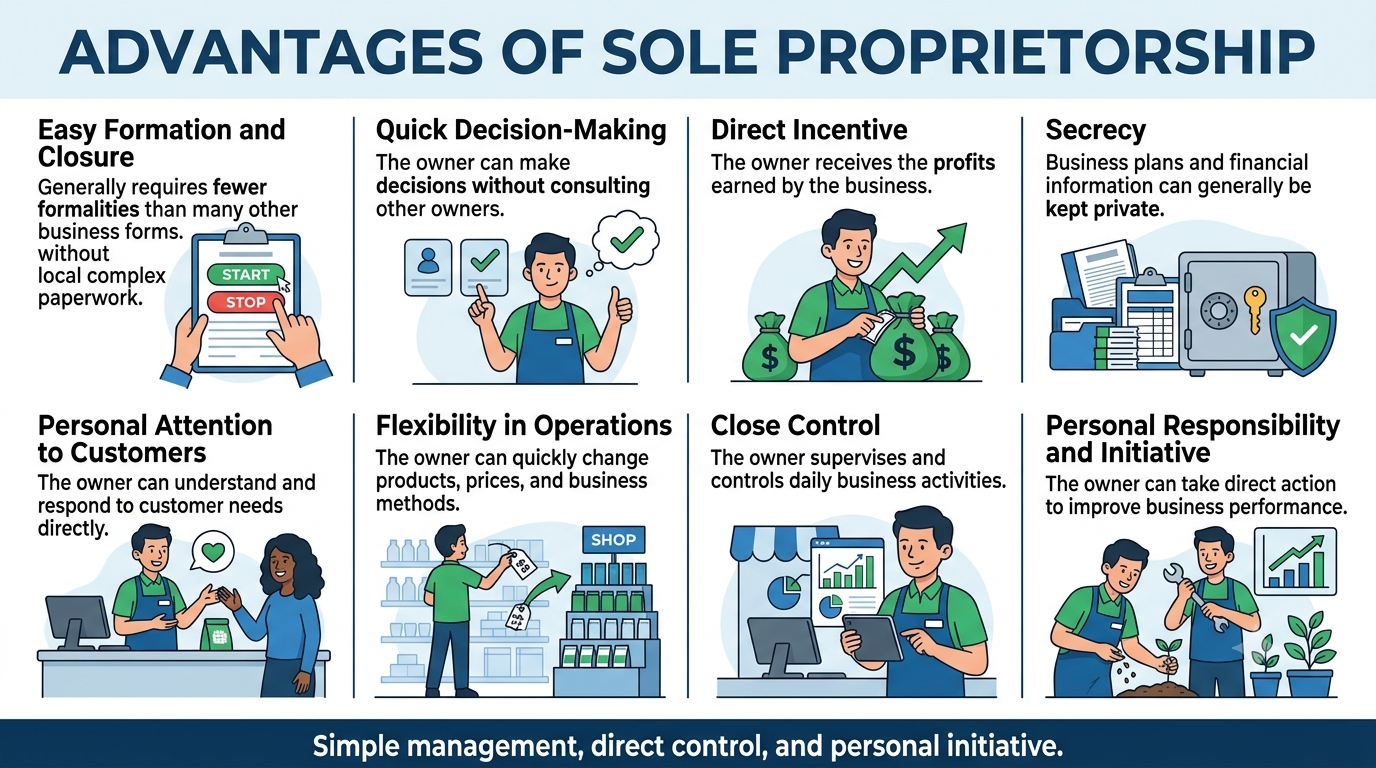
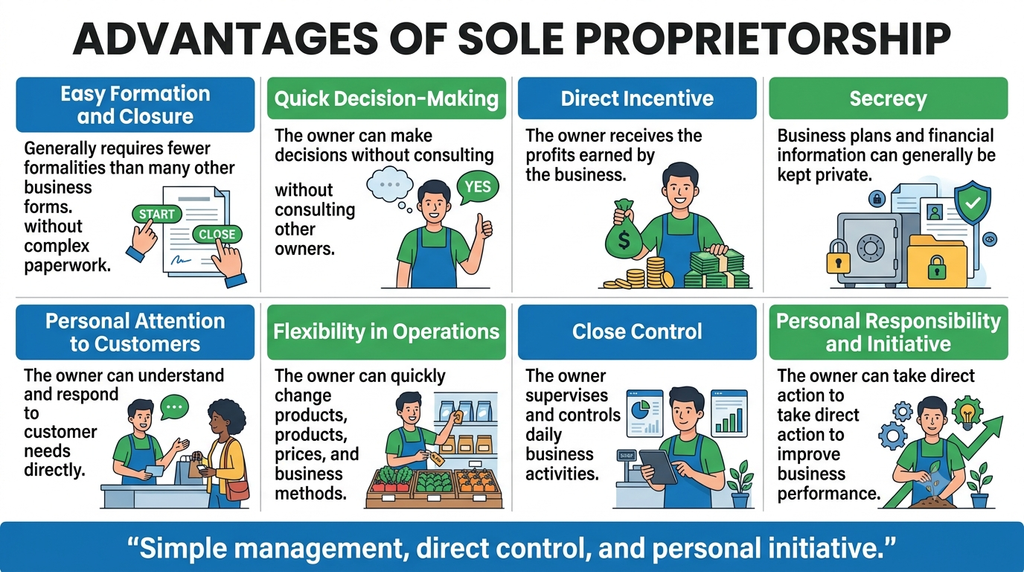
A sole proprietorship is generally easy to establish and close because it involves fewer formalities than many other forms of business organisation. However, applicable registrations and licences may be required.
Example: A person can start a small stationery shop after completing the necessary formalities.
2. Quick Decision-Making
The owner can make business decisions independently without consulting partners or other owners. This allows quick responses to changing market conditions.
Example: A shop owner can quickly decide to offer a discount to attract more customers.
3. Direct Incentive
The proprietor receives the profits earned by the business. This encourages the owner to work hard, reduce costs, and improve business performance.
Example: If a bakery increases its sales and earns more profit, the owner benefits directly.
4. Secrecy
The proprietor can generally keep business plans, costs, profits, and other internal information private, subject to applicable legal requirements.
Example: A restaurant owner can keep a special recipe and pricing strategy confidential.
5. Personal Attention to Customers
The owner can interact directly with customers, understand their needs, and provide personalised service.
Example: A tailor can customise clothes according to individual customer preferences.
6. Flexibility in Operations
The proprietor can change products, prices, working hours, or business methods according to customer demand and market conditions.
Example: A grocery shop owner can introduce home delivery after receiving customer requests.
7. Close Control Over the Business
The owner has direct control over daily activities and can supervise employees, purchases, sales, and finances personally.
Example: A shop owner can check stock levels and monitor daily sales.
Limitations of Sole Proprietorship
1. Unlimited Liability
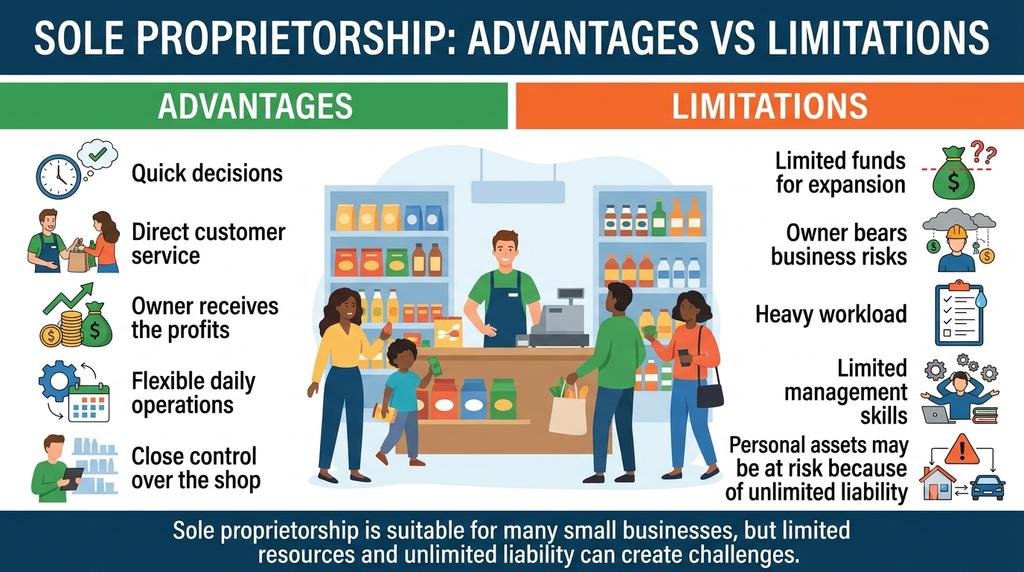
The proprietor has unlimited liability for business debts. If the business cannot repay its debts using business assets, the owner’s personal assets may also be at risk, subject to applicable law.
Example: If a shop fails to repay a business loan, the owner’s personal property may be exposed to claims.
2. Limited Financial Resources
The business usually depends on the owner’s personal savings and borrowing capacity. This may restrict expansion and investment.
Example: A small grocery shop may find it difficult to open several new branches because of a shortage of funds.
3. Limited Managerial Ability
One person may not have all the knowledge and skills needed to manage every business function, such as accounting, marketing, finance, and human resources.
Example: A shop owner who is good at selling may struggle to manage complex accounts.
4. Lack of Continuity
The business depends heavily on the proprietor. The owner’s death, illness, or inability to manage the business may interrupt its operations.
Example: A small shop may face difficulties if its owner becomes seriously ill and no one else can manage it.
5. Limited Scope for Expansion
Limited capital and dependence