
Introduction
A sole proprietorship is one of the oldest and simplest forms of business organisation. It is commonly found in small businesses such as grocery shops, beauty salons, tailoring shops, and small retail stores. It is suitable for businesses that can be managed by one person.
Meaning of Sole Proprietorship
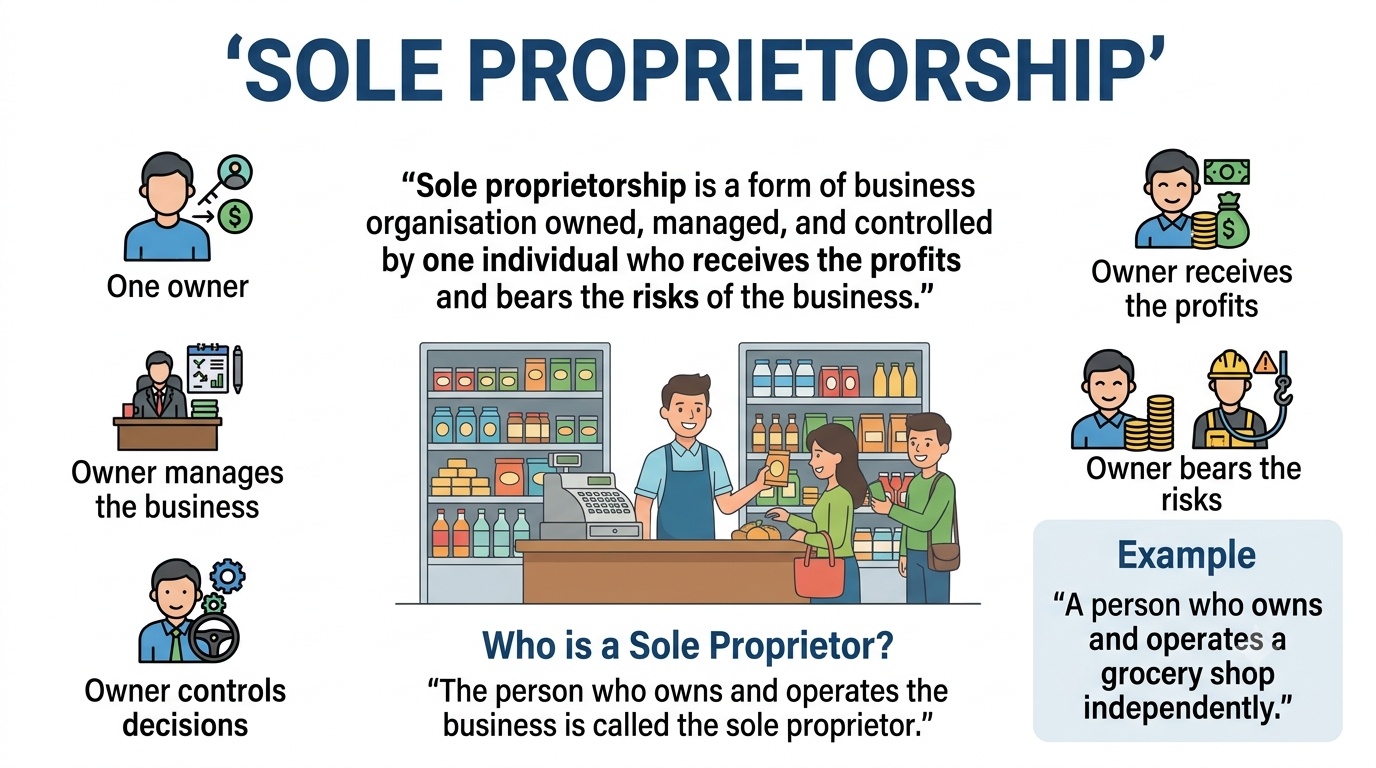
A sole proprietorship is a form of business organisation that is owned, managed, and controlled by a single individual who receives all the profits and bears all the risks of the business.
The person who owns the business is called the sole proprietor. The proprietor makes business decisions and is responsible for its operations.
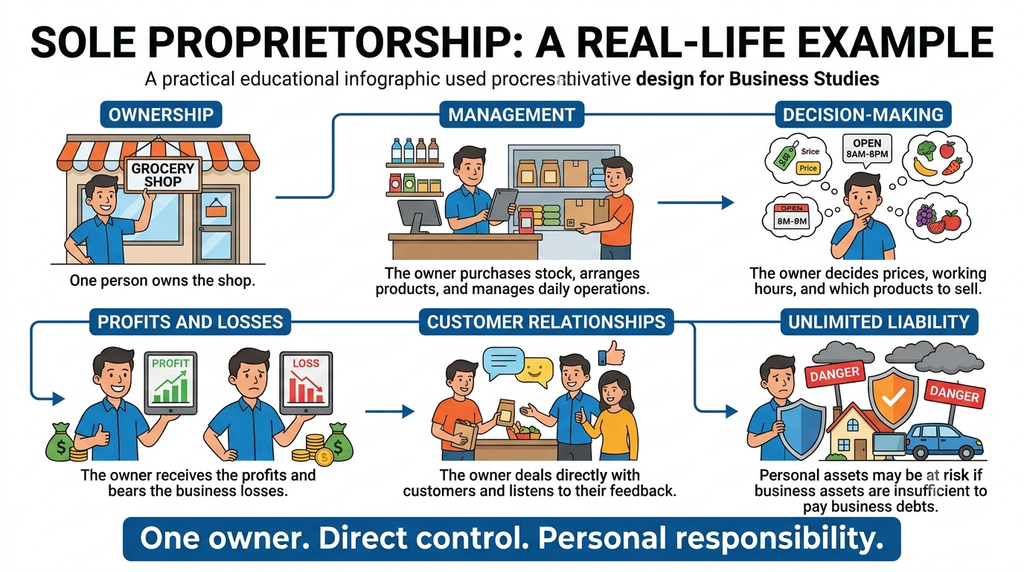
Example: A person who owns and operates a grocery shop independently is a sole proprietor.
Chief Characteristics of Sole Proprietorship
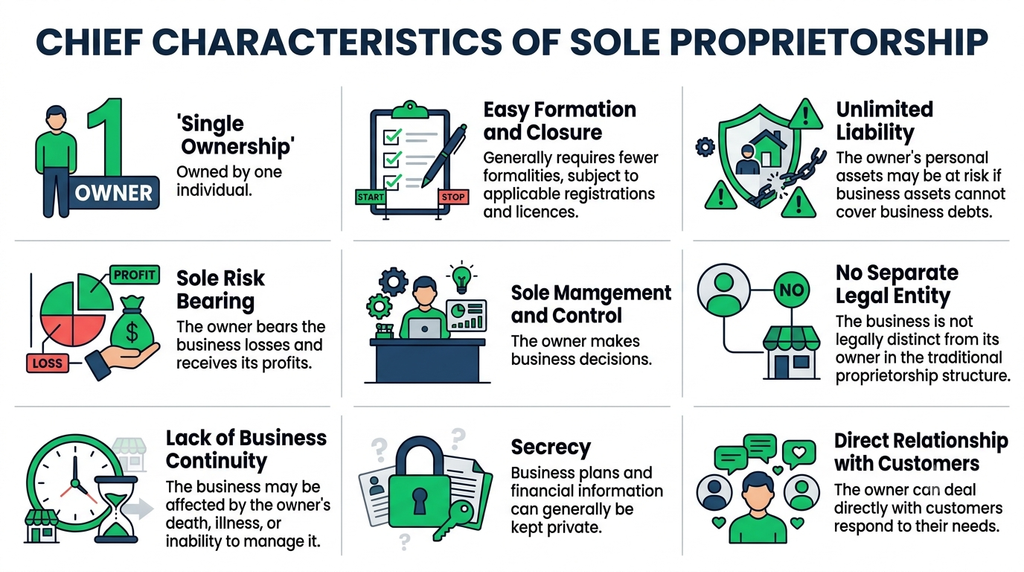
1. Single Ownership
A sole proprietorship is owned by one person. The proprietor provides the capital and owns the business assets.
Example: A person owns a small stationery shop.
2. Easy Formation and Closure
A sole proprietorship is generally easy to start and close compared with many other forms of business organisation. It usually involves fewer formalities, although applicable registrations and licences may be required.
Example: A person can start a small tailoring business after completing the necessary formalities.
3. Unlimited Liability
The sole proprietor has unlimited liability for business debts. If the business assets are insufficient to pay its debts, the proprietor’s personal assets may also be used to repay them, subject to applicable law.
Example: If a shop cannot repay its business loan, the owner’s personal assets may be at risk.
4. Sole Risk Bearing
The proprietor bears the risks and losses of the business alone. At the same time, the proprietor receives the profits earned by the business.
Example: If a grocery shop suffers a loss because of falling sales, the owner bears that loss.
5. Sole Management and Control
The proprietor manages and controls the business. They make important decisions regarding purchasing, pricing, sales, and daily operations.
Example: A shop owner decides which products to stock and what prices to charge.
6. No Separate Legal Entity
In the traditional business-law understanding, a sole proprietorship does not have a legal identity separate from its owner. The owner and the business are not legally distinct in the same way as a company and its shareholders.
Example: The proprietor is personally responsible for the business’s contractual obligations.
7. Lack of Business Continuity
The continuity of a sole proprietorship depends heavily on its owner. The business may be affected by the owner’s death, illness, or inability to manage it. It may continue if another person takes over, subject to applicable requirements.
Example: A small shop may face difficulties if its owner becomes seriously ill and no one else can manage it.
8. Secrecy
The proprietor can maintain considerable privacy regarding business plans, costs, profits, and other internal information because there are generally fewer disclosure requirements than for companies.
Example: A shop owner may keep their pricing strategy and profit details private.
9. Direct Relationship with Customers
The proprietor often deals directly with customers and can respond quickly to their needs, complaints, and suggestions.
Example: A bakery owner can introduce a new product based on regular customer feedback.
Summary Table
| Characteristic | Explanation |
|---|---|
| Single ownership | Owned by one individual |
| Easy formation and closure | Generally requires fewer formalities |
| Unlimited liability | The owner’s personal assets may be at risk for business debts |
| Sole risk bearing | The owner bears business losses |
| Sole management and control | The owner makes business decisions |
| No separate legal entity | The business is not legally distinct from its owner |
| Lack of business continuity | Continuity depends heavily on the owner |
| Secrecy | Business information can generally be kept private |
| Direct customer contact | The owner can interact directly with customers |
Conclusion
A sole proprietorship is a simple and flexible form of business organisation in which one individual owns, manages, and controls the business. Its main advantages include easy formation, quick decision-making, secrecy, and direct customer contact. However, unlimited liability, limited resources, and dependence on one person can create challenges. Therefore, it is generally suitable for small businesses that can be managed effectively by an individual.