

Introduction
Business activities are mainly divided into three important areas: Industry, Commerce, and Trade. These activities are closely related and help goods and services reach consumers. However, each has a different role in business.

1. Meaning of Industry, Commerce, and Trade
Industry: Industry refers to economic activities concerned with the production, processing, extraction, or construction of goods. For example, a textile factory produces clothes, and a mining company extracts minerals.
Commerce: Commerce refers to activities that help in the distribution and exchange of goods and services. It includes trade and auxiliaries to trade, such as transport, banking, insurance, warehousing, and advertising.
Trade: Trade refers to the buying and selling of goods and services. It connects producers and consumers through the exchange of goods and services.
2. Difference Between Industry, Commerce, and Trade
| Basis | Industry | Commerce | Trade |
|---|---|---|---|
| Meaning | Activities related to producing, processing, extracting, or constructing goods. | Activities that facilitate the exchange and distribution of goods and services. | Buying and selling of goods and services. |
| Main purpose | To produce or process goods. | To facilitate the smooth distribution and exchange of goods and services. | To transfer ownership of goods and services through exchange. |
| Scope | Concerned mainly with production and related activities. | Broader than trade; includes trade and auxiliaries to trade. | A part of commerce. |
| Main activities | Manufacturing, mining, fishing, farming, and construction. | Trade, transport, banking, insurance, warehousing, and advertising. | Buying and selling goods and services. |
| Utility created | Mainly creates or increases form utility. | Helps create place, time, and other distribution-related utilities. | Helps transfer goods to those who need them. |
| Examples | A factory manufacturing shoes; a mine extracting coal. | Transporting shoes, storing them, advertising them, and arranging payments. | A wholesaler selling shoes to retailers or a retailer selling shoes to customers. |
3. Example to Understand the Difference
Consider a company that manufactures biscuits.
- Industry: The company produces biscuits in its factory.
- Commerce: Transport, warehousing, banking, insurance, and advertising help the biscuits reach the market.
- Trade: Wholesalers and retailers buy and sell the biscuits to distribute them to consumers.
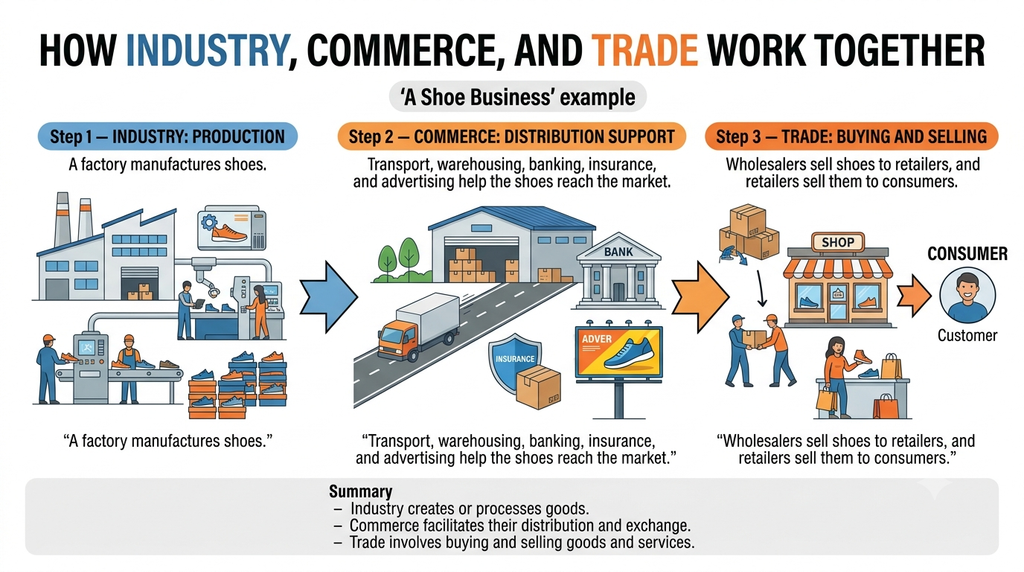
This example shows that industry produces goods, commerce facilitates their distribution, and trade involves buying and selling them.
Conclusion
Industry, commerce, and trade are interconnected parts of business. Industry produces goods, trade buys and sells them, and commerce facilitates their exchange and distribution. Together, they help satisfy consumer needs and support economic development.