
Introduction
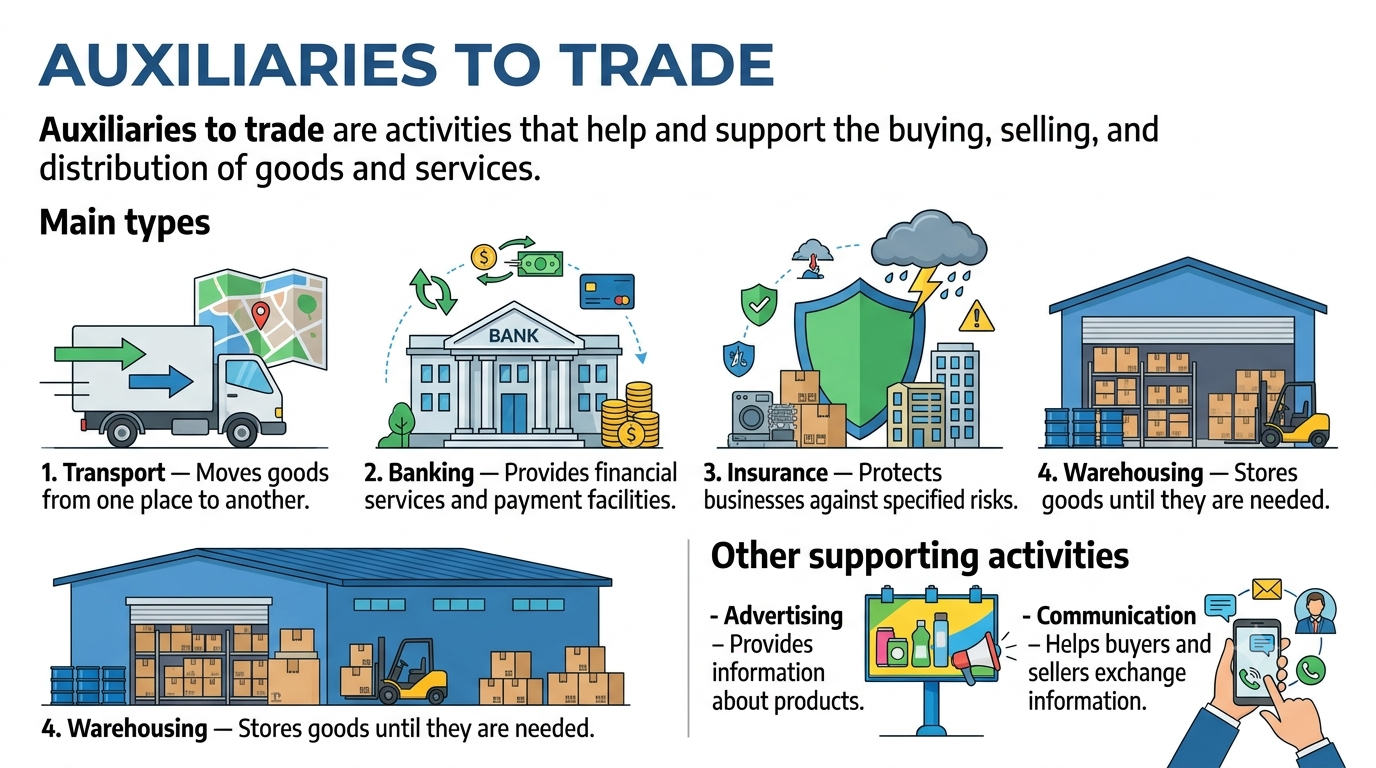
Trade is an important part of business because it involves buying and selling goods and services. However, trade cannot operate smoothly through buying and selling alone. Businesses also need transport, banking, insurance, warehousing, and advertising to move goods and reach customers.
These supporting activities are known as auxiliaries to trade. They help remove difficulties in the exchange of goods and services and make business activities easier and more efficient.
Meaning of Auxiliaries to Trade
Auxiliaries to trade are activities that support and facilitate the buying, selling, and distribution of goods and services.
They help businesses overcome difficulties related to distance, time, finance, risk, and information.
Examples: Transport, banking, insurance, warehousing, advertising, and communication.
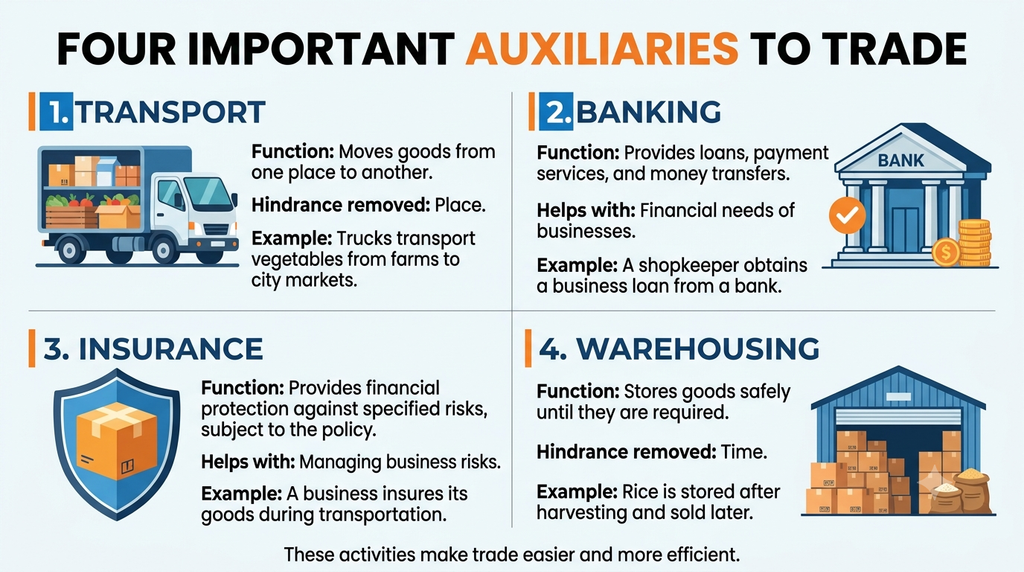
Four Important Auxiliaries to Trade
1. Transport
Transport refers to the movement of goods and people from one place to another. It helps businesses deliver goods from production centres to markets and customers.
Goods can be transported through roadways, railways, airways, and waterways.
Examples:
- Trucks transport vegetables from farms to city markets.
- Trains carry raw materials to factories.
- Ships transport goods between different countries.
Importance of Transport
- Removes the hindrance of distance.
- Helps businesses reach distant markets.
- Supports domestic and international trade.
- Makes goods available to consumers in different locations.
2. Banking
Banking refers to financial services provided by banks to individuals and businesses. Banks help businesses manage money, make payments, and obtain funds for their activities.
Examples:
- A bank provides a loan to a shopkeeper who wants to expand the business.
- A company transfers money to its suppliers through online banking.
- A business uses a bank account to receive payments from customers.
Importance of Banking
- Provides financial assistance to businesses.
- Makes payments and money transfers easier.
- Supports buying and selling activities.
- Helps businesses manage their financial transactions.
3. Insurance
Insurance is an arrangement that provides financial protection against specified risks in exchange for a premium, according to the terms of an insurance policy.
Businesses face risks such as fire, theft, accidents, and damage to goods during transportation. Insurance helps reduce the financial impact of covered losses.
Examples:
- A factory insures its building and machinery against specified risks.
- A transport company insures its delivery vehicles.
- A trader insures goods in transit against covered losses.
Importance of Insurance
- Helps businesses manage financial risks.
- Provides compensation for covered losses.
- Reduces uncertainty in business activities.
- Supports business continuity after certain unexpected events.
4. Warehousing
Warehousing refers to the safe storage of goods until they are required for sale or consumption. Goods are not always sold immediately after production, so businesses need storage facilities to maintain their supply.
Examples:
- Farmers store rice after harvesting so it can be sold throughout the year.
- A company stores woollen clothes before the winter season.
- Cold storage facilities preserve fruits and vegetables for longer periods.
Importance of Warehousing
- Removes the hindrance of time.
- Protects goods from certain types of damage.
- Helps maintain a regular supply of products.
- Allows businesses to store goods until customer demand increases.
Other Auxiliaries to Trade
Apart from the four activities explained above, other important auxiliaries to trade include:
1. Advertising: Advertising informs customers about products, prices, and features. For example, a company advertises a new mobile phone through television and online platforms.
2. Communication: Communication helps buyers, sellers, suppliers, and customers exchange information. For example, a retailer places an order with a wholesaler through email or telephone.
Summary Table
| Auxiliary to Trade | Main Function | Hindrance Removed or Reduced | Example |
|---|---|---|---|
| Transport | Moves goods between places | Place | Trucks deliver goods to markets |
| Banking | Provides financial services | Finance | A bank provides a business loan |
| Insurance | Protects against specified financial risks | Risk | A company insures its goods in transit |
| Warehousing | Stores goods until required | Time | Rice is stored after harvesting |
| Advertising | Provides product information | Information | A company advertises its products |
| Communication | Helps exchange business information | Communication | A retailer orders goods by email |
Practical Example
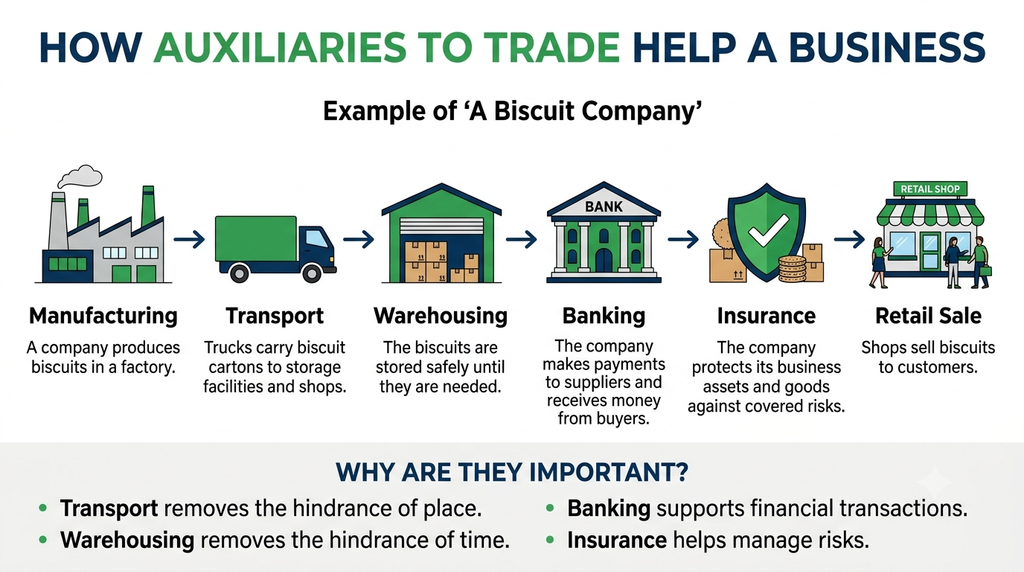
Consider a company that manufactures biscuits.
- Transport delivers biscuits from the factory to shops.
- Banking helps the company make payments to suppliers and receive money from customers.
- Insurance provides protection against specified risks, such as covered damage to goods in transit.
- Warehousing stores biscuits safely until they are distributed.
- Advertising informs customers about the product.
- Communication helps the company coordinate orders with wholesalers and retailers.
These activities support trade and help the company deliver its products to customers more efficiently.
Conclusion
Auxiliaries to trade are essential supporting activities that make the buying, selling, and distribution of goods and services easier. Transport, banking, insurance, and warehousing help businesses overcome difficulties related to place, finance, risk, and time. Advertising and communication also support the smooth functioning of trade.
Therefore, auxiliaries to trade play an important role in business operations, market expansion, and economic development.