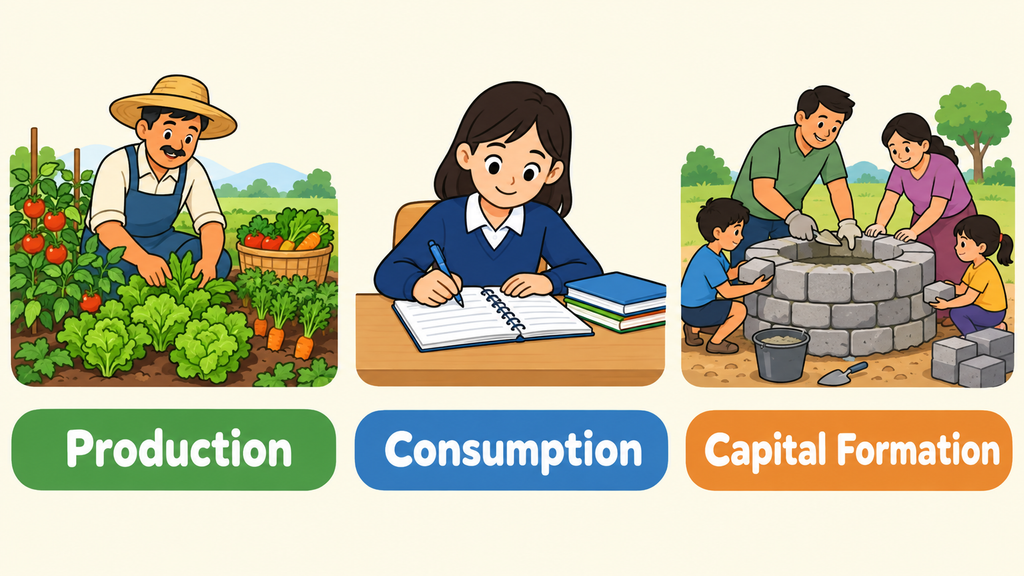
(a) Capital formation increases the capital of a country.
Answer: True
Capital formation adds new assets to a country’s capital.
For example, building factories and buying machines increase capital.
Remember: Capital formation means adding to capital.
(b) Growing vegetables in the kitchen garden is not a part of production.
Answer: False
Growing vegetables creates useful goods.
Even if a family grows vegetables for its own use, production takes place.
Remember: Growing vegetables is production.
(c) A farmer producing wheat for self-consumption is a part of production.
Answer: True
The farmer grows wheat. This creates a useful product.
The farmer may eat the wheat instead of selling it.
It is still production.
Remember: Production can be for personal use or for sale.
(d) A teacher teaching in school is production.
Answer: True
A teacher provides an educational service.
This service helps students gain knowledge and skills.
Paid teaching is an example of economic production.
Remember: Providing services is also production.
(e) A student using stationery is production.
Answer: False
A student uses pens, pencils, and notebooks for studying.
The student is using goods, not making them.
This activity is called consumption.
Remember: Using goods is consumption.
(f) Digging a well by family members in their own field is a part of capital formation.
Answer: True
A well is a useful asset.
It can provide water for farming in the future.
Building the well adds to the family’s productive assets.
Therefore, it is capital formation.
Remember: Creating a lasting asset for future production is capital formation.
(g) A truck transporting wheat from a village to a nearby town market is a part of production.
Answer: True
The truck carries wheat from the village to the market.
Transportation makes the wheat available where buyers need it.
It adds place utility to the wheat.
Place utility means making a product available at a useful place.
Remember: Transportation is a productive service.
Quick Revision Table
| Statement | Answer | Key Concept |
|---|---|---|
| (a) Capital formation increases capital. | True | Capital formation |
| (b) Kitchen gardening is not production. | False | Production |
| (c) Wheat grown for self-consumption is production. | True | Production |
| (d) Teaching in school is production. | True | Services |
| (e) Using stationery is production. | False | Consumption |
| (f) Digging a well is capital formation. | True | Capital formation |
| (g) Transporting wheat is production. | True | Transportation service |